

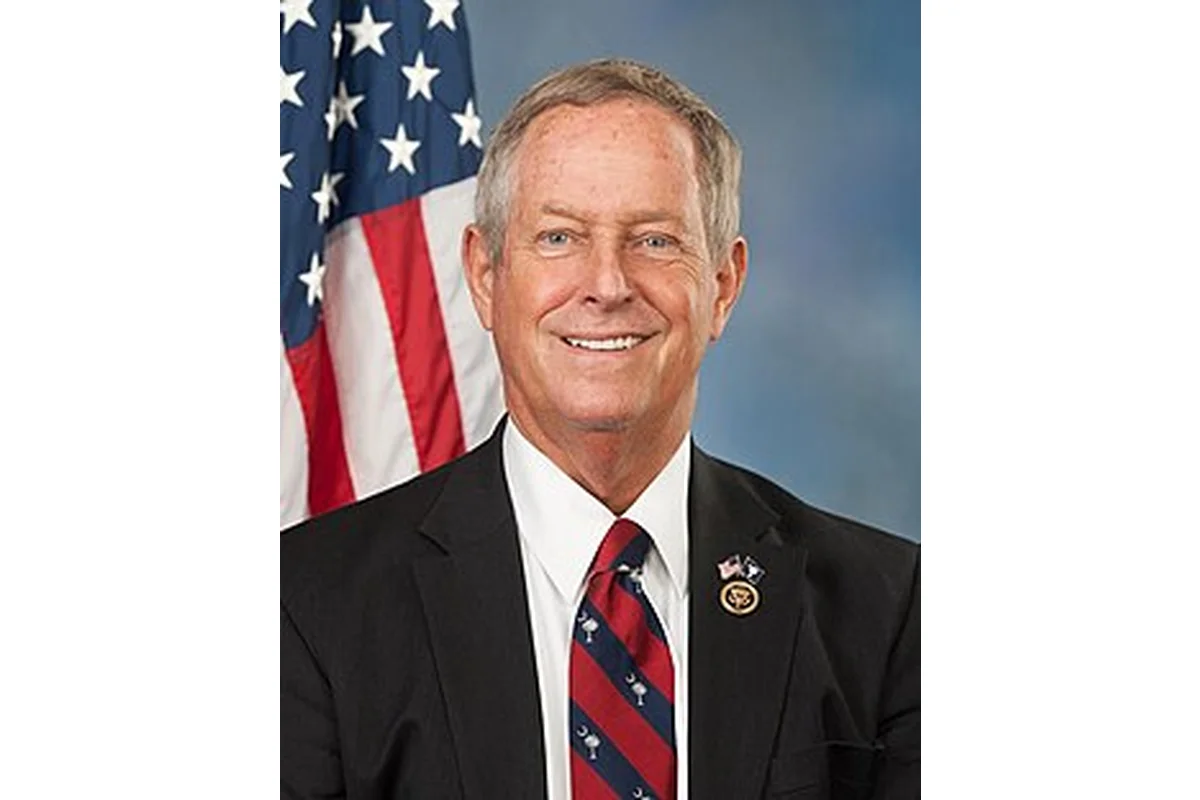
Joe Wilson Bio
Addison Graves “Joe” Wilson Sr., widely known as Joe Wilson, is an American politician and attorney who has represented South Carolina’s 2nd congressional district in the United States House of Representatives since 2001. A Republican, he built a long career in South Carolina politics before winning a special election to Congress following the death of Representative Floyd Spence. Beyond policy work, he is widely known for a single, nationally televised moment: a shouted interruption of President Barack Obama’s 2009 address to a joint session of Congress that led to a formal rebuke by the House.
Wilson continues to represent his district in Congress while serving in senior Republican caucus roles and on several standing committees. His legislative work has spanned tax policy, education, national security, foreign affairs, and technology workforce reform. He is also a retired colonel of the South Carolina Army National Guard and a former real estate attorney who practiced in West Columbia for more than two decades.
Early Life and Background
Joe Wilson was born in Charleston, South Carolina, on July 31, 1947, the son of Hugh deVeaux Wilson and Wray Wilson, née Graves. His family had deep roots in the South Carolina Lowcountry, with a heritage that extended back to Confederate-era ancestors. He was named in part for Confederate brigadier general David A. Weisiger, a great-great-granduncle, though Wilson’s own account of his ancestor as a bank cashier has been complicated by historical records showing slave ownership in earlier generations of his family.
Wilson grew up in a household shaped by military service and civic engagement. His father, Hugh, served as a member of the Flying Tigers during World War II, an experience Wilson has cited in discussing his own commitment to national service. The family attended First Presbyterian Church in Columbia, where Wilson remained a member during his political career.
His earliest exposure to Republican politics came at age 15, when he volunteered for his first GOP campaign in 1962. At a time when the Republican Party was a small minority in South Carolina, he worked as an aide to Senator Strom Thurmond and to Congressman Floyd Spence, the mentors who would shape his future in public life.
Path to US Politics
Wilson earned a Bachelor of Arts degree in political science from Washington and Lee University in 1969, where he joined the Sigma Nu fraternity. He went on to receive his Juris Doctor from the University of South Carolina School of Law in 1972 and was admitted to the South Carolina bar. He also completed the Leadership Institute in Arlington, Virginia, a training ground founded by conservative activist Morton Blackwell.
After law school, Wilson served in the United States Army Reserve from 1972 to 1975 before joining the South Carolina Army National Guard as a Staff Judge Advocate with the 218th Mechanized Infantry Brigade. He rose through the ranks and retired as a colonel in 2003. During this same period, he co-owned the West Columbia law firm Kirkland, Wilson, Moore, Taylor & Thomas, where he practiced real estate law for more than 25 years, and he also served as a municipal judge in Springdale, South Carolina.
In 1981 and 1982, during President Ronald Reagan’s first term, Wilson served as deputy general counsel to former South Carolina Governor Jim Edwards at the United States Department of Energy. His growing involvement in Republican state politics led to his election to the South Carolina Senate in 1984, where he would represent the 23rd district for the next seventeen years and become the first Republican to chair the Senate Transportation Committee after the GOP took control of the chamber in 1996.
Joe Wilson Career
Early Career (1984–2000)
Wilson was elected to the South Carolina Senate in 1984 as a Republican from Lexington County, a strongly conservative area that had become one of the most reliably Republican counties in the state. He was reelected four times, the last three without opposition, and never missed a regular legislative session during his seventeen years in office. His legislative priorities included creating a National Guard license plate, providing paid leave for state employees serving in disaster relief, and requiring men aged 18 to 26 to register with the Selective Service System when applying for a driver’s license.
In 2000, Wilson was one of only seven South Carolina senators to vote against removing the Confederate battle flag from display over the state house, a stand that reflected his social conservative outlook and the views of his longtime mentor, Strom Thurmond. He also served on the boards of visitors of Columbia College and of trustees of Coker College, deepening his ties to South Carolina’s civic and educational institutions.
US House Breakthrough (2001–2008)
Wilson won his seat in Congress on December 18, 2001, in a special election triggered by the death of Floyd Spence, his former boss. He captured 75 percent of the vote in a crowded five-way Republican primary before winning the general election with 73 percent. He was sworn in later that year and quickly won a full term in 2002 with 84 percent of the vote, an unusually strong margin in a deeply Republican district that stretches from Columbia to the Georgia–South Carolina border.
From the start of his House career, Wilson focused on tax relief, education, and national security policy. He initiated the Job Creation and Worker Assistance Act of 2002, which allowed businesses to immediately write off 50 percent of the cost of new equipment, a bonus depreciation provision later extended in stimulus legislation. He also spearheaded the Teacher Recruitment and Retention Act, offering higher education loan forgiveness to math, science, and special education teachers in schools with predominantly low-income student populations. By early 2006, eight bills he had co-sponsored had passed the House, including the Senator Paul Simon Water for the Poor Act of 2005.
Wilson first drew sustained national attention in 2002, when he clashed with Representative Bob Filner on C-SPAN’s Washington Journal over U.S. policy in Iraq. After Filner noted that the United States had provided Iraq with chemical and biological materials in the 1980s, Wilson told Filner that the idea was “made up” and urged him to “get over” what he called a hatred of America. Wilson later apologized for the remark.
Congressional Career (2009–Present)
Wilson’s national profile exploded on September 9, 2009, when he interrupted President Barack Obama’s nationally televised joint address to Congress. After Obama said that his health care reform proposal would not apply to those in the country illegally, Wilson shouted, “You lie!” The outburst drew bipartisan condemnation, including from Senator John McCain, who called it “totally disrespectful.” Obama accepted Wilson’s apology, but House Democrats pushed for a formal rebuke. On September 15, 2009, the House approved a resolution of disapproval against Wilson by a 240–179 vote, almost exactly along party lines.
The incident reshaped Wilson’s political fortunes. In the week after the outburst, Wilson raised $1.8 million for his 2010 reelection campaign, while his Democratic challenger, Rob Miller, raised $1.6 million, both figures far above their prior fundraising totals. Wilson went on to defeat Miller in both 2008 and 2010, and to win every subsequent reelection in the 2nd district, including a 2024 victory with 59.5 percent of the vote against Democrat David Robinson.
As of the 118th Congress, Wilson served on the House Armed Services Committee, the Education and the Workforce Committee, and the Foreign Affairs Committee, where he chairs the Subcommittee on the Middle East, North Africa, and Central Asia. He also serves as Chair of the United States Helsinki Commission and is a member of the Republican Study Committee, the Tea Party Caucus, and the House Republican Policy Committee, where he has worked as an assistant Republican whip. In June 2024, he announced a bid to chair the House Foreign Affairs Committee.
Notable Events and Milestones
Beyond the 2009 outburst, Wilson has been a vocal presence on foreign policy, particularly with respect to Georgia, Iran, and Syria. In 2023, he introduced the Assad Regime Anti-Normalization Act of 2023, which extended Caesar sanctions and was passed by the House in 2024. In 2024, he introduced the MEGOBARI Act targeting Georgian Dream party officials, and in late December 2024 he announced plans for legislation to recognize Salome Zourabichvili as the sole legitimate president of Georgia. He has also advocated for federal action on online gambling, sponsored a 2021 bill establishing a wage floor for the H-1B visa program, and proposed a bust of Ukrainian President Volodymyr Zelenskyy for display in the U.S. Capitol. In October 2024, Columbia Airport Expressway was renamed the Congressman Joe Wilson Expressway in his honor.
Joe Wilson Family
Family Background and Political Lineage
Wilson is the adoptive father of Alan Wilson, who has served as Attorney General of South Carolina since 2011. He has traced his political lineage to his early mentors in South Carolina Republican politics, including Senator Strom Thurmond and Congressman Floyd Spence, the latter of whom he succeeded in Congress. His great-great-grandfather Stephen H. Boineau and his great-great-granduncle David A. Weisiger were both enslavers in the antebellum South, a family history Wilson has publicly addressed.
Personal Life
Wilson married Roxanne McCrory in 1978, and the couple has remained married throughout his political career. The family attends First Presbyterian Church in Columbia, South Carolina. On September 10, 2024, Wilson was hospitalized in Washington, D.C., after collapsing at an event, and was treated for what his son Alan described as stroke-like symptoms before recovering. He resides in the Columbia area and continues to represent his constituents in the United States Congress.