
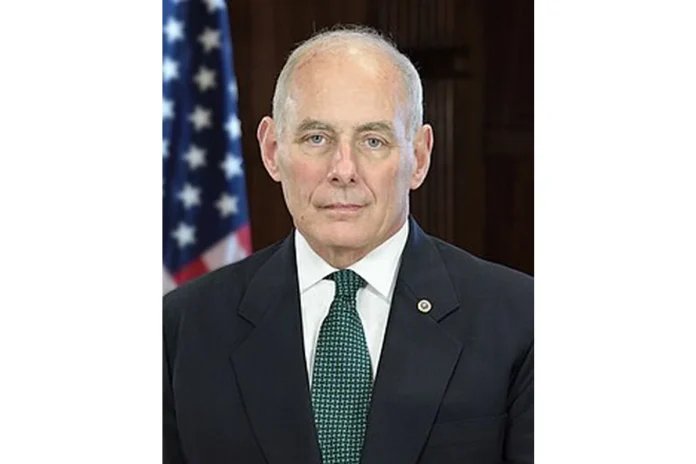
John F. Kelly Bio
John Francis Kelly (born May 11, 1950) is a retired United States Marine Corps four-star general and American political advisor who served at the highest levels of the U.S. government. He was the Secretary of Homeland Security in 2017 and then served as White House Chief of Staff under President Donald Trump from 2017 to 2019. Earlier in his military career, he commanded United States Southern Command and held numerous senior leadership posts across the Marine Corps. After leaving the Trump administration, Kelly became one of the most prominent former officials to publicly criticize the former president on national security, democratic institutions, and the use of military force.
Early Life and Background
Kelly was born on May 11, 1950, in Boston, Massachusetts, the son of John F. Kelly, a postal worker in Brighton, and Josephine “Honey” (Pedalino) Kelly. He was raised in the Brighton neighborhood of Boston in a Catholic family, with an Irish father and an Italian mother. Before the age of 16, Kelly hitchhiked to Washington State and rode trains back across the country, including a freight-hop from Seattle to Chicago. The experience of travel and independence at a young age helped shape the discipline that would later define his career.
After high school, Kelly spent one year in the United States Merchant Marine, an experience that included a deployment that took him overseas. In 1970, when his draft number came up, he enlisted in the U.S. Marine Corps. He served in an infantry company with the 2nd Marine Division at Camp Lejeune, North Carolina, and was discharged to the inactive reserve as a sergeant in 1972 to attend college. He returned to active duty with the Marines in 1975, completed Officer Candidates School, and was commissioned as a second lieutenant on December 27, 1975.
Path to U.S. Politics
Kelly’s entry into public service began with his commissioning as a Marine officer in 1975. He graduated from the University of Massachusetts Boston in 1976 with a Bachelor of Arts degree, then rose steadily through Marine Corps ranks, holding command and staff positions in the United States and abroad. He later earned a Master of Arts in National Security Affairs from the Georgetown School of Foreign Service in 1984 and a Master of Science in Strategic Studies from the National Defense University in 1995, building a deep resume in national security policy.
His transition to political life came after a 45-year military career. Before joining the Trump administration in January 2017, Kelly had served on the board of advisors of DC Capital Partners, an investment firm tied to Caliburn International. In December 2016, President-elect Donald Trump nominated Kelly to head the Department of Homeland Security, citing his expertise on the southwest border. He was confirmed by the U.S. Senate on January 20, 2017, by a vote of 88–11, and was sworn in that evening by Vice President Mike Pence, becoming a member of the president’s cabinet.
John F. Kelly Career
Early Career (1975–2002)
Kelly’s early Marine Corps career included service as a rifle platoon and weapons platoon commander, company executive officer, and rifle company commander in the 2nd Marine Division. He served at sea aboard the aircraft carriers USS Forrestal and USS Independence, and in 1980 attended the U.S. Army’s Infantry Officer Advanced Course at Fort Benning, Georgia. After staff assignments in Washington, D.C., and command tours in California, he transferred to the Basic School in Quantico, Virginia, where he instructed young officers and directed the Infantry Officer Course.
He was later assigned as commanding officer of the 1st Light Armored Reconnaissance Battalion at Camp Pendleton, California. In 1995, after graduating from the National War College, he served as the Marine Corps commandant’s liaison officer to the U.S. House of Representatives. He went on to joint duty in Mons, Belgium, as special assistant to the supreme allied commander, Europe, and returned to the United States in 2001 for further command and staff assignments, including a tour in Iraq where he was promoted to brigadier general in March 2003.
Command in Iraq (2003–2009)
In April 2003, Kelly took command of the newly formed Task Force Tripoli and led it north from Baghdad into Samarra and Tikrit. During the initial assault on Baghdad, he famously told a reporter that his Marines could handle any threat, comparing the campaign to historic battles like Guadalcanal and Iwo Jima. In March 2003, while deployed in Iraq, he became the first Marine Corps colonel known to be promoted to brigadier general in an active combat zone since Chesty Puller in January 1951.
He went on to serve as legislative assistant to the Commandant of the Marine Corps and was confirmed by the U.S. Senate as a major general on September 11, 2007. In July 2007, he assumed command of I Marine Expeditionary Force (Forward), and on February 9, 2008, took command of Multi-National Force–West in Iraq, replacing Major General Walter E. Gaskin. He completed that tour in February 2009.
Senior Pentagon and Southern Command Leadership (2011–2016)
Kelly was confirmed as a lieutenant general on March 16, 2011, and served as senior military assistant to the Secretary of Defense. He greeted Secretary Leon Panetta at the Pentagon on Panetta’s first day in office on July 1, 2011. He was nominated for general on January 31, 2012, and confirmed by the Senate on July 26, 2012. On November 19, 2012, he succeeded General Douglas M. Fraser as commander of U.S. Southern Command, the unified combatant command responsible for American military operations in Central America, South America, and the Caribbean.
As head of Southern Command, Kelly became a leading voice on counterterrorism and border security. In a May 2014 speech, he warned that the war on terror would continue for generations. He was succeeded as commander by Navy Admiral Kurt W. Tidd on January 14, 2016, and retired from active duty after more than four decades of service.
Trump Administration Era (2017–2019)
On January 20, 2017, Kelly was confirmed as Secretary of Homeland Security and sworn in that evening. He was widely described as one of the most aggressive enforcers of immigration law in recent American history, overseeing expanded deportations, a travel ban targeting several majority-Muslim countries, a reduction in refugee admissions, and stricter enforcement at the southwest border. After six months, he was selected to replace Reince Priebus as White House Chief of Staff to bring more stability to the West Wing.
As Chief of Staff, Kelly was the first career military officer to hold the position since Alexander Haig in the Nixon and Ford administrations. He removed Anthony Scaramucci and Steve Bannon from their roles, restructured policy staff reporting lines, and was a strong internal voice on immigration and family separation policy. His tenure was also marked by controversies, including disputes over his handling of staff accused of domestic abuse and the Rob Porter and Omarosa Manigault episodes. On December 8, 2018, Trump announced that Kelly would leave at the end of the year, and on December 14, 2018, the White House announced that Mick Mulvaney would replace him.
Post-Administration Years (2019–2024)
After leaving government, Kelly joined the board of Caliburn International, a professional services provider that operates facilities for migrant children, which raised conflict-of-interest concerns in Congress. He also became one of Trump’s most prominent critics among former cabinet officials. Following the January 6, 2021 Capitol attack, he supported removing Trump from office under the Twenty-fifth Amendment. In October 2023, he confirmed reporting that Trump had expressed disdain for fallen American servicemembers. In an October 2024 interview with The New York Times, Kelly described Trump as meeting the definition of a fascist and said he would govern like a dictator if allowed.
Notable Events and Milestones
Kelly’s defining moments include leading Task Force Tripoli into Samarra and Tikrit in 2003, his 2014 warnings about the long-term nature of the war on terror, and becoming the first career military officer to serve as White House Chief of Staff since Alexander Haig. In November 2010, his son, First Lieutenant Robert Michael Kelly, was killed in action in Sangin, Afghanistan, making John Kelly the highest-ranking American military officer to lose a child in Iraq or Afghanistan. Kelly’s personal sacrifice has been a defining theme of his public service.
John F. Kelly Career Wins
Kelly’s career is marked by a series of confirmed promotions and leadership posts, including service as a Marine Corps four-star general, commander of U.S. Southern Command, U.S. Secretary of Homeland Security, and White House Chief of Staff. His military awards include the Defense Distinguished Service Medal, the Defense Superior Service Medal, and the Legion of Merit (2) with valor. Each of these positions reflects a different chapter of leadership, from tactical Marine command to strategic national security policy at the cabinet level.
Senior Leadership Highlights
Kelly’s most senior military role was as commander of U.S. Southern Command from November 19, 2012, to January 14, 2016, where he led American military operations across Central America, South America, and the Caribbean. He was the first career military officer to serve as White House Chief of Staff since Alexander Haig, holding the post from July 31, 2017, to the end of 2018. He was confirmed by the U.S. Senate as Secretary of Homeland Security on January 20, 2017, by a vote of 88–11.
Other Wins and Achievements
Kelly earned a reputation as one of the most aggressive enforcers of immigration law in modern American history during his six months leading the Department of Homeland Security. He was also recognized with major military decorations, including the Defense Distinguished Service Medal, the Defense Superior Service Medal, and the Legion of Merit (2) with valor. His Senate confirmations to brigadier general, major general, lieutenant general, and four-star general each reflect Senate trust in his leadership.
| Position | Years Served | Confirmation |
|---|---|---|
| Secretary of Homeland Security | 2017 | Senate vote 88–11 |
| White House Chief of Staff | 2017–2019 | Appointed by President Trump |
| Commander, U.S. Southern Command | 2012–2016 | Confirmed by U.S. Senate |
John F. Kelly Family
Family Background and Military Lineage
Kelly was born into a Catholic family in the Brighton neighborhood of Boston, Massachusetts. His father, John F. Kelly, was a postal worker of Irish ancestry, and his mother, Josephine “Honey” (Pedalino) Kelly, was of Italian descent. He grew up alongside siblings in a working-class Boston household, and his parents’ blue-collar roots shaped his lifelong emphasis on discipline and service.
The Kelly family has a deep military tradition. His son, First Lieutenant Robert Michael Kelly, was killed in action in Sangin, Afghanistan, on November 9, 2010, when he stepped on a land mine while leading a Marine platoon. Robert’s death made John Kelly the highest-ranking American military officer to lose a child in the wars in Iraq or Afghanistan. Kelly’s other son served as a Marine Corps Lieutenant Colonel.
Personal Life
Kelly married Karen Hernest in 1976, and the couple has raised three children together: Robert, John Jr., and Kathleen. Kelly’s Marine Corps career required the family to move frequently, including assignments in Belgium and across the United States, and Karen Hernest has been a constant presence through decades of service and political controversy. The death of their son Robert in Afghanistan has been a defining element of Kelly’s public and personal identity.