
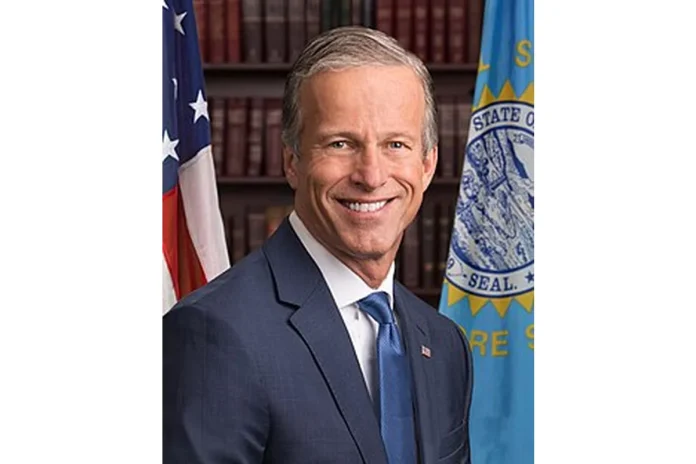
John Thune Bio
John Randolph Thune (born January 7, 1961) is an American politician and Republican member of the United States Senate who has represented South Dakota since 2005. He currently serves as Senate majority leader, a position he assumed in January 2025 after being elected Senate Republican leader in November 2024. Before joining the Senate, Thune served in the U.S. House of Representatives from 1997 to 2003 and gained national attention in 2004 when he defeated Senate Democratic leader Tom Daschle.
A native of Pierre, South Dakota, Thune earned a Bachelor of Arts degree in business from Biola University in 1983 and a Master of Business Administration from the University of South Dakota in 1984. Over more than two decades in the Senate, he has held a series of senior leadership roles, including Republican chief deputy whip, chair of the Senate Republican Policy Committee, chair of the Senate Republican Conference, majority whip, and minority whip.
Early Life and Background
John Randolph Thune was born on January 7, 1961, in Pierre, South Dakota, the son of Yvonne Patricia (née Bodine) Thune and Harold Richard Thune. His father was a fighter pilot in the Pacific theater during World War II who flew the Grumman F6F Hellcat and received the Distinguished Flying Cross after shooting down four enemy planes. Thune’s paternal grandfather, Nicholas Thune, emigrated to the United States from Norway in 1906 and partnered with his brother to operate a chain of hardware stores in South Dakota. The grandfather had changed the family name from Gjelsvik after immigration officials told him the original spelling was too difficult to pronounce.
Thune’s maternal grandfather was from Ontario, Canada, and his mother was born in Saskatchewan. The family background blended Norwegian and Canadian roots, and Thune grew up in a household shaped by military service and small-business experience. He graduated from Jones County High School in 1979, where he was a standout athlete active in basketball, track, and football.
Thune played college basketball at Biola University in California and graduated in 1983 with a Bachelor of Arts degree in business. He returned to his home state to earn a Master of Business Administration from the University of South Dakota in 1984, completing his formal education before entering public life.
Path to US Politics
After completing his MBA, Thune moved directly into political work in South Dakota. From 1985 to 1987, he served as a legislative aide for U.S. Senator James Abdnor, building relationships in the state and in Washington, D.C. In 1989, he returned to Pierre, where he served as executive director of the South Dakota Republican Party for two years. Governor George S. Mickelson later appointed him Railroad Director of South Dakota, a position he held from 1991 to 1993. He then served as executive director of the South Dakota Municipal League from 1993 to 1996.
These early positions allowed Thune to develop strong ties across South Dakota’s political, business, and civic communities. His mentor network from the Abdnor years and his hands-on experience in state government prepared him to run for federal office. In 1996, he entered the race for South Dakota’s lone seat in the U.S. House of Representatives and won the Republican primary against sitting Lieutenant Governor Carole Hillard, despite entering as a significant underdog.
John Thune Career
Early Career (1997–2003)
John Randolph Thune was elected to the U.S. House of Representatives in 1996, defeating Democrat Rick Weiland with 58 percent of the vote. The Almanac of American Politics noted that he entered the primary race as a clear underdog, but he won the Republican primary 59 percent to 41 percent by relying on personal campaigning and the support of longtime South Dakota political figures. He was sworn in as U.S. Representative for South Dakota’s at-large congressional district in January 1997.
Thune won reelection to the House in 1998 with 75 percent of the vote and again in 2000 with 73 percent. In 2002, after briefly considering a run for governor, he set his sights on the U.S. Senate and challenged incumbent Democratic Senator Tim Johnson. That race ended in a narrow defeat for Thune, who lost by just 524 votes, a margin later attributed to factors including Native American turnout, low turnout in key Republican counties, drought conditions, and the presence of a Libertarian candidate on the ballot.
U.S. Senate (2005–Present)
John Randolph Thune returned to the Senate race in 2004 and defeated Senate Democratic leader Tom Daschle on November 2, 2004, by 4,508 votes, winning 51 percent of the vote. The 2004 race was the most expensive Senate contest of that year, with a combined $30 million spent, and the most expensive in South Dakota history. Thune’s victory made Daschle the first incumbent Senate party leader to lose a reelection bid since 1952, and it elevated Thune to national prominence as a rising Republican star.
After winning his Senate seat, Thune rose steadily through the Republican leadership ranks. In December 2006, he was chosen by Senate Republican Whip Trent Lott to serve as the GOP’s chief deputy whip. He later became chairman of the Senate Republican Policy Committee in 2009 and was elected Republican Conference chairman in 2011, taking office in January 2012. The Conference chair is the third-ranking position in the Senate. He served as majority whip in the 116th Congress, then as minority whip in both the 117th and 118th Congresses.
Senate Republican Leader (2025–Present)
On November 13, 2024, John Randolph Thune won the Senate Republican Conference leadership election on the second ballot, defeating Rick Scott and John Cornyn to become the next Senate majority leader. The vote followed the November 2024 elections, in which Republicans won control of the Senate. Thune was chosen to replace the retiring Mitch McConnell as the chamber’s top Republican. On January 3, 2025, he became Senate majority leader, and on January 7, 2025, he spoke at the funeral service for former President Jimmy Carter alongside Vice President Kamala Harris and House Speaker Mike Johnson.
Thune is the first Senate party leader to have first taken office as a senator in the 21st century. His ascent from freshman senator in 2005 to majority leader two decades later represents one of the most rapid leadership climbs in the modern Senate.
John Thune Career Wins
John Randolph Thune has compiled a long record of electoral victories in South Dakota, winning multiple U.S. House races, three Senate reelection bids, and the 2004 Senate race that defined his career. His victories include the 1996 House general election, the 1998 and 2000 House reelection campaigns, the 2004 Senate race against Tom Daschle, a 2010 reelection with no major-party opposition, a 2016 reelection against Democrat Jay Williams, and a 2022 reelection against Democrat Brian Bengs.
U.S. Senate Highlights
Thune’s signature win came on November 2, 2004, when he defeated Senate Democratic leader Tom Daschle by 4,508 votes, capturing 51 percent of the vote. In his 2010 reelection, Thune ran without any primary or general election opposition. In 2016, he defeated Democrat Jay Williams with 71.8 percent of the vote. In 2022, despite public criticism from former President Donald Trump and a brief consideration of retirement, Thune won a fourth Senate term with 69.6 percent of the vote over Democrat Brian Bengs.
Other Wins and Achievements
Beyond electoral success, Thune co-authored the Telephone Robocall Abuse Criminal Enforcement and Deterrence (TRACED) Act in 2019, which passed the Senate 97-1 and became law in December 2019. He has also been a leading advocate for 5G deployment and rural broadband expansion and chaired the Communications, Technology, Innovation, and the Internet Subcommittee from 2019 to 2021.
John Thune Family
Family Background and Public Service Lineage
Thune comes from a family with deep roots in South Dakota and a strong record of public service. His father, Harold Richard Thune, was a World War II fighter pilot who earned the Distinguished Flying Cross. His paternal grandfather, Nicholas Thune, emigrated from Norway in 1906 and built a hardware-store business in South Dakota. Thune’s mother, Yvonne Patricia (née Bodine) Thune, was born in Saskatchewan, Canada, giving the family ties to both the Great Plains and the Canadian Prairies.
Personal Life
John Randolph Thune married Kimberley Weems of Doland, South Dakota, in 1984, and the couple has two daughters. As of 2025, the Thunes had six grandchildren. Thune is an evangelical Christian and is known for his personal fitness, having frequently competed in running events; a 2012 Runner’s World Magazine feature called him the fastest man in Congress since 2009. He is also a fan of the bands Styx, Journey, Boston, and the Doobie Brothers.