
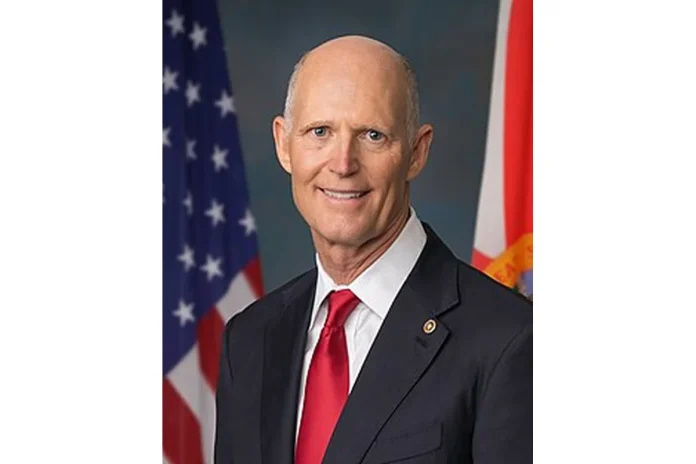
Rick Scott Bio
Richard Lynn Scott, widely known as Rick Scott, is an American attorney, businessman, politician, and Navy veteran who has served as the senior United States senator from Florida since 2019. A member of the Republican Party, he previously served two terms as the 45th governor of Florida from 2011 to 2019. Before entering public office, Scott co-founded Columbia Hospital Corporation, which grew into Columbia/HCA, one of the largest for-profit health care companies in the United States. He is also a veteran of the United States Navy.
Scott earned a Bachelor of Business Administration from the University of Missouri–Kansas City and a Juris Doctor from Southern Methodist University. He lives in Naples, Florida, with his wife Frances Annette Holland, and the couple has two daughters, including one named Allison. As one of the most recognizable Republican figures in Florida politics, Scott has shaped state and national policy debates on jobs, health care, taxes, and election laws.
Early Life and Background
Richard Lynn Scott was born on December 1, 1952, in Bloomington, Illinois, though he grew up in Kansas City, Missouri. His father was Gordon William Myers, and his mother was Esther J. Scott. After his parents separated, his mother married Orba George Scott Jr., whose surname Richard later took. The family lived in the Kansas City area, and Scott attended North Kansas City High School.
While working his way through college and law school, Scott made his first foray into business by buying and reviving a failing doughnut shop called the Flavor Maid Do-Nut. He later purchased and turned around a second doughnut shop, an early experience that sparked his lifelong interest in entrepreneurship. These early ventures gave him practical experience in managing payroll, marketing, and operations.
Scott went on to earn his Bachelor of Business Administration from the University of Missouri–Kansas City, followed by a Juris Doctor from Southern Methodist University Dedman School of Law. His education in both business and law helped lay the groundwork for a career that would later blend legal training, corporate leadership, and eventually public service.
Path to US Politics
After graduating from law school, Scott worked as an attorney at the law firm of Johnson and Swanson in Dallas, Texas, building a foundation in corporate and health law. He soon shifted his focus to the health care industry, co-founding Columbia Hospital Corporation with his partner Richard Rainwater in 1987. Columbia grew rapidly through a series of mergers, eventually becoming Columbia/HCA, one of the largest for-profit hospital companies in the country.
Scott led Columbia/HCA as its chairman and chief executive officer until 1997, when the company became the subject of a major federal fraud investigation. The company ultimately paid substantial federal fines, although Scott was never personally charged with wrongdoing. His departure from Columbia/HCA marked a turning point, and he went on to acquire and turn around several smaller businesses.
Encouraged by fellow Republicans and Florida business leaders, Scott entered the 2010 gubernatorial race as a political outsider promising to run the state like a business. He invested more than 70 million dollars of his own money in the campaign, won the Republican primary, and narrowly defeated Democrat Alex Sink. His election launched a political career that has since spanned the governorship and the U.S. Senate.
Rick Scott Career
Early Career (2011–2014)
Scott was sworn in as the 45th governor of Florida in January 2011. His early tenure was marked by some of the lowest approval ratings of any governor in the country, hovering around 26 percent in December 2011. He moved quickly to cut state spending, reduce the size of government agencies, and sign legislation requiring drug testing for welfare applicants, a law later struck down in court.
Despite the rocky start, Scott’s approval ratings steadily rose through his first term. He focused on job creation, promising to add 700,000 jobs over seven years, a pledge that was later rated a Promise Kept by PolitiFact. He also pushed school choice measures, signed legislation creating the Hope Scholarship Program for bullied students, and vetoed billions of dollars in proposed spending, including 2.3 billion dollars in federal high-speed rail funds between Tampa and Orlando.
Governorship and Policy Battles (2015–2018)
Scott won re-election in 2014, defeating former governor Charlie Crist. During his second term, he led Florida through Hurricane Irma in 2017, ordering the largest mass evacuation in United States history. His handling of the storm boosted his public profile, and his approval rating climbed to a high of 61 percent in the months that followed.
He also signed the Marjory Stoneman Douglas High School Public Safety Act in 2018 after the Parkland school shooting, raising the minimum age for firearm purchases to 21 and banning bump stocks. At the same time, Scott faced criticism for signing a 2011 law restricting doctors from asking patients about gun ownership, a measure later ruled unconstitutional, and for policies on felon voting rights that a federal court called arbitrary in 2018.
On the health care front, Scott was a longtime critic of the Affordable Care Act, although he voiced support for protecting people with preexisting conditions. He opposed Medicaid expansion for most of his first term, briefly supported it, then reversed course again in 2015. He also signed Florida’s first medical marijuana implementation law after voters approved a constitutional amendment, though he appealed a court ruling that allowed smokeable forms of the drug.
U.S. Senate Era (2019–Present)
Scott was sworn in to the U.S. Senate on January 8, 2019, by Vice President Mike Pence, having chosen to finish his term as governor before transitioning to Washington. As senator, he quickly aligned himself with President Donald Trump, supporting border security measures and calling for the repeal of the Affordable Care Act, though he later softened his public criticism of the law.
In April 2021, Scott was elected chairman of the National Republican Senatorial Committee, the campaign arm responsible for electing Republican senators. He used the position to shape the party’s Senate strategy through the 2022 midterms. Following disappointing results that year, he challenged Senate Minority Leader Mitch McConnell for the leadership position, receiving 10 votes to McConnell’s 37 in a secret ballot, the first challenge McConnell had faced since 2006.
Scott has also been a leading voice on the national debt, releasing his 11-Point Plan to Rescue America in February 2022, which called for sunsetting all federal legislation within five years and required all Americans to pay some income tax. The proposal drew sharp criticism from Democrats and mixed reviews from fellow Republicans. After Republicans won the Senate in 2024, Scott ran for Senate Majority Leader but was eliminated on the first ballot, finishing behind John Thune and John Cornyn.
Notable Events and Milestones
Among Scott’s signature moments are the founding of Columbia/HCA, the largest for-profit hospital company of its time, his role leading Florida through Hurricane Irma, and his ascent to the U.S. Senate. He was also the first Florida governor to preside over more executions than any predecessor, with 28 carried out during his tenure, and he pushed historic school choice and tax-cutting legislation in the state.
Rick Scott Career Wins
Scott’s political career includes two gubernatorial victories, one U.S. Senate win, and leadership roles within the Republican Party at the national level. His electoral success has been built on a consistent focus on jobs, taxes, and conservative policy priorities, often funded by substantial personal investment in his own campaigns.
Gubernatorial Wins
Scott won his first race for governor in 2010, narrowly defeating Democrat Alex Sink after spending more than 70 million dollars of his own money. He won re-election in 2014 against former Republican governor Charlie Crist, who had switched parties to run as a Democrat. Both victories were narrow but cemented Scott’s grip on Florida’s Republican base.
U.S. Senate and Party Leadership
Scott won Florida’s U.S. Senate seat in 2018, defeating three-term Democratic incumbent Bill Nelson in a closely contested race. In the Senate, he was elected chairman of the National Republican Senatorial Committee in 2020 and served in that role through the 2022 election cycle. He has also mounted internal party challenges, including his 2022 bid for Senate Republican leader and his 2024 candidacy for Senate Majority Leader.
Rick Scott Family
Family Background and Political Lineage
Rick Scott was born Richard Lynn Myers in Bloomington, Illinois, to Gordon William Myers and Esther J. Scott. After his parents separated, his mother married Orba George Scott Jr., whose surname Richard adopted. He grew up in the Kansas City area with his mother and stepfather, the family that shaped his Midwestern upbringing and his early work ethic.
Personal Life
Scott married Frances Annette Holland in 1972, and the couple has two daughters, one of whom is named Allison. The family resides in Naples, Florida. Scott’s business career allowed him to invest tens of millions of dollars of his own wealth into his political campaigns, making him one of the wealthiest members ever to serve in the U.S. Senate.