

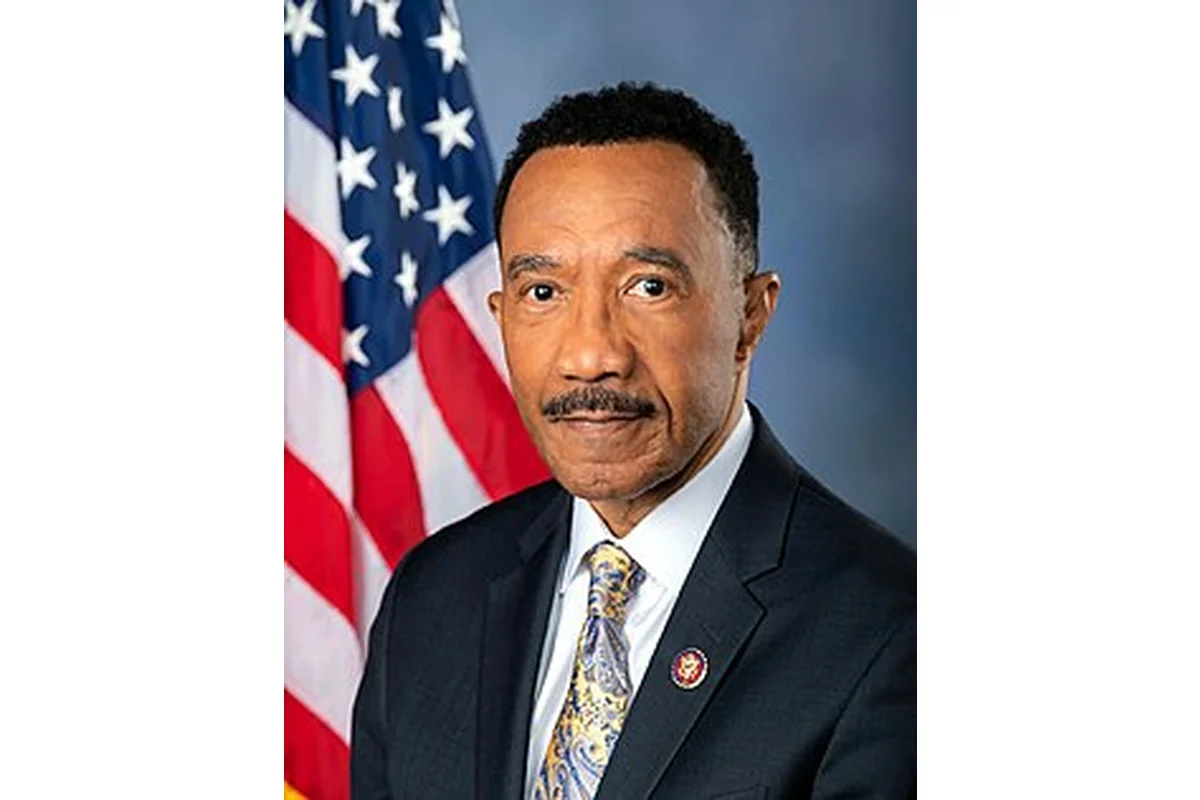
Kweisi Mfume Bio
Kweisi Mfume (born Frizzell Gerard Tate; October 24, 1948) is an American politician and former non-profit executive who represents Maryland’s 7th congressional district in the United States House of Representatives. A member of the Democratic Party, Mfume has held the seat on two occasions, first from 1987 to 1996 and again since 2020. He is widely recognized for leading the National Association for the Advancement of Colored People (NAACP) as its president and chief executive officer from 1996 to 2004.
Beyond his congressional service, Mfume is known for his advocacy on behalf of inner-city communities, his earlier tenure on the Baltimore City Council, and his role as chairman of the Congressional Black Caucus in the mid-1990s. He returned to the House in 2020 after winning a special election to fill the vacancy created by the death of Representative Elijah Cummings.
Kweisi Mfume Career
Early Career (1978–1986)
Mfume began his political career in Baltimore, where he was elected to the Baltimore City Council in 1978. On the council, he frequently clashed with Mayor William Donald Schaefer, accusing the administration of neglecting the city’s poor neighborhoods. His outspoken advocacy for underserved communities earned him a reputation as a progressive voice in local government.
After eight years on the city council, Mfume set his sights on federal office. In November 1986, he won election to the United States House of Representatives to represent Maryland’s 7th congressional district, succeeding the retiring Democrat Parren Mitchell. The victory launched a national career that would span several decades.
U.S. House of Representatives (1987–1996)
During his first stint in Congress, Mfume represented a district that included West Baltimore as well as suburban and rural communities, and he consistently pushed for greater federal aid to American inner cities. He balanced progressive priorities with a willingness to negotiate, helping him win reelection four times. From 1993 to 1995, he served as chairman of the Congressional Black Caucus, a position that elevated his profile on civil rights and economic policy matters.
In February 1996, Mfume made the surprising decision to leave the House and accept the presidency and chief executive officer role at the NAACP. He explained that he believed he could do more to advance American civil rights through the organization than by remaining in Congress. He worked to reform the NAACP’s finances and pay down its substantial debt during his early tenure.
NAACP Leadership (1996–2004)
As NAACP president and CEO, Mfume restored the organization’s financial stability and broadened its civil rights advocacy. His tenure was marked by efforts to engage new generations of African Americans and to spotlight issues ranging from criminal justice reform to economic opportunity. He remained a prominent national voice on racial equity throughout this period.
Mfume stepped down from the NAACP in 2004 following an internal investigation into allegations that he had sexually harassed female subordinates. He acknowledged having had an affair with an NAACP employee and apologized publicly in May 2005. The organization reportedly paid a settlement of $100,000 related to the allegations.
2006 U.S. Senate Campaign
On March 14, 2005, Mfume announced his candidacy for the United States Senate seat being vacated by retiring Maryland Democrat Paul Sarbanes. He campaigned on his record of civil rights advocacy and legislative experience, hoping to translate his national profile into a Senate victory.
On September 12, 2006, Mfume lost the Democratic primary to U.S. Representative Ben Cardin, who went on to win the general election. Following the defeat, Mfume briefly considered a run for mayor of Baltimore but ultimately decided against entering the 2007 race, stating that incoming Mayor Sheila Dixon deserved the opportunity to lead.
Post-Congressional Work (2007–2020)
After leaving the NAACP and his unsuccessful Senate bid, Mfume remained active in public life. In March 2010, he was named chief executive officer of the National Medical Association (NMA), a position he held until June 2011. In May 2013, he was named chair of the board of regents of Morgan State University, his undergraduate alma mater, succeeding interim chair Martin Resnick and taking the position on July 1, 2013.
From 2013 to 2018, Mfume served as the principal investigator for the Health Policy Research Consortium. He continued to be regarded as a senior statesman in Maryland politics and within national civil rights circles during this period.
Return to the U.S. House of Representatives (2020–Present)
On November 4, 2019, Mfume announced his candidacy for the special election to fill the vacancy in his old congressional seat, which had been left open by the October 2019 death of Representative Elijah Cummings. On February 4, 2020, he won the Democratic nomination, defeating Maya Rockeymoore Cummings, the late congressman’s widow, and was considered the favorite in the heavily Democratic district.
Mfume defeated Republican nominee Kimberly Klacik in the April 28, 2020, special election and was sworn in on May 5, 2020, returning to Congress after a 24-year absence. He later won a full term in the November 2020 rematch against Klacik. According to a FiveThirtyEight analysis, Mfume voted with President Joe Biden’s stated position 100 percent of the time during the 117th Congress.
Notable Events and Milestones
Among Mfume’s signature achievements are his role as chairman of the Congressional Black Caucus, his stewardship of the NAACP during a period of financial recovery, and his successful return to the House in 2020 after more than two decades away from elected office.
Kweisi Mfume Family
Family Background and Personal Life
Mfume was born as Frizzell Gerard Tate in Baltimore, Maryland, on October 24, 1948, the eldest of four children. His surname was changed to Gray after his stepfather, a truck driver who later abandoned the family. Following his mother’s death, he dropped out of high school at 16 to support his three sisters, working as many as three jobs at a time.
He changed his name to Kweisi Mfume in the early 1970s and went on to earn a Bachelor of Science degree from Morgan State University in 1976 and a Master of Science degree from Johns Hopkins University in 1984. His first marriage to Linda Shields lasted from 1972 to 1975 and ended in divorce. In 2012, he married Tiffany McMillan, the granddaughter of Enolia McMillan, the first female president of the NAACP. He has six children, including his son Michael Mfume, who wrote, produced, directed, and starred in the 1992 slasher film Ax ‘Em.
Mfume is a member of the Prince Hall Freemasons and the Omega Psi Phi fraternity.