
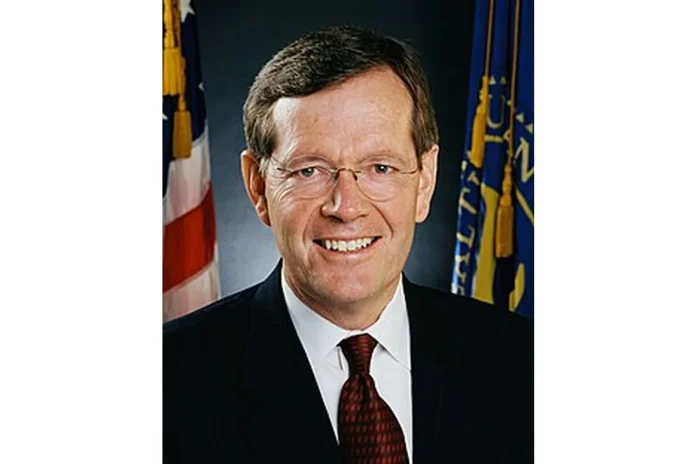
Mike Leavitt Bio
Michael Okerlund Leavitt (born February 11, 1951) is an American politician and business executive whose career has spanned state government, federal cabinet posts, and the private sector. A Republican, he served as the 14th Governor of Utah from 1993 to 2003, the 10th Administrator of the Environmental Protection Agency from 2003 to 2005, and the 20th United States Secretary of Health and Human Services from 2005 to 2009. After leaving federal service, he founded Leavitt Partners, a health care consulting firm, and later became president of the Tabernacle Choir in 2021.
Leavitt began his professional life in the insurance industry and rose to lead a regional firm before entering politics. Across more than three decades of public and private work, he has remained active in health care policy, presidential transition planning, and corporate governance.
Early Life and Background
Michael Okerlund Leavitt was born in Cedar City, Utah, on February 11, 1951. He is the son of Dixie L. Leavitt and Phyllis Anne Okerlund. His father founded The Leavitt Group, a regional insurance company, and later served as a Utah state senator, giving the younger Leavitt early exposure to both business and politics.
Leavitt graduated from Southern Utah University with a degree in business. The university later became one of several institutions he supported as governor, and he served for four years as chair of its board of trustees. His upbringing in southern Utah, combined with a family rooted in insurance and public service, shaped the path that led him toward a career combining business management with elected office.
Path to US Politics
Leavitt joined The Leavitt Group, the firm founded by his father, and built his career in insurance and risk management. He became president and chief executive officer of the company in 1984 and oversaw a period of expansion. He also served on the boards of local and regional companies, including Utah Power and Light, and was a member of the Utah State Board of Regents, where he helped oversee the state’s public colleges and universities.
His first direct involvement in a political campaign came in 1976, when he assisted his father’s unsuccessful run for governor. Through the 1980s, he worked on United States Senate campaigns for Republicans Jake Garn and Orrin Hatch. These experiences in campaigns and policy circles prepared him for his own entry into elective office, and in 1992 he successfully ran for governor of Utah.
Mike Leavitt Career
Early Career (1972–1992)
Leavitt’s business career began in 1972 when he joined The Leavitt Group. He spent two decades in the insurance and risk management industry, working his way up to president and CEO in 1984. Under his leadership, the company expanded and gained a regional presence in the American West.
Alongside his business responsibilities, he took on civic roles, including service on the Utah State Board of Regents and later as chair of the Southern Utah University board of trustees. He also worked behind the scenes on Republican campaigns, gaining the political experience that would carry him into the governorship.
Governor of Utah (1993–2003)
Leavitt first ran for governor in 1992. After a competitive Republican primary against Richard Eyre, he won the general election, defeating Independent Merrill Cook and Democrat Stewart Hanson to become Utah’s 14th governor. A few weeks into his tenure, a holiday fire on December 15, 1993, destroyed much of the Utah Governor’s Mansion, though his wife, Jacalyn Leavitt, family members, and staff escaped safely.
He was reelected in 1996 with the largest vote total in state history at that point, and in 2000 he became only the second governor in Utah history to win a third term. As governor, he co-founded Western Governors University in 1997 with Colorado Governor Roy Romer, established the first charter schools in Utah, led the state’s preparation for the 2002 Winter Olympics, negotiated major federal land exchanges, and championed engineering education. He also held leadership roles in the Republican Governors Association, the Western Governors Association, the Council of State Governments, and the National Governors Association.
EPA Administrator (2003–2005)
On August 11, 2003, President George W. Bush nominated Leavitt as Administrator of the Environmental Protection Agency. He was confirmed by the United States Senate on October 28, 2003, by a vote of 88–8, and was sworn in on November 5, 2003, after resigning as governor. He was succeeded in office by Lieutenant Governor Olene Walker.
At the EPA, Leavitt raised standards for ozone, diesel fuels, and other air pollutants and organized a federal collaboration to clean up the Great Lakes. He also co-authored an environmental policy framework known as Enlibra.
Secretary of Health and Human Services (2005–2009)
On December 13, 2004, President Bush nominated Leavitt to succeed Tommy Thompson as Secretary of Health and Human Services. He was confirmed by the Senate by voice vote on January 26, 2005, and served through the end of the Bush administration. During his tenure, he oversaw the implementation of Medicare Part D, developed the National Pandemic Plan, promoted value-based health care, and led the department’s response to Hurricane Katrina. He also opened new Food and Drug Administration offices in China, India, and South America, and helped reauthorize the State Children’s Health Insurance Program and Temporary Assistance for Needy Families. In August 2007, he became the first cabinet-level blogger in United States history.
Leavitt Partners and Later Career (2009–Present)
After leaving government in 2009, Leavitt organized Leavitt Partners, a consulting firm advising clients on health care policy. The firm grew into a recognized authority on value-based health care, and in April 2021 it merged with Health Management Associates, with Leavitt appointed co-chairman of the combined company. He also served on the Homeland Security Advisory Council and chaired Mitt Romney’s 2012 presidential transition team, the first transition planned under the Presidential Transition Act of 2010.
He later advised Congress on transition improvements, contributing to the Edward “Ted” Kaufman and Michael Leavitt Presidential Transitions Improvements Act of 2015. In 2013, he helped launch Count My Vote, a bipartisan effort that succeeded in changing Utah’s primary election laws. On August 6, 2021, he was named president of the Tabernacle Choir at Temple Square, replacing Ron Jarrett.
Notable Events and Milestones
Among the signature events of Leavitt’s career are the 1993 Governor’s Mansion fire, the founding of Western Governors University, the successful negotiation of the 2002 Winter Olympics in Utah, the implementation of Medicare Part D, and his leadership of the first modern presidential transition under the 2010 law. His Senate confirmation to lead the EPA by an 88–8 vote also stands out as a strong bipartisan moment early in his federal service.
Mike Leavitt Family
Family Background and Public Service
Leavitt was born into a family with deep roots in southern Utah business and politics. His father, Dixie L. Leavitt, founded The Leavitt Group and served in the Utah State Senate, while his mother, Phyllis Anne Okerlund, raised the family in Cedar City. The insurance firm his father built became the foundation of Leavitt’s own business career before he moved into public service.
Personal Life
Leavitt married Jacalyn Smith, and together they have five children. She served as Utah’s First Lady during his time as governor and was present in the Governor’s Mansion during the December 1993 fire that damaged the residence. The family has remained closely connected to Cedar City and to Southern Utah University, where Leavitt has held long-standing leadership roles.