
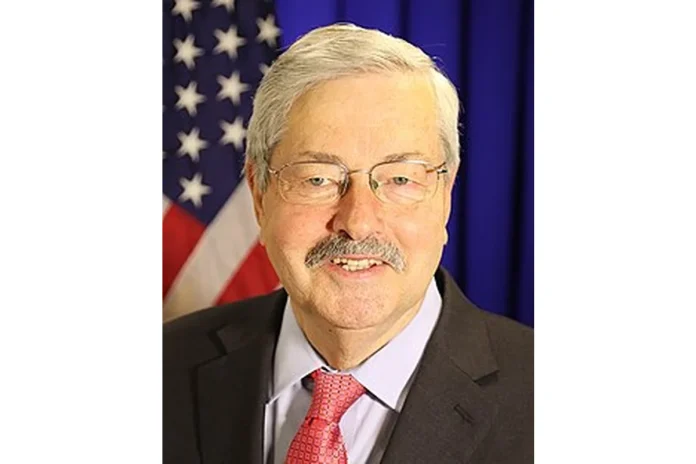
Terry Branstad Bio
Terry Edward Branstad (born 17 November 1946) is a retired American politician, diplomat, and U.S. Army veteran best known for serving as the 39th and 42nd Governor of Iowa. A member of the Republican Party, he is the longest-serving governor in United States history, with a combined tenure of more than 22 years. After leaving the governorship he served as the United States Ambassador to China from 2017 to 2020 and later led the World Food Prize Foundation before retiring in 2025.
First elected to office in 1972, Branstad built a career that spanned the Iowa House of Representatives, the lieutenant governorship, four terms as governor, and a high-profile diplomatic posting. His record on tax reform, balanced budgets, and trade with China shaped both Iowa policy and broader national conversations on federalism and international relations.
Early Life and Background
Terry Edward Branstad was born on 17 November 1946 in Leland, Iowa, a small farming community in Winnebago County. He is the son of Edward Arnold Branstad, a farmer, and Rita (née Garland) Branstad. His mother was Jewish and his father was a Norwegian American Lutheran, and Branstad was raised Lutheran before later converting to Catholicism.
Branstad grew up in the rural traditions of northern Iowa and attended high school in Forest City, where he was active in student government and athletics. His upbringing on a family farm gave him an early understanding of agriculture, an interest that would later shape his policy priorities as governor.
He is a second cousin of Merrick Garland, the attorney general who served under President Joe Biden. A 2015 biography by Iowa historian Mike Chapman, Iowa’s Record-Setting Governor: The Terry Branstad Story, details Branstad’s youth on the family farm and his rise in state politics.
Path to US Politics
Branstad received a Bachelor of Arts in political science from the University of Iowa in 1969 and went on to earn a Juris Doctor from Drake University Law School in 1974. While at the University of Iowa he became active in Republican student politics, sharpening the campaign skills that would later define his career.
After college he was drafted into the United States Army and served from 1969 to 1971 as a military policeman in the 503rd Military Police Battalion at Fort Bragg. He was awarded the Army Commendation Medal for meritorious service during his time in uniform, an experience that strengthened his sense of civic duty.
Returning to Iowa after military service, Branstad set his sights on the state legislature and won a seat in the Iowa House of Representatives in 1972, the same year he earned his law degree. His path from farm community to state capitol laid the groundwork for a rapid ascent in Iowa politics.
Terry Branstad Career
Early Career (1973–1982)
Branstad served three terms in the Iowa House of Representatives from 1973 to 1979, focusing on agricultural policy, education funding, and fiscal discipline. His reputation for hard work and constituent service earned him a statewide profile well beyond his north Iowa district.
In 1978 he was elected the 40th Lieutenant Governor of Iowa, serving from 1979 to 1983 under Governor Robert D. Ray. The role gave him direct experience with the state budget, agency oversight, and the legislative process, preparing him to run for the top office in 1982.
First Tenure as Governor of Iowa (1983–1999)
When Branstad took office in January 1983 at age 36, he became the youngest governor in Iowa history. He was reelected in 1986, 1990, and 1994, eventually leaving office as the longest-serving governor the state had ever seen.
His first tenure was marked by steady economic growth. Iowa’s unemployment rate fell from 8.5 percent in 1983 to a record low 2.5 percent by 1999, and the state transformed a $90 million budget deficit into a $900 million surplus over the same period. Branstad also chaired the National Governors Association in 1989–1990 and led the Education Commission of the States and the Republican Governors Association in the late 1990s.
He made reinstatement of the death penalty a central focus of his 1994 reelection campaign, winning another term but ultimately being blocked by Democrats in the Iowa State Senate. Earlier, in 1983, he had vetoed a bill to establish a state lottery, signaling his fiscal conservatism.
Inter-gubernatorial Career (1999–2010)
After leaving the governorship in January 1999, Branstad stepped back from electoral politics and built a portfolio of business and advisory roles. He founded Branstad and Associates, LLC, and worked as a financial advisor for Robert W. Baird and Co. He also served on a number of corporate and nonprofit boards, including the Iowa Health System, Liberty Bank, and Living History Farms.
President George W. Bush appointed him to chair the President’s Commission on Excellence in Special Education, where he worked on plans to improve outcomes for students with disabilities. In August 2003 Branstad accepted an offer to become president of Des Moines University, a private osteopathic medical school, where he served until 2009, when he announced his retirement from the university to mount another run for governor.
Second Tenure as Governor of Iowa (2011–2017)
Branstad won the 2010 Republican gubernatorial nomination and defeated Democratic incumbent Chet Culver in the general election, returning to the Statehouse as the 42nd Governor of Iowa. He was reelected in 2014 with 59 percent of the vote against State Senator Jack Hatch, cementing his standing as the dominant figure in Iowa Republican politics.
On 14 December 2015 he surpassed George Clinton’s record to become the longest-serving governor in United States history, a milestone that capped decades of electoral success. His second tenure featured a sweeping 2013 tax reform bill that delivered the largest tax cut in state history, including an estimated $4.4 billion in property tax relief.
Branstad also signed a 2017 bill expanding gun rights and stand-your-ground provisions and made controversial appointments to the Iowa Utilities Board that effectively cleared the way for the Dakota Access pipeline. In 2012 a personnel decision that he made led to a 2019 jury verdict of $1.5 million in damages against the state for sexual orientation discrimination.
U.S. Ambassador to China (2017–2020)
In December 2016 President-elect Donald Trump nominated Branstad to serve as United States Ambassador to China, citing his decades of experience with the country. He was confirmed by the U.S. Senate on 22 May 2017 in an 82 to 13 vote, resigned as governor two days later, and was sworn in as ambassador on 12 July 2017.
Branstad’s relationship with Chinese President Xi Jinping dated to 1985, when Xi, then a young Hebei Province official, led an agricultural delegation to Iowa. Xi has long considered Branstad an old friend, and the ambassador used that rapport to navigate the increasingly tense U.S.–China trade relationship, including a 2018 opposition to a proposed ban on student visas and a 2019 visit to the Tibet Autonomous Region.
He resigned as ambassador in early October 2020 at President Trump’s request to help with the 2020 reelection campaign, ending a tenure that combined agricultural diplomacy with high-stakes trade negotiations.
World Food Prize Foundation (2023–2025)
On 24 January 2023 it was announced that Branstad would become president of the World Food Prize Foundation, the Des Moines-based organization that honors breakthroughs in fighting world hunger. He announced his retirement on 19 November 2024 and formally stepped down in February 2025, ending a public career that spanned more than five decades.
Terry Branstad Family
Family Background and Political Lineage
Branstad comes from a deeply rooted Iowa family. His father, Edward Arnold Branstad, was a farmer in Winnebago County, and his mother, Rita (née Garland), brought Jewish heritage to a household that Branstad later balanced by converting to Catholicism. He is a second cousin of Merrick Garland, who served as United States attorney general under President Joe Biden.
Personal Life
Branstad married Christine Johnson on 17 June 1972, and the couple has three children: Eric, Allison, and Marcus, along with eight grandchildren. His wife has worked as a medical assistant and as a volunteer at schools and hospitals.
Allison moved with her father to Beijing in 2017 to teach third grade at the International School of Beijing. Marcus was appointed by his father to the Iowa Natural Resources Commission in 2013 and works as a lobbyist for the American Chemistry Council. Eric Branstad is a political consultant and lobbyist whose work on behalf of Chinese firms while his father was ambassador drew conflict-of-interest scrutiny, which Branstad denied.
Branstad is a member of the Ancient and Accepted Scottish Rite of Freemasonry, receiving the rank of Knight Commander of the Court of Honor in 2015. He is also a recipient of the Army Commendation Medal for his service in the United States Army.