
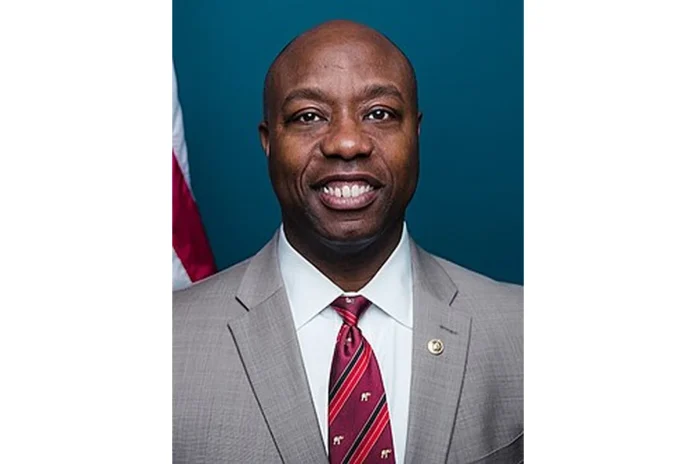
Tim Scott Bio
Timothy Eugene Scott (born September 19, 1965) is an American businessman and politician serving as the junior United States senator from South Carolina since 2013. A Republican, he is the first African American senator in the Southern United States to be directly elected and the first African American to serve in both chambers of the United States Congress. He also chairs the Senate Committee on Banking and was elected chair of the National Republican Senatorial Committee after the 2024 elections. Before the Senate, Scott built a career in financial services and local government in the Lowcountry region of South Carolina.
Raised by a single mother in working-class North Charleston, Scott overcame early academic struggles and went on to earn a Bachelor of Science degree in political science from Charleston Southern University. He entered politics in 1995, won seats on the Charleston County Council, the South Carolina House, and the U.S. House of Representatives, and was appointed to the U.S. Senate by Governor Nikki Haley in December 2012. Scott launched a campaign for the 2024 Republican presidential nomination but suspended it in November 2023.
Early Life and Background
Tim Scott was born on September 19, 1965, in North Charleston, South Carolina, to Frances, a nursing assistant, and Ben Scott Sr. His parents divorced when he was seven, and he and his older brother were raised in working-class poverty by their mother, who often worked double shifts. After the divorce, the family moved into his maternal grandparents’ home, where he formed a close bond with his grandfather. His brother later served as a sergeant major in the United States Army.
As a freshman at R.B. Stall High School in North Charleston, Scott failed several subjects, and his mother required him to attend summer school, which he financed by working at a local movie theater. During this period, he met John Moniz, the owner of a nearby Chick-fil-A, who became a formative mentor and introduced him to ideas about individual responsibility, conservative business principles, philanthropy, and finance. Scott enjoyed sports and excelled at football, eventually being elected student body vice president in his junior year and student body president in his senior year.
A month before his senior year, Scott fell asleep while driving and was involved in a car accident that ended his prospects as a football recruit. He went on to attend Presbyterian College from 1983 to 1984 on a partial football scholarship, where he joined the Fellowship of Christian Athletes and committed to the Christian faith. He later transferred to Charleston Southern University, graduating in 1988 with a Bachelor of Science degree in political science.
Path to US Politics
After graduating from college, Scott worked as an insurance agent and financial adviser, eventually founding Tim Scott Allstate and becoming a partner in Pathway Real Estate Group, LLC. His business career in the Charleston area laid the groundwork for his entry into public service and connected him with local Republican leaders in the Lowcountry.
Scott’s political start came in February 1995, when he won a special election for the Charleston County Council at-large seat, receiving nearly 80 percent of the vote. He became the first Black Republican elected to any office in South Carolina since the late 19th century. He was reelected in 2000 and 2004, became council chairman in 2007, and served until 2009, while also briefly contesting a state Senate seat in 1996.
Tim Scott Career
Early Career (1995–2010)
Scott’s first notable political breakthrough came with his 1995 win on the Charleston County Council, where he served fourteen years and rose to chairman. During his tenure, he backed the posting of the Ten Commandments outside council chambers and supported South Carolina’s right-to-work laws, while also engaging in legal disputes over the county’s at-large voting system, which the U.S. Department of Justice challenged under the Voting Rights Act.
In 2008, Scott won the Republican primary for District 117 of the South Carolina House of Representatives with 53 percent of the vote and won the general election unopposed. His victory made him the first Republican African American state representative in South Carolina in more than a century. He served in the state House from 2009 to 2011, earning an 80 out of 100 rating from the South Carolina Club for Growth’s 2009–2010 scorecard.
U.S. House Breakthrough (2011–2013)
Scott entered the 2010 race for South Carolina’s 1st congressional district after incumbent Henry Brown announced his retirement. He finished first in a nine-candidate Republican primary with 32 percent of the vote, won a runoff against Paul Thurmond 68–32 percent, and captured every county in the district. His general-election victory over Democrat Ben Frasier 65–29 percent made him, alongside Allen West of Florida, the first African American Republicans in Congress since J. C. Watts retired in 2003 and the first African American Republican elected to Congress from South Carolina in 114 years.
During his two years in the U.S. House, Scott was appointed to the committees on Transportation, Small Business, and later Rules. He also secured nearly $300 million in federal funds for a Charleston harbor dredging project, which he defended as a merit-based investment in jobs and trade capacity. In December 2012, after Senator Jim DeMint announced he would leave the Senate to lead The Heritage Foundation, Governor Nikki Haley chose Scott to replace him, making him the first African American U.S. senator from South Carolina.
U.S. Senate Era (2013–Present)
Scott was sworn in to the U.S. Senate in January 2013 and won the 2014 special election for the remaining two years of DeMint’s term. He was elected to a full term in 2016 and reelected in 2022, defeating Democratic nominee Krystle Matthews. In the Senate, he helped introduce the bipartisan Justice for Victims of Lynching Act with Senators Cory Booker and Kamala Harris in 2018, delivered the 2021 Republican response to President Joe Biden’s joint address to Congress, and led the drafting of a 106-page Justice Act on race and police reform in 2020.
As chair of the Senate Committee on Banking, Scott has championed the cryptocurrency industry and backed infrastructure investments. He also chairs the National Republican Senatorial Committee following the 2024 elections. In 2019, he broke with his party to block the nomination of Thomas A. Farr for a federal judgeship, citing concerns about the suppression of African American voters, and he similarly opposed the nomination of Ryan Bounds to the 9th U.S. Circuit Court of Appeals.
2024 Presidential Campaign
Scott began laying the groundwork for a presidential run in early 2023 with a listening tour that included a Black History Month event in Charleston and stops across Iowa. He formed an exploratory committee in April 2023, filed with the Federal Election Commission on May 19, and formally announced his candidacy in North Charleston on May 22, 2023. On November 12, 2023, he announced the suspension of his campaign on Fox News, citing low polling numbers, and returned his focus to the Senate.
Tim Scott Career Wins
Scott has compiled a long string of electoral victories across more than two decades in public office, beginning in 1995 and continuing through his 2022 Senate reelection. He has consistently performed strongly in Lowcountry districts, where he first built his political base as a county councilman and state representative.
U.S. Senate Highlights
Scott’s first Senate win came in the 2014 special election to fill the remaining two years of Jim DeMint’s term. He then won a full six-year term in 2016 and secured reelection in 2022 by defeating Democratic nominee Krystle Matthews. He also became the longest-serving African American senator in U.S. history and the first African American senator to chair a full Senate committee.
Other Wins & Achievements
Scott’s earlier wins include his 1995 special election to the Charleston County Council, his 2008 primary and unopposed general election in South Carolina House District 117, and his 2010 primary, runoff, and general-election victories for South Carolina’s 1st congressional district. He was elected to lead the National Republican Senatorial Committee after the 2024 elections, further extending his influence within the Senate GOP.
Tim Scott Family
Family Background and Public Service Lineage
Scott is the son of Frances, a nursing assistant, and Ben Scott Sr., and he has an older brother who served as a sergeant major in the United States Army. After his parents divorced, he and his brother were raised by their mother, who often worked double shifts, with support from their maternal grandparents. His grandfather was a particularly close figure in his upbringing, helping shape the values that later informed his political career.
Personal Life
Scott worked in the insurance and real estate industries before entering politics, founding Tim Scott Allstate and co-founding Pathway Real Estate Group, LLC. He is a member of Seacoast Church, a large evangelical congregation in Charleston. In November 2023, he publicly announced he was dating Mindy Noce, an interior designer from Charleston; the couple became engaged on January 21, 2024, and married on August 3, 2024, in Mount Pleasant, South Carolina.