
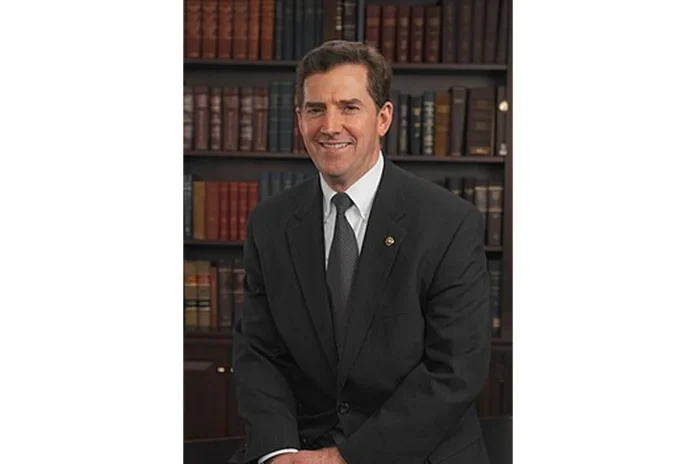
Jim DeMint Bio
James Warren DeMint (born September 2, 1951) is an American businessman, author, and retired politician from South Carolina. A Republican and one of the early leaders of the Tea Party movement, he served in the U.S. House of Representatives from 1999 to 2005 and in the U.S. Senate from 2005 to 2013. He founded the Senate Conservatives Fund, a political action committee, and later served as president of The Heritage Foundation, a leading conservative think tank, from 2013 to 2017. After leaving Heritage, he became a senior advisor to Citizens for Self-Governance and founded the Conservative Partnership Institute.
Early Life and Background
Jim DeMint was born in Greenville, South Carolina, one of four children. His parents were Thomas Eugene DeMint and Betty W. DeMint (née Rawlings). His parents divorced when he was five, and his mother later operated a dance studio out of the family home. Growing up in Greenville shaped much of his early years and gave him a strong connection to his home state.
He attended Christ Church Episcopal School and Wade Hampton High School, where he played drums in a cover band called Salt & Pepper. He went on to earn a bachelor’s degree from the University of Tennessee in 1973, where he became a member of the Sigma Alpha Epsilon fraternity. He later returned to South Carolina and completed an MBA at Clemson University in 1981, sharpening his skills in business and research.
Path to US Politics
After completing his MBA, DeMint joined his father-in-law’s advertising firm in Greenville in 1981, working in market research. In 1983, he founded The DeMint Group, a research firm that served businesses, schools, colleges, and hospitals. His work in market research gave him a strong understanding of messaging and voter outreach, which would later shape his political career.
DeMint’s entry into politics came in 1992, when he was hired by Republican Representative Bob Inglis to work on his campaign for South Carolina’s Fourth Congressional District. Inglis defeated three-term Democratic incumbent Liz J. Patterson, and DeMint continued to assist Inglis through two more successful election cycles. When Inglis ran for the U.S. Senate in 1998, DeMint left his firm to seek the open House seat, beginning his own run for elected office.
Jim DeMint Career
Early Career (1998-2002)
DeMint’s first congressional bid came in 1998 for South Carolina’s Fourth Congressional District, considered the most Republican district in the state. He finished second in the Republican primary behind State Senator Michael Fair but won the runoff by 2,030 votes. In the general election, he defeated Democratic State Senator Glenn Reese with 57 percent of the vote to Reese’s 40 percent, securing his first term in the U.S. House.
He was elected president of the freshman class of House Republicans and pledged to serve only three terms in the House. DeMint won his second and third House terms with little opposition, facing no major-party challenger in 2000 and defeating an underfunded Democrat in 2002. During his time in the House, he earned a reputation as a staunch conservative, breaking with his party on several high-profile issues.
Breakthrough (2003-2010)
DeMint announced his Senate candidacy on December 12, 2002, after Senator Ernest Hollings announced his retirement. In the 2004 Republican primary, he placed a distant second behind former governor David Beasley but won the runoff with support from Thomas Ravenel, who had finished just behind him. In the general election, he defeated Democratic state education superintendent Inez Tenenbaum by 9.6 percentage points, helping South Carolina have two Republican senators for the first time since Reconstruction.
During his first Senate term, DeMint served on the Commerce, Science and Transportation Committee, the Environment and Public Works Committee, the Joint Economic Committee, and the Special Committee on Aging. He also served on the Committee on Foreign Relations. In 2008, he founded the Senate Conservatives Fund, a political action committee designed to support conservative candidates overlooked by the national party. The SCF became closely associated with the Tea Party movement and supported successful first-time Senate candidates including Rand Paul, Marco Rubio, Mike Lee, and Pat Toomey.
He won reelection in 2010 in a landslide, defeating Democrat Alvin Greene by a margin of 63 percent to 28 percent, with Green Party candidate Tom Clements receiving 9 percent. Following that victory, DeMint became the highest-ranking elected official associated with the Tea Party movement. He later introduced the REINS Act, which aimed to require congressional approval of major federal regulations, and voted against Hillary Clinton’s appointment as Secretary of State in 2009.
Republican Era (2010-2017)
During his second Senate term, DeMint led efforts to push for a balanced federal budget without tax increases and continued his work with the Senate Conservatives Fund. In 2012, he announced his resignation from the Senate effective January 2, 2013, to become president of The Heritage Foundation. South Carolina Governor Nikki Haley named Congressman Tim Scott to fill his vacated seat.
DeMint began his first full day leading The Heritage Foundation on April 4, 2013. He oversaw the organization’s research and advocacy work on conservative policy, including limited government, free markets, and traditional social values. On May 2, 2017, the Heritage Foundation’s board of trustees voted unanimously to dismiss him following an investigation that found significant management issues and a breakdown in internal communications.
Notable Events and Milestones
Among his most significant career moments, DeMint helped shape the modern conservative movement by founding the Senate Conservatives Fund and championing Tea Party-aligned candidates. His 2010 reelection marked his rise as the highest-ranking elected Tea Party figure, and his appointment to lead The Heritage Foundation reflected his influence within the conservative establishment. His dismissal from Heritage in 2017 was a notable conclusion to his time in major institutional leadership.
Jim DeMint Career Wins
Jim DeMint compiled a strong record of election victories throughout his political career, winning three U.S. House races and two U.S. Senate races in South Carolina. He was consistently elected in strongly Republican districts and statewide contests, and his political action committee helped elect a new generation of conservative senators.
Congressional and Senate Highlights
DeMint won his first House race in 1998, defeating Glenn Reese with 57 percent of the vote, and was reelected in 2000 and 2002 without significant opposition. He won his first U.S. Senate race in 2004, defeating Inez Tenenbaum by 9.6 percentage points, and secured a second Senate term in 2010 with a commanding 63 percent of the vote against Alvin Greene. His 2010 victory was his final and most decisive electoral win.
Other Wins and Achievements
Beyond his own elections, DeMint’s Senate Conservatives Fund raised $9.1 million toward the 2010 U.S. Senate elections and helped elect Pat Toomey, Rand Paul, Mike Lee, Ron Johnson, and Marco Rubio to the Senate. He also founded the Conservative Partnership Institute in 2017 to support the professional development of conservative staffers and elected officials, extending his influence well beyond his own campaigns.
Jim DeMint Family
Family Background and Lineage
Jim DeMint was raised in Greenville, South Carolina, in a family shaped by his parents’ divorce when he was five years old. His father, Thomas Eugene DeMint, and his mother, Betty W. DeMint (née Rawlings), raised him alongside his three siblings, with his mother later running a dance studio from the family home. His wife, Debbie DeMint (née Henderson), is one of three children of the late Greenville advertising entrepreneur and South Carolina Republican figure James Marvin Henderson Sr., connecting the DeMint family to a longstanding network in state Republican politics.
Personal Life
Jim DeMint married Debbie Henderson in 1973, and the couple has built a life together in South Carolina. His professional background in market research and advertising shaped his approach to political messaging throughout his career. He has remained active in conservative advocacy after his time in elected office, focusing on efforts to limit federal government power and promote constitutional amendments through organizations such as the Conservative Partnership Institute.