
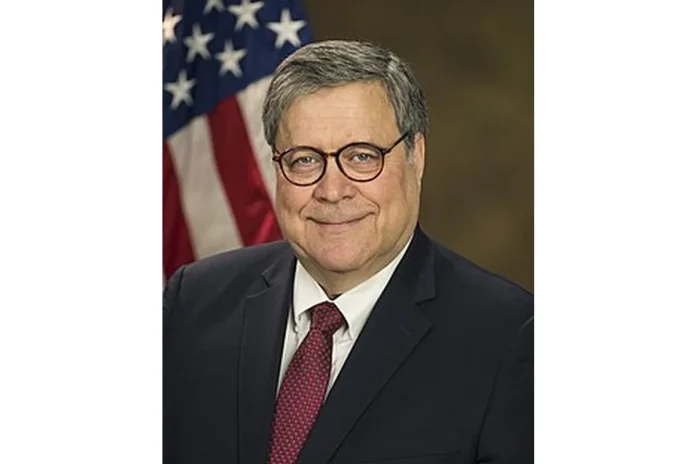
William Barr Bio
William Pelham Barr (born May 23, 1950) is an American attorney and politician who served as the 85th United States Attorney General. A member of the Republican Party, Barr held the nation’s top law enforcement post on two occasions: first under President George H. W. Bush from 1991 to 1993, and later under President Donald Trump from 2019 to 2020. He is the second person in U.S. history to serve two non-consecutive terms as attorney general, following John J. Crittenden in 1850.
Raised in New York City and educated at Columbia University and George Washington University Law School, Barr built a career spanning intelligence work, private practice, corporate leadership, and senior Justice Department posts. A longtime proponent of the unitary executive theory, he has advocated for expansive presidential authority and tougher criminal-justice policies. His two tenures as attorney general were consequential and deeply controversial, marked by high-profile prosecutorial decisions and vigorous defense of executive power.
Early Life and Background
William Pelham Barr was born on May 23, 1950, in New York City. He was the second of four sons. His father, Donald Barr, was an educator and writer who taught English literature at Columbia University before serving as headmaster of the Dalton School in Manhattan and later the Hackley School in Tarrytown, New York. His mother, Mary Margaret (née Ahern), also taught at Columbia. Donald Barr was raised Jewish but converted to Roman Catholicism, while Mary Margaret was of Irish Catholic ancestry, and William was raised Catholic.
Barr grew up on the Upper West Side of Manhattan. As a child, he attended Corpus Christi School, a Catholic grammar school, before enrolling at the Horace Mann School. After high school, he attended Columbia University, where he majored in government and earned a Bachelor of Arts in 1971. He was an active member of the Sigma Nu fraternity. He remained at Columbia for two additional years of graduate study, receiving a Master of Arts in government and Chinese studies in 1973. While on campus, he opposed student anti-Vietnam War occupation protests.
After completing his graduate studies, Barr moved to Washington, D.C., to work as an intelligence analyst for the Central Intelligence Agency. While working at the agency, he entered the evening program at George Washington University Law School, graduating in 1977 with a Juris Doctor with highest honors.
Path to US Politics
Barr’s path to prominence in US politics began in the executive branch. From 1971 to 1977, he served in a variety of roles at the Central Intelligence Agency, including time as a summer intern, an analyst in the Intelligence Directorate, and an assistant in the Office of Legislative Counsel. After law school, he clerked for Judge Malcolm Richard Wilkey of the United States Court of Appeals for the District of Columbia Circuit.
In the 1980s, Barr joined the law firm of Shaw, Pittman, Potts & Trowbridge, with a one-year interlude at the Reagan White House as Deputy Assistant Director for Legal Policy on the domestic policy staff. His White House experience established his ties to conservative legal policymaking and set the stage for his later work in the Department of Justice.
In 1989, President George H. W. Bush appointed Barr as Assistant Attorney General for the Office of Legal Counsel, the office that functions as the principal legal adviser to the president and executive agencies. This role gave him a national platform and positioned him for elevation to the Deputy Attorney General post and, eventually, the attorney generalship.
William Barr Career
Early Career (1971–1989)
Barr’s early career was defined by intelligence work and legal practice. He spent six years at the Central Intelligence Agency, beginning as a summer intern and progressing to roles in the Intelligence Directorate and the Office of Legislative Counsel. Following his graduation from George Washington University Law School in 1977, he served a one-year clerkship with Judge Malcolm Richard Wilkey on the D.C. Circuit.
He then entered private practice at the law firm of Shaw, Pittman, Potts & Trowbridge, working there in two stints: from 1978 to 1982, and again from 1983 to 1989. Between those periods, he served in the Reagan White House on the domestic policy staff dealing with legal policy. During these years, Barr never prosecuted a case.
George H. W. Bush Era (1989–1993)
Barr’s first period of national prominence came under President George H. W. Bush. As Assistant Attorney General for the Office of Legal Counsel, he was a strong defender of presidential power. He authored an advisory opinion justifying the 1989 U.S. invasion of Panama and the arrest of Manuel Noriega, and wrote legal justifications for the practice of rendition.
Barr was later elevated to Deputy Attorney General. In 1991, he authorized an FBI operation that freed hostages at the Talladega federal prison. In 1992, as attorney general, he authored the report “The Case for More Incarceration,” arguing for an increase in the U.S. incarceration rate. On his recommendation, President Bush pardoned six officials involved in the Iran-Contra affair. He was confirmed as attorney general and served from 1991 to 1993.
Trump Era (2019–2020)
On December 7, 2018, President Donald Trump announced Barr’s nomination to succeed Jeff Sessions as attorney general. Barr was confirmed by the Senate on February 14, 2019, by a 54-45 near party-line vote, and was sworn in as the 85th attorney general by Chief Justice John Roberts. He became the first person to be appointed to a second non-consecutive term as attorney general since John J. Crittenden in 1850.
During his second tenure, Barr championed Trump’s political agenda, repeatedly asserted that those investigating Trump had engaged in spying, defied congressional subpoenas, and declined to provide Congress an unredacted version of the Mueller report. He changed the Justice Department’s position on the Affordable Care Act to argue the entire law was unconstitutional, declined to bring federal civil rights charges against the New York police officer involved in the death of Eric Garner, ordered the resumption of federal executions after a 17-year pause, and oversaw the executions of 13 federal inmates by the end of the Trump administration. On December 1, 2020, Barr stated that the Justice Department had found no evidence of widespread election irregularities that would have changed the outcome of the 2020 presidential election.
Notable Events and Milestones
Among the defining moments of Barr’s career was his 2019 decision to release his own summary of the Mueller report before the full report was made public, a move that drew sharp criticism from Democrats and some former Justice Department officials. He also faced intense scrutiny over his interventions in the cases of Roger Stone and Michael Flynn, and over allegations of political interference in the removal of Geoffrey Berman as U.S. Attorney for the Southern District of New York. In 2022, Barr testified before the House Select Committee on the January 6 Attack, telling investigators that he had informed President Trump that allegations of election fraud were “bullshit” and that Trump had become “detached from reality.”
William Barr Career Wins
Although William Barr is a politician and lawyer rather than a competitive candidate in elections, his career is marked by a series of consequential confirmations, appointments, and policy victories. He was twice confirmed by the United States Senate to serve as attorney general, and his work has shaped federal criminal-justice policy, executive authority doctrine, and the legal landscape of telecommunications regulation.
Government Service Highlights
Barr’s most significant career wins include his 1989 appointment as Assistant Attorney General for the Office of Legal Counsel, his service as Deputy Attorney General, and his two confirmations as attorney general. He successfully led a corporate litigation campaign at GTE and Verizon that achieved deregulation of the local telephone industry, personally arguing cases in the federal courts of appeals and the U.S. Supreme Court.
Other Wins & Achievements
Barr’s additional achievements include serving on the board of directors for Time Warner from 2009 to 2018 and on the Board of Visitors of the College of William & Mary from 1997 to 2000. In 1992, he was awarded an honorary Doctor of Laws (LL.D) by George Washington University. After leaving the Bush Justice Department in 1993, he was appointed by Virginia Governor George Allen to co-chair a commission that implemented tougher criminal-justice policies and abolished parole in the state.
William Barr Family
Family Background and Lineage
William Pelham Barr was born into a family of educators. His father, Donald Barr, taught English literature at Columbia University before leading two prominent New York preparatory schools. His mother, Mary Margaret (née Ahern), also taught at Columbia. He is the second of four sons, and his younger brother Stephen Barr is a professor of physics at the University of Delaware. The family was raised in the Roman Catholic tradition.
Personal Life
William Barr has been married to Christine Moynihan Barr since 1973. She holds a master’s degree in library science. Together they have three daughters: Mary Barr Daly, Patricia Barr Straughn, and Margaret (Meg) Barr. Mary Daly is a former senior Justice Department official who worked on the department’s anti-opioid and addiction efforts; Patricia Straughn served as counsel for the House Agriculture Committee; and Meg Barr is a former Washington prosecutor and cancer survivor who served as counsel for Republican Senator Mike Braun of Indiana. Barr is an avid bagpiper who began playing at age eight and has performed competitively in Scotland with a major American pipe band.