

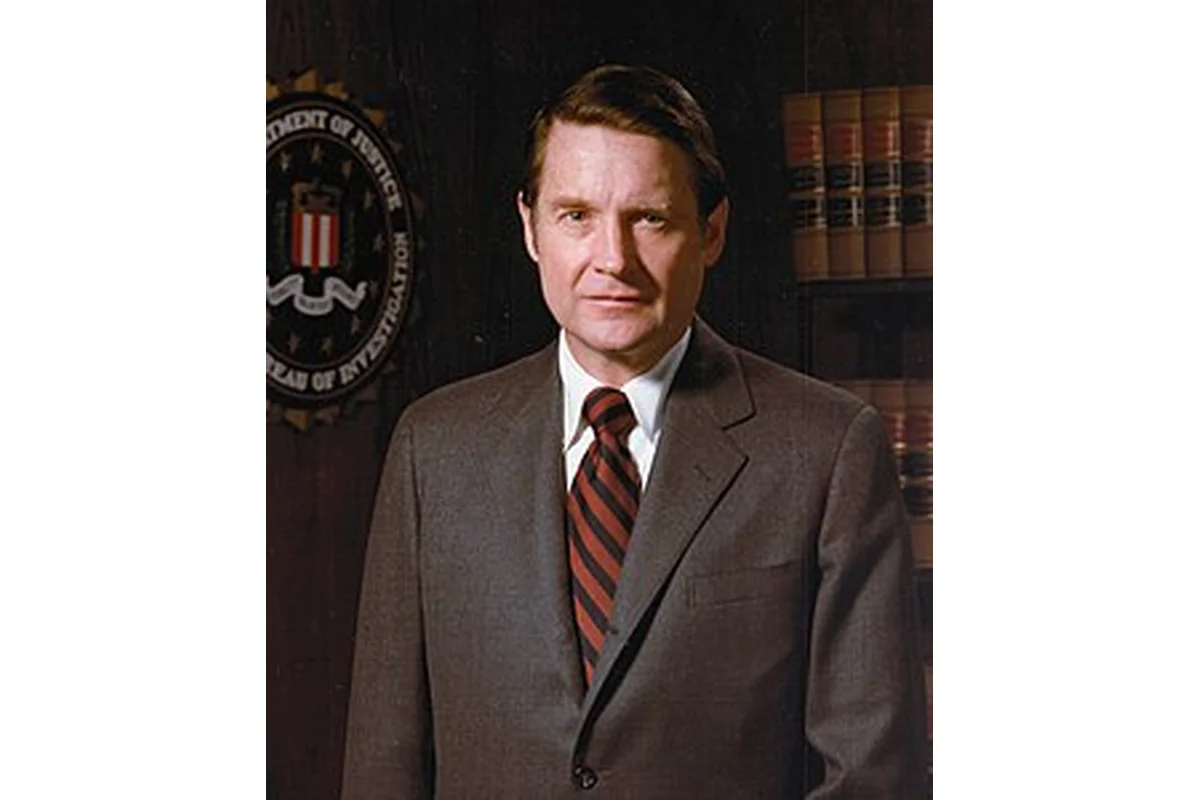
William H. Webster Bio
William Hedgcock Webster (March 6, 1924 – August 8, 2025) was an American attorney, jurist, and public servant whose career spanned more than seven decades. He served as director of the Federal Bureau of Investigation from 1978 to 1987 and as director of Central Intelligence from 1987 to 1991, making him the only person in U.S. history to lead both agencies. A Republican and a Navy veteran of World War II and the Korean War, Webster earned a national reputation for integrity and steady leadership in times of crisis.
Earlier in his career, Webster served as a United States district judge for the Eastern District of Missouri and as a circuit judge on the United States Court of Appeals for the Eighth Circuit. He later chaired the Homeland Security Advisory Council from 2005 to 2020 and became the first chairman of the Public Company Accounting Oversight Board in 2002. Webster received numerous honors, including the Presidential Medal of Freedom, and was widely regarded as one of the most respected public servants of his generation.
Early Life and Background
William Hedgcock Webster was born on March 6, 1924, in St. Louis, Missouri. He was the son of Thomas Milliken Webster and Katherine Hedgcock, and he received his early education in Webster Groves, Missouri. Growing up in a stable Midwestern family during the interwar years, Webster developed the disciplined habits and civic-minded outlook that would shape his future career.
He served as a lieutenant in the United States Navy during World War II, an experience that exposed him to leadership and global affairs at a young age. Following his wartime service, Webster attended Amherst College in Amherst, Massachusetts, where he earned a Bachelor of Arts degree in 1947. While at Amherst, he joined the Psi Upsilon fraternity and continued to build the scholarly and leadership foundation that would carry him into public life.
Webster then pursued legal studies at the Washington University School of Law in St. Louis, earning his Juris Doctor in 1949. After law school, he returned to military service during the Korean War, serving in the Navy once again. These combined experiences in the military, the courtroom, and the classroom prepared him for a long and distinguished career in law and government.
Path to U.S. Politics and Public Service
After completing his second tour in the Navy, Webster joined the St. Louis law firm Armstrong Teasdale, where he built a strong reputation as a practicing attorney. He did not remain in private practice for long, however, choosing instead to devote his career to public service. In 1960, he was named United States Attorney for the Eastern District of Missouri, a position he held until 1961, and he subsequently served on the Missouri Board of Law Examiners from 1964 to 1969.
Webster’s path to the federal bench began in 1970, when President Richard Nixon nominated him to the United States District Court for the Eastern District of Missouri. He was confirmed by the United States Senate and received his commission that same year, beginning a federal judicial career that would steadily expand. In 1973, Nixon elevated him to the United States Court of Appeals for the Eighth Circuit, where he served with distinction and was later described by Attorney General Edward H. Levi as a competent, energetic, and intelligent judge.
When Supreme Court Justice William O. Douglas retired in 1975, Webster was on Levi’s final shortlist from which President Gerald Ford chose a successor. Although Ford ultimately selected John Paul Stevens, Webster’s inclusion on the list reflected the high regard in which he was held within the legal establishment. His combined record as a federal judge, former U.S. Attorney, and trusted public servant set the stage for his appointment as director of the FBI in 1978.
William H. Webster Career
Federal Judicial Service (1970–1978)
Webster’s federal judicial career began in December 1970, when he was confirmed to the United States District Court for the Eastern District of Missouri. He served on the district court for nearly three years, handling a wide range of federal cases and earning a reputation for fairness and preparation. His early performance on the bench drew the attention of senior officials in the Nixon administration.
In June 1973, President Nixon nominated Webster to a seat on the United States Court of Appeals for the Eighth Circuit, vacated by Judge Marion Charles Matthes. He was confirmed by the Senate in July 1973 and served on the appellate court until February 1978. During his time on the Eighth Circuit, Webster was widely respected for his clear writing, careful reasoning, and steady temperament, qualities that later made him a leading candidate for the Supreme Court.
Director of the Federal Bureau of Investigation (1978–1987)
In 1978, President Jimmy Carter appointed Webster as director of the Federal Bureau of Investigation, even though Webster was a registered Republican. He assumed the role on February 23, 1978, and went on to lead the FBI for nearly a decade. His tenure included significant reforms to the bureau following the turbulent years of the 1970s, and he worked to restore public confidence in federal law enforcement.
Webster’s leadership of the FBI was marked by professionalism, restraint, and a strong commitment to the rule of law. He presided over a period of major investigative activity, including efforts related to organized crime, domestic terrorism, and foreign intelligence threats. His performance at the FBI drew praise from members of both political parties and positioned him as one of the most respected law enforcement leaders in the country’s history. In popular culture, Webster was later portrayed by actor Sean Cullen in the second season of the Netflix show Mindhunter, which was set during his time as FBI director.
Director of Central Intelligence (1987–1991)
In 1987, President Ronald Reagan appointed Webster as director of the Central Intelligence Agency, making him the only person ever to serve as head of both the FBI and the CIA. He led the CIA from May 26, 1987, until his retirement on August 31, 1991, a tenure of four years and ninety-seven days that ranks as the fifth-longest of the agency’s nineteen directors. His appointment was seen as a continuation of the disciplined, nonpartisan approach he had brought to the FBI.
Webster’s term at the CIA coincided with the end of the Cold War, a period of profound change for American intelligence. He guided the agency through major transitions and was widely credited for maintaining morale and professional standards during a difficult era. After retiring from the CIA in 1991, Webster joined the law firm Milbank, where he focused on arbitration, mediation, and internal investigation work.
Public Company Accounting Oversight Board (2002)
In 2002, Webster became the first chairman of the newly created Public Company Accounting Oversight Board (PCAOB), an organization established to oversee the audits of public companies in the wake of major corporate scandals. His appointment was intended to lend credibility and prestige to the new board. However, his tenure became controversial when it was reported that Webster had previously headed the board audit committee of U.S. Technologies, a company facing accusations of accounting irregularities and fraud.
Webster resigned from the PCAOB less than three weeks after the organization was formally set up. Although his departure was sudden, it did not damage his broader standing in the legal and national security communities, and he soon returned to other forms of public service.
Homeland Security Advisory Council (2005–2020)
From 2005 to 2020, Webster served as chairman of the Homeland Security Advisory Council, where he advised federal officials on a wide range of security and emergency preparedness issues. He also co-chaired the council at various points, helping to shape the federal government’s response to evolving threats. In 2009, he was named to lead an independent investigation of the FBI’s actions surrounding the Fort Hood shooting.
Webster also served as an honorary director on the board of the Atlantic Council, continuing his lifelong engagement with international affairs and national security policy. In the 2020 presidential election, Webster joined more than 130 other former Republican national security officials in signing a statement asserting that President Donald Trump was unfit to serve another term and endorsing Joe Biden. He similarly endorsed Kamala Harris in 2024.
William H. Webster Family
Family Background and Heritage
William Hedgcock Webster was the son of Thomas Milliken Webster and Katherine Hedgcock, and he received his early education in Webster Groves, Missouri, a community closely associated with his family name. His Midwestern upbringing, combined with his parents’ steady guidance, helped shape the disciplined and service-oriented outlook that defined his career. He carried these values into every stage of his professional life, from the Navy to the federal bench and beyond.
Personal Life
Webster married Drusilla Lane in 1950, and the couple remained together for 34 years until her death in 1984. They had three children together. In 1990, Webster married Lynda Clugston, with whom he shared many years of public life and who was with him at their home in Warrenton, Virginia.
In 2015, Webster and Clugston were targeted in a lottery scam conducted by Keniel Aeon Thomas of Jamaica, who threatened them over repeated phone calls and emails. Thomas was later sentenced to nearly six years in prison in early 2019. Webster turned 100 on March 6, 2024, and died at a care facility in Warrenton, Virginia, on August 8, 2025, at the age of 101.