
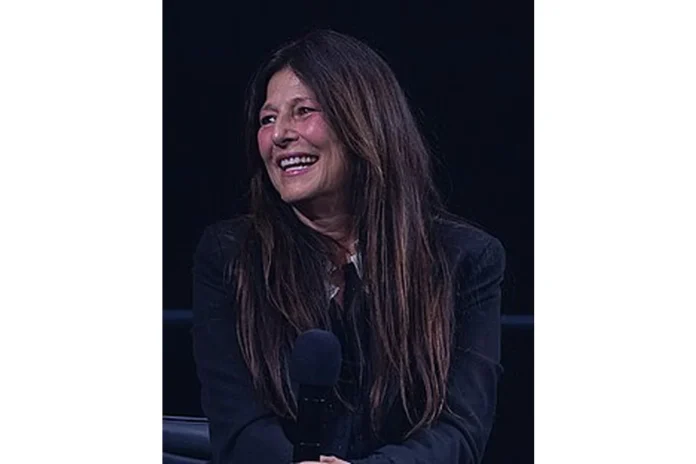
Catherine Keener Bio
Catherine Keener (born March 26, 1959) is an American actress and producer widely recognized for her distinctive portrayals of disgruntled, melancholic, and sympathetic women in independent films. Over a career spanning more than three decades, she has earned a reputation for bringing empathy, nuance, and a fearless quality to complex characters, whether working on intimate indie features or larger studio productions. Her accolades include nominations for two Academy Awards, a British Academy Film Award, two Golden Globe Awards, and a Primetime Emmy Award.
Early Life and Background
Catherine Keener was born on March 26, 1959, in Miami, Florida, to Jim Keener and Evelyn Jamiel Keener. Her father was of Irish descent and her mother is of Lebanese descent, giving Keener a multicultural heritage that shaped her upbringing in the American South. She was raised in nearby Hialeah, Florida, and attended Catholic schools throughout her childhood, including Monsignor Edward Pace High School.
Keener later attended Wheaton College in Norton, Massachusetts, where she majored in American Studies while also enrolling in a theater course. Her first theatrical production was the Wendy Wasserstein play Uncommon Women and Others, performed during her junior year. She graduated from Wheaton College with a Bachelor of Arts degree in 1983, carrying with her the early stage experience that would eventually lead to a professional career in performance.
Path to Acting
After completing her education, Catherine Keener moved into television with a supporting role as Lieutenant Cricket Sideris in the series Ohara, which ran from January 1987 to May 1988. Her first film appearance came a year earlier with a single line in About Last Night… (1986), followed three years later by a part in Survival Quest. These early roles gave her the opportunity to learn the rhythms of on-screen performance and to build the foundation for a longer career in film and television.
Keener soon earned her first starring role in Johnny Suede (1991), starring opposite the then-unknown Brad Pitt. Her performance drew strong critical notice and earned her first Independent Spirit Award nomination for Best Female Lead. She continued to work with director Tom DiCillo in Living in Oblivion (1995) and was nominated again for an Independent Spirit Award for her performance in Walking and Talking (1996), an independent cult-comedy film directed by Nicole Holofcener. These early achievements established her as a respected figure within the growing American independent film scene.
Catherine Keener Career
Early Career (1986-1998)
During the late 1980s and 1990s, Catherine Keener steadily built her reputation through a series of independent films and small but memorable supporting roles. She appeared in the first four films directed by Tom DiCillo, demonstrating an early commitment to collaborative work with emerging filmmakers. She also guest starred on Seinfeld in the episode “The Letter,” playing Jerry’s girlfriend, an artist who painted a famous portrait of Kramer. These appearances helped her refine a screen presence that critics would later describe as grounded, intelligent, and quietly magnetic.
Her performances in Johnny Suede and Walking and Talking brought her Independent Spirit Award nominations and positioned her as a favorite of the independent film community. Directors such as Nicole Holofcener, Tom DiCillo, Spike Jonze, and later Charlie Kaufman sought her out, drawn to her ability to inhabit difficult, complicated women with honesty and dry wit. By the end of the 1990s, she had become a recognizable name among cinephiles and was ready to step into wider recognition.
Breakthrough (1999-2009)
Catherine Keener earned her first Academy Award nomination for Best Supporting Actress for her role in the inventive Spike Jonze comedy Being John Malkovich (1999), a performance that announced her talent to a much broader audience. She continued to collaborate with Nicole Holofcener in Lovely and Amazing (2001), which brought her a third Independent Spirit Award nomination. In 2002, she co-starred with Edward Norton in the off-Broadway revival of Burn This and appeared in films including Death to Smoochy, Full Frontal, and Simone alongside Al Pacino.
In 2005, she took on a wide range of roles, including a Secret Service agent in The Interpreter, a part in The Ballad of Jack and Rose with Daniel Day-Lewis, and the love interest of Steve Carell in Judd Apatow’s The 40-Year-Old Virgin. Her performance as writer Harper Lee in Capote (2005) earned her several awards and nominations, including her second Academy Award nomination for Best Supporting Actress. The following years brought collaborations with Sean Penn in Into the Wild (2007), a starring role in Charlie Kaufman’s directorial debut Synecdoche, New York (2008), and work in Where the Wild Things Are (2009).
Notable Works and Milestones
Among Catherine Keener’s signature works are her Oscar-nominated performances in Being John Malkovich and Capote, both of which remain touchstones of her career. She is regarded as the muse of director Nicole Holofcener, having appeared in each of Holofcener’s first five films, and she has worked with directors including Tom DiCillo, Spike Jonze, and Charlie Kaufman across multiple projects. Her willingness to embrace unusual characters and challenging material has cemented her status as one of the most respected actresses of her generation.
Catherine Keener Award Nominations
Throughout her career, Catherine Keener has earned recognition from major awards organizations, including nominations for two Academy Awards, a British Academy Film Award, two Golden Globe Awards, and a Primetime Emmy Award. Her Oscar nominations both came in the Best Supporting Actress category, while her Emmy nomination recognized her work in television.
Catherine Keener Awards Won
Independent Spirit Award nominations and a steady stream of critical honors have accompanied Catherine Keener’s career, with critics and peers consistently praising her work in independent cinema. Her performances in films such as Johnny Suede, Walking and Talking, and Lovely and Amazing brought repeated recognition from the independent film community.
Catherine Keener Family
Catherine Keener was born to Jim Keener and Evelyn Jamiel Keener. Her father was of Irish descent and her mother is of Lebanese descent. She was raised in Hialeah, Florida, and attended Catholic schools, including Monsignor Edward Pace High School, before going on to study at Wheaton College in Massachusetts.
Personal Life
Catherine Keener met actor Dermot Mulroney in 1987 while working on the film Survival Quest. The couple married in 1990 and have a son, Clyde, born in 1999, who is a singer. Mulroney filed for divorce in June 2007, citing irreconcilable differences, and the divorce became final on December 19, 2007. Keener is widely known for being press-shy and for valuing her privacy.