
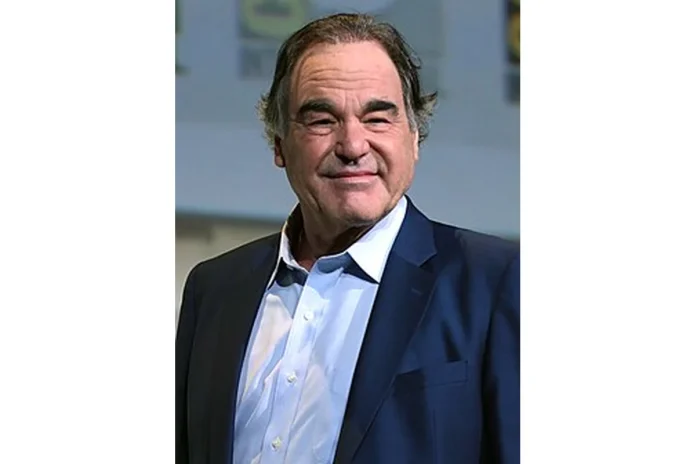
Oliver Stone Bio
William Oliver Stone (born September 15, 1946) is an American filmmaker, screenwriter, producer, and author whose politically charged dramas have left a lasting mark on modern cinema. A Yale University undergraduate and a New York University film graduate, he broke through with Platoon (1986), a Vietnam War epic that earned him the Academy Award for Best Director and Best Picture. Stone followed with provocative studies of power, media, and policy in works such as Wall Street, JFK, Nixon, and Born on the Fourth of July, often blending documentary style with narrative drama. His career spans mainstream thrillers and ambitious documentaries, tackling topics from warfare to Washington politics, while his outspoken views frequently stirred controversy and sparked debates about historical memory, propaganda, and the responsibilities of cinema.
Early Life and Background
William Oliver Stone was born on September 15, 1946, at Doctors Hospital in New York City, the only child of Jacqueline Goddet and Louis Stone. His parents met in Paris during World War II, where his father, a U.S. Army colonel, served as a financial officer on General Eisenhower’s staff. After the war, Louis worked on Wall Street as a stockbroker and eventually became vice president of Shearson Lehman Brothers. Stone’s paternal great-grandparents were Ashkenazi Jewish immigrants from Poland, and the family changed its surname from Silverstein to Stone in the 1920s due to widespread antisemitism. While his American father was Jewish, his French mother was Roman Catholic, though both were non-practicing; Stone was raised in the Episcopal Church and later converted to Buddhism.
Stone grew up in Manhattan and Stamford, Connecticut, attended Trinity School through eighth grade, and was then sent to The Hill School, a college-preparatory boarding school in Pottstown, Pennsylvania. He spoke French as his first language, which made his early school years difficult. His father paid him a quarter each week to write one or two pages on a theme, sparking an early love of writing. Stone often spent summers with his maternal grandparents in France, both in Paris and La Ferté-sous-Jouarre, where he was fascinated by his grandfather’s stories of serving in the French Army during World War I. As a teenager in Paris, he worked as a runner at the Paris Commodities Exchange, an experience that later inspired his film Wall Street.
Path to Celebrity
After graduating from The Hill School in 1964, Stone was admitted to Yale University but left in June 1965 to teach English at the Free Pacific Institute in Saigon. He worked briefly as a merchant seaman in 1966 before returning to Yale, then dropped out again after one semester. During this period, Stone battled severe depression and suicidal ideation, experiences that shaped his later work. In April 1967, he enlisted in the United States Army and requested combat duty in Vietnam, serving with the 25th Infantry Division and later the 1st Cavalry Division. He was wounded in action multiple times and earned a Bronze Star with “V” Device for valor, a Purple Heart with Oak Leaf Cluster, and the Combat Infantryman Badge.
Following the war, Stone attended New York University on the G.I. Bill, graduating with a Bachelor of Fine Arts degree in film in 1971. His teachers at NYU included director Martin Scorsese, in whose class he made a well-received short film about a disabled veteran. Stone worked varied jobs as a taxi driver, PBS production assistant, messenger, and salesman before making his mark as a screenwriter. His first major success came in 1978, when he adapted Billy Hayes’ prison memoir into the screenplay for Midnight Express, directed by Alan Parker, which won the Academy Award for Best Adapted Screenplay.
Oliver Stone Career
Early Career (1971–1979)
During the 1970s, Stone built his reputation primarily as a screenwriter, contributing to projects such as the Brian De Palma drug lord epic Scarface (1983) and Year of the Dragon (1985), co-written with Michael Cimino. He also penned the screenplay for Conan the Barbarian (1982). These scripts established Stone’s voice in Hollywood and his willingness to tackle gritty, controversial subject matter. In 1979, he won his first Academy Award for adapting the true-life prison story Midnight Express.
While studying at NYU, Stone had a small acting role in the comedy The Battle of Love’s Return. He also worked in various behind-the-scenes roles, gradually building the industry connections that would support his eventual transition to directing. His experiences during this decade, combined with the lingering effects of his Vietnam service, gave his writing a distinctive urgency and moral intensity.
Breakthrough (1980–1989)
Stone’s career as a writer-director began in earnest in 1986, when he directed two films back to back: the critically acclaimed Salvador, shot largely in Mexico, and his long-in-development Vietnam project Platoon, shot in the Philippines. Platoon won rave reviews from critics including Roger Ebert, who named it the best film of 1986. It earned Academy Awards for Best Picture and Best Director and was later selected by the Library of Congress for preservation in the United States National Film Registry. In 2007, the American Film Institute ranked it at number 83 in a poll of the previous century’s best American movies.
Following the success of Platoon, Stone directed Wall Street in 1987, starring Charlie Sheen and Michael Douglas, who won the Academy Award for Best Actor for his portrayal of corporate raider Gordon Gekko. In 1989, he co-wrote and directed Born on the Fourth of July, based on the autobiography of Ron Kovic, which received eight Academy Award nominations and earned Stone his second Best Director Oscar. At the 47th Golden Globes, he became the first filmmaker to win Best Director, Best Screenplay, and Best Picture for the same film.
Notable Works and Milestones
Among Stone’s signature works are the political dramas JFK (1991), which earned eight Academy Award nominations and inspired the President John F. Kennedy Assassination Records Collection Act of 1992, and Nixon (1995), which received Oscar nominations for its script, score, and the performances of Joan Allen and Anthony Hopkins. He also directed the musical biopic The Doors (1991), the satirical crime film Natural Born Killers (1994), the biographical drama Alexander (2004), the September 11 tribute World Trade Center (2006), the George W. Bush biopic W. (2008), and the Edward Snowden biopic Snowden (2016). His films have collectively grossed more than $1.3 billion worldwide.
Oliver Stone Award Nominations
Throughout his career, Oliver Stone has received numerous award nominations across major industry ceremonies. Born on the Fourth of July earned him eight Academy Award nominations, including Best Picture and Best Director, and multiple Golden Globe nominations. JFK also received eight Academy Award nominations, including Best Picture and Best Director, while Nixon received four Academy Award nominations, including recognition for its screenplay, score, and the performances of its lead actors. Stone has additionally received multiple Golden Globe, BAFTA, and Independent Spirit Award nominations for his directorial and writing work across decades of filmmaking.
Oliver Stone Awards Won
Oliver Stone has won three Academy Awards: Best Adapted Screenplay for Midnight Express (1978), and Best Director for both Platoon (1986) and Born on the Fourth of July (1989). Platoon additionally won the Academy Award for Best Picture. He has also won a BAFTA Award, a Primetime Emmy Award for Outstanding Television Movie as executive producer of Indictment: The McMartin Trial, three Independent Spirit Awards, and six Golden Globe Awards. At the Venice Film Festival, Natural Born Killers received the Grand Special Jury Prize.
| Award | Wins | Year |
|---|---|---|
| Academy Award for Best Adapted Screenplay (Midnight Express) | 1 | 1978 |
| Academy Award for Best Director (Platoon) | 1 | 1986 |
| Academy Award for Best Picture (Platoon, as producer) | 1 | 1986 |
| Academy Award for Best Director (Born on the Fourth of July) | 1 | 1989 |
| Primetime Emmy Award for Outstanding Television Movie (Indictment: The McMartin Trial) | 1 | 1995 |
Oliver Stone Family
Oliver Stone was the only child of Louis Stone, a U.S. Army colonel and Wall Street stockbroker, and Jacqueline Goddet, a French woman from Paris. His paternal great-grandparents were Ashkenazi Jewish immigrants from Poland, and the family changed its surname from Silverstein to Stone in the 1920s. Stone’s aunt was author and editor Babette Rosmond, and his cousins include writer Gene Stone and former chairman of the U.S. Commodity Futures Trading Commission James Stone. His parents divorced in 1962, and following a court ruling, his father was granted sole custody.
Personal Life
Stone has been married three times: first to Najwa Sarkis Stone, a United Nations protocol attache, from 1971 to 1977; then to Elizabeth Burkit Cox, an assistant in film production, from 1981 to 1993; and since 1996 to Sun-jung Jung, a Korean-born woman he credits as his opposite politically, culturally, and spiritually. With Elizabeth Burkit Cox, he had two sons, Sean (born 1984) and Michael Jack (born 1991). With Sun-jung Jung, he has a daughter, Tara Chong Stone (born 1995). All three of his children had cameos in his films, with Any Given Sunday being the only feature to include all three. Stone and his family live in Los Angeles, and he holds dual U.S. and French citizenship.