
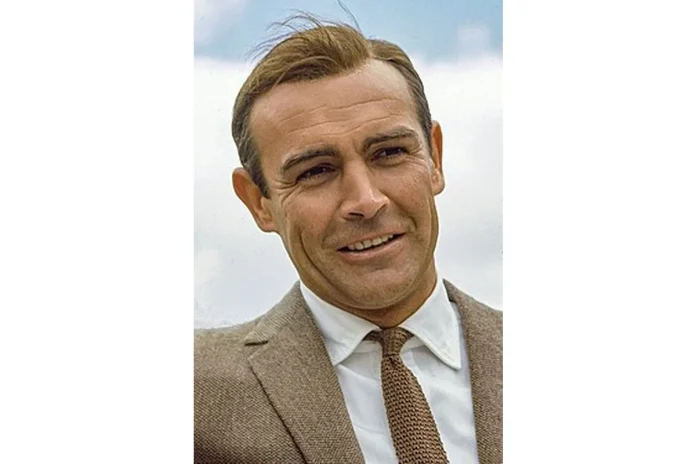
Sean Connery Bio
Sir Thomas Sean Connery (25 August 1930 – 31 October 2020) was a Scottish actor and producer whose career reshaped the modern action film. He was the first actor to portray the fictional British secret agent James Bond in motion pictures, starring in seven Bond films between 1962 and 1983. Connery is also known for his work with directors such as Alfred Hitchcock, Sidney Lumet, and John Huston, appearing in films like Marnie, The Hill, and The Man Who Would Be King. He received numerous accolades throughout his career including an Academy Award for Best Supporting Actor for his role in The Untouchables. Connery was also awarded a knighthood by Queen Elizabeth II in 2000 for his services to drama.
Early Life and Background
Thomas Sean Connery was born at the Royal Maternity Hospital in Edinburgh, Scotland, on 25 August 1930, and was named after his paternal grandfather. Connery was of half-Irish and half-Scottish descent and was raised at No. 176 Fountainbridge, a block that has since been demolished. His mother, Euphemia McBain McLean, was a cleaning woman, while his father, Joseph Connery, worked as a factory worker and lorry driver. The family had deep roots in Scotland, with his maternal great-grandparents being native Scottish Gaelic-speakers from Fife and Uig on Skye.
Connery grew up with a younger brother, Neil, and was generally referred to in his youth as Tommy. Although small in primary school, he grew rapidly around the age of 12, reaching his full adult height of 6 feet 2 inches (188 cm) by 18. He became known during his teen years as Big Tam. His first job was as a milkman in Edinburgh with St. Cuthbert’s Co-operative Society, and he later worked as a lorry driver, a lifeguard, a labourer, and an artist’s model for the Edinburgh College of Art. In 1946, at the age of 16, he joined the Royal Navy, where he acquired two tattoos reading Mum and Dad and Scotland Forever, and was eventually discharged at 19 for a duodenal ulcer.
Path to Acting
Connery began bodybuilding at the age of 18 and competed in the Mr. Universe contest in the early 1950s. He was also a keen footballer, having played for Bonnyrigg Rose in his younger days, and was reportedly offered a trial with East Fife. His entry into the entertainment world came in late 1951, when he helped out backstage at the King’s Theatre in Edinburgh to supplement his income. During a 1953 bodybuilding competition in London, Connery learned of auditions for a production of South Pacific, landing a small part as one of the Seabees chorus boys. By the time the production reached Edinburgh, he had been promoted to the role of Lieutenant Buzz Adams.
During a 1954 Manchester production of South Pacific, Connery developed a serious interest in theatre through the American actor Robert Henderson, who lent him works by Henrik Ibsen, Proust, Tolstoy, and Shakespeare, and urged him to take elocution lessons. Connery had already begun his film career as an extra in Herbert Wilcox’s 1954 musical Lilacs in the Spring with Errol Flynn. He went on to take roles in BBC Television productions including a 1957 adaptation of Requiem for a Heavyweight, which marked his first leading role on screen. His early film work included Hell Drivers (1957), Action of the Tiger (1957), and a major role opposite Lana Turner in Another Time, Another Place (1958).
Sean Connery Career
Early Career (1951–1959)
Connery’s earliest notable work came in small television and film roles throughout the 1950s. He appeared in theatrical productions including Witness for the Prosecution at the Q Theatre and Eugene O’Neill’s Anna Christie at the Oxford Playhouse, where he built a reputation as a serious stage actor. In 1959, Connery landed a leading role in Walt Disney Productions’ Darby O’Gill and the Little People, starring alongside Albert Sharpe, Janet Munro, and Jimmy O’Dea in a tale of an Irishman and his battle of wits with leprechauns. He also had prominent television roles in BBC Television’s An Age of Kings, a major adaptation of Shakespeare’s Henriad in which he played Hotspur, and a 1961 CBC television adaptation of Macbeth with Zoe Caldwell as Lady Macbeth.
Breakthrough (1962–1983)
Connery’s breakthrough came in the role of James Bond. Initially reluctant to commit to a film series, he ultimately starred in seven Bond films between 1962 and 1983, beginning with Dr. No (1962) and continuing with From Russia with Love (1963), Goldfinger (1964), Thunderball (1965), You Only Live Twice (1967), and Diamonds Are Forever (1971), all produced by Eon Productions. His final appearance as Bond came with the non-Eon-produced Never Say Never Again (1983). The line Bond, James Bond, delivered in Dr. No, became a permanent fixture in Western popular culture, and the American Film Institute selected Connery’s portrayal of Bond as the third-greatest hero in cinema history.
While making the Bond films, Connery also pursued more serious dramatic work. He starred opposite Tippi Hedren in Alfred Hitchcock’s Marnie (1964) and in Sidney Lumet’s The Hill (1965), a critical success that debuted at the Cannes Film Festival and won the Best Screenplay award. In 1975, he appeared in John Huston’s The Man Who Would Be King opposite Michael Caine, a film both actors regarded as their favourite. He also took ensemble roles in Murder on the Orient Express (1974) and Richard Attenborough’s war epic A Bridge Too Far (1977), and played Robin Hood opposite Audrey Hepburn in Robin and Marian (1976).
In 1986, Connery starred in the European production The Name of the Rose, for which he won the BAFTA Award for Best Actor, and appeared in Highlander, showcasing his ability to play older mentors to younger leads. The following year, he starred in Brian De Palma’s The Untouchables (1987), playing a hard-nosed Irish-American cop alongside Kevin Costner’s Eliot Ness. Connery’s performance in The Untouchables earned him the Academy Award for Best Supporting Actor, making him the first Scottish actor to win a major Oscar, as well as the Golden Globe Award for Best Supporting Actor.
Notable Works and Milestones
Connery’s signature work remains his portrayal of James Bond, a role that defined a generation of action cinema and made him a global icon. He received the Academy Award for Best Supporting Actor for The Untouchables (1987), as well as the Golden Globe for the same role and a BAFTA Award for Best Actor for The Name of the Rose (1986). In 1998, he received the BAFTA Fellowship, and in 1999, he was honoured with the Kennedy Center Honors. He was also awarded a knighthood by Queen Elizabeth II in 2000 and received the American Film Institute’s Lifetime Achievement Award in 2006.
Sean Connery Award Nominations
Throughout his career, Sean Connery received numerous award nominations in recognition of his work in film. He was nominated for BAFTA Awards for his performances in The Untouchables (1987) and Indiana Jones and the Last Crusade (1989), and received Golden Globe nominations for the latter as well. Connery was also widely honoured for his contributions to cinema through honorary nominations and recognitions from major institutions across the world, including the Cecil B. DeMille Award in 1987 and the Kennedy Center Honors in 1999.
Sean Connery Awards Won
Sean Connery won many of the entertainment industry’s most prestigious honours during his career. For his performance in The Untouchables (1987), he won the Academy Award for Best Supporting Actor and the Golden Globe Award for Best Supporting Actor. The same year, he won the BAFTA Award for Best Actor in a Leading Role for The Name of the Rose (1986). In 1998, Connery won the Tony Award for Best Play as producer of Art, and he also received the BAFTA Fellowship, a lifetime achievement honour from the British Academy of Film and Television Arts. He was knighted by Queen Elizabeth II in the 2000 New Year Honours for his services to drama.
Sean Connery Family
Sean Connery was the son of Joseph Connery, a factory worker and lorry driver, and Euphemia McBain McLean, a cleaning woman. He had a younger brother, Neil Connery. Connery was married to the Australian actress Diane Cilento from 1962 to 1973, and together they had a son, the actor Jason Connery. In 1975, he married the French-Moroccan painter Micheline Roquebrune, and the couple remained together until Connery’s death in 2020. The family spent much of their later life at their home in the Lyford Cay community of Nassau in the Bahamas, where Connery died in his sleep on 31 October 2020, at the age of 90.
Personal Life
Connery’s personal life was marked by his long marriage to Micheline Roquebrune, which lasted from 1975 until his death. Earlier, he had been married to Diane Cilento from 1962 to 1973, with the couple separating in 1971. Connery was the father of one son, Jason Connery, who also became an actor. A keen golfer, Connery was introduced to the game by his friend Iain Stewart and even received lessons from the English professional golfer Peter Alliss before filming the golf scene in Goldfinger (1964). In his later years, he relocated to the Bahamas in the 1990s, where he owned a mansion in the Lyford Cay community on New Providence. He passed away in his sleep on 31 October 2020, at the age of 90, with his family later revealing he had suffered from dementia in his final years.