

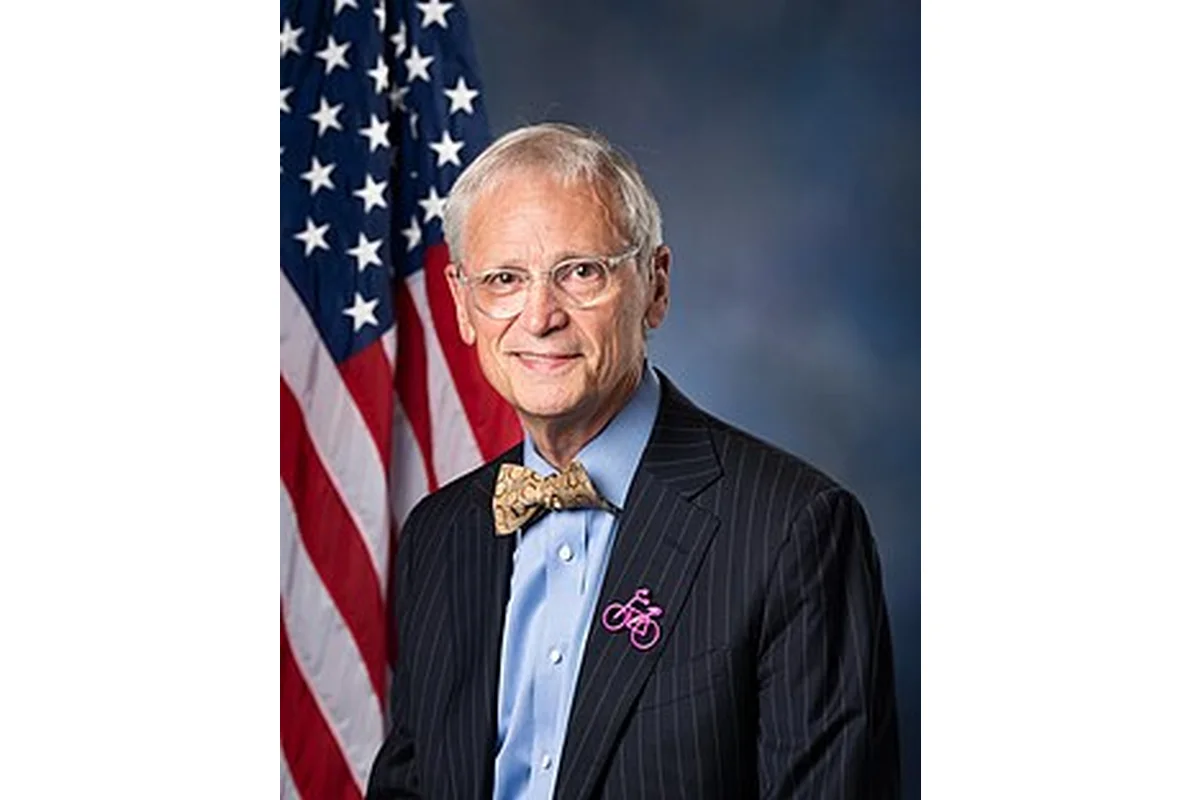
Earl Blumenauer Bio
Earl Francis Blumenauer is an American lawyer, author, and politician best known for his nearly three decades of service in the United States House of Representatives. A member of the Democratic Party, he represented Oregon’s 3rd congressional district from 1996 to 2025, focusing much of his work on transportation, environmental, and agricultural policy. Since January 2025, he has served as a senior fellow at Portland State University and as a special advisor to university president Ann Cudd.
Before his time in Congress, Blumenauer spent more than two decades in local and state government in Oregon, including service on the Portland City Council. He is widely recognized for his distinctive bow ties and neon bicycle lapel pins, and he founded the Congressional Bike Caucus. His career has combined legal training, public service, and a long-standing commitment to livable communities and sustainable infrastructure.
Early Life and Background
Earl Francis Blumenauer was born in Portland, Oregon, on August 16, 1948. He grew up in the same city he would later represent in Congress, attending Centennial High School on Portland’s east side and graduating in 1966. His upbringing in Portland helped shape his early interest in civic life and public policy.
After high school, Blumenauer enrolled at Lewis & Clark College, where he majored in political science and earned a Bachelor of Arts degree in 1970. Before starting law school, he worked as an assistant to the president of Portland State University from 1970 until 1977. He continued his education at the same institution’s law school, completing a Juris Doctor degree in 1976 from what is now known as Lewis & Clark Law School.
Path to U.S. Politics
Blumenauer’s path to politics began in 1969 and 1970, when he organized and led Oregon’s “Go 19” campaign, an effort to lower the state voting age. Although the campaign was not immediately successful, it supported the broader national movement that led to the Twenty-sixth Amendment to the United States Constitution, which lowered the voting age to 18.
In 1972, he was elected to the Oregon House of Representatives, representing the 11th district in Multnomah County, and he was reelected in 1974 and 1976. He continued serving in the Oregon legislature until the 1979 session, and from 1975 to 1981 he also served on the board of Portland Community College. After his time in the state legislature, he served on the Multnomah County Commission from 1979 to 1986. He lost a race for the Portland City Council in 1981, but returned to win a council seat in 1986, beginning a long career in Portland city government.
Earl Blumenauer Career
Early Career (1972–1996)
Blumenauer’s early career was rooted in Oregon state and local government. After his years in the Oregon House of Representatives, he served on the Multnomah County Commission, gaining experience in regional policy. In 1992, he ran for mayor of Portland but was defeated by Vera Katz, in what was, at that time, only the second election he had lost.
He returned to the Portland City Council in 1986 and remained there until 1996. From the start of his first term, he was named Commissioner of Public Works, putting him in charge of the Portland Bureau of Transportation. In 1990 and 1991, Oregon Governor Neil Goldschmidt also appointed him to the state’s commission on higher education, expanding his influence on education policy.
U.S. House of Representatives Breakthrough (1996–Present)
Blumenauer was elected to the United States House of Representatives in 1996 in a special election to fill the vacancy caused by the election of Ron Wyden to the U.S. Senate. He received 69 percent of the vote, defeating Republican Mark Brunelle, and was elected to a full term that November. He went on to win reelection ten times in what has long been Oregon’s most Democratic district, never receiving less than 66 percent of the vote.
In Congress, he became known for his advocacy of mass transit, supporting projects like Portland’s MAX Light Rail and the Portland Streetcar. A strong supporter of bicycle commuting, he founded and co-chaired the Congressional Bike Caucus and was often seen cycling to the Capitol and even to the White House for meetings. Among the bills he sponsored that became law were the Bunning-Bereuter-Blumenauer Flood Insurance Reform Act of 2004, the Senator Paul Simon Water for the Poor Act of 2005, the Legal Timber Protection Act (passed as part of the 2008 Farm Bill), and the Bicycle Commuter Act (passed with the 2008 bailout bill).
He also played roles in foreign policy, human rights, and trade issues, supporting free trade agreements with several countries while drawing criticism from some labor and environmental groups. He pressured the United States to take stronger action during the Darfur conflict and was active in the political response to Hurricane Katrina. In more recent years, he voted to provide Israel with support following the October 7 attacks and, during the 117th Congress, voted with President Joe Biden’s stated position 99.1 percent of the time, according to a FiveThirtyEight analysis.
Post-Congress Era (2025–Present)
On October 30, 2023, Blumenauer announced he would not run for reelection in 2024, paving the way for the end of his long congressional career. After his term concluded, he joined Portland State University as a senior fellow and special advisor to university president Ann Cudd, beginning the role on January 3, 2025. He also serves as a Presidential Fellow of the Institute of Portland Metropolitan Studies.
His policy interests have continued to focus on agricultural reform, alternative proteins, animal welfare, and environmental sustainability. In April 2021, he led a letter by 20 members of Congress requesting $100 million in funding for alternative proteins research and development. He also co-chaired the Congressional Animal Protection Caucus and has long pushed for stronger federal protections for farm animal welfare.
Notable Events and Milestones
One of the most discussed moments of Blumenauer’s career came during the 2009 health care reform debate, when he sponsored an amendment that would have required Medicare to cover end-of-life counseling. The proposal generated significant controversy after some conservative figures, including former Alaska Governor Sarah Palin, claimed it could lead to “death panels.” Blumenauer called the claim “mind-numbing” and an “all-time low,” and his criticism was echoed by Republican Senator Johnny Isakson of Georgia. In 2019, he was one of the first lawmakers to publicly support the Green New Deal, and in 2020 he was named a candidate for Secretary of Transportation in the incoming Biden administration, though Pete Buttigieg was ultimately chosen. In 2010, he received the Ralph Lowell Award for outstanding contributions to public television.
Earl Blumenauer Career Wins
Over a career that has spanned more than five decades, Earl Blumenauer has built a long record of electoral success, policy achievement, and public recognition. From his early elections in the Oregon House of Representatives to his repeated landslides in Congress, he has been a consistent voice for progressive causes in the Pacific Northwest.
U.S. House of Representatives Highlights
Blumenauer served 11 terms in the U.S. House of Representatives, winning his first special election in 1996 with 69 percent of the vote and going on to win ten subsequent reelection campaigns without serious difficulty. He never received less than 66 percent of the vote in his solidly Democratic district, a record that reflects both his personal popularity and the political makeup of Oregon’s 3rd congressional district.
Other Wins & Achievements
Beyond his congressional victories, Blumenauer earned a Juris Doctor degree, served on the board of Portland Community College, led Oregon’s “Go 19” voting age campaign, and spent nearly a decade on the Portland City Council. He also received the Ralph Lowell Award in 2010 in recognition of his contributions to public television. His influence has been especially strong in the areas of bicycle infrastructure, agricultural reform, and animal welfare legislation.
Earl Blumenauer Family
Family Background and Personal Life
Earl Blumenauer was born and raised in Portland, Oregon, the city that would later define much of his political career. He married Margaret Kirkpatrick in 2004, and the couple has made their home in Portland, Oregon, United States.
Personal Life
An avid cyclist, Blumenauer founded and co-chaired the Congressional Bike Caucus, a reflection of his long-standing personal commitment to bicycle advocacy. Each year, in the weeks leading up to Christmas, he bakes and delivers hundreds of fruitcakes to his colleagues on Capitol Hill, a personal tradition that has become a small holiday ritual in Washington, D.C.