

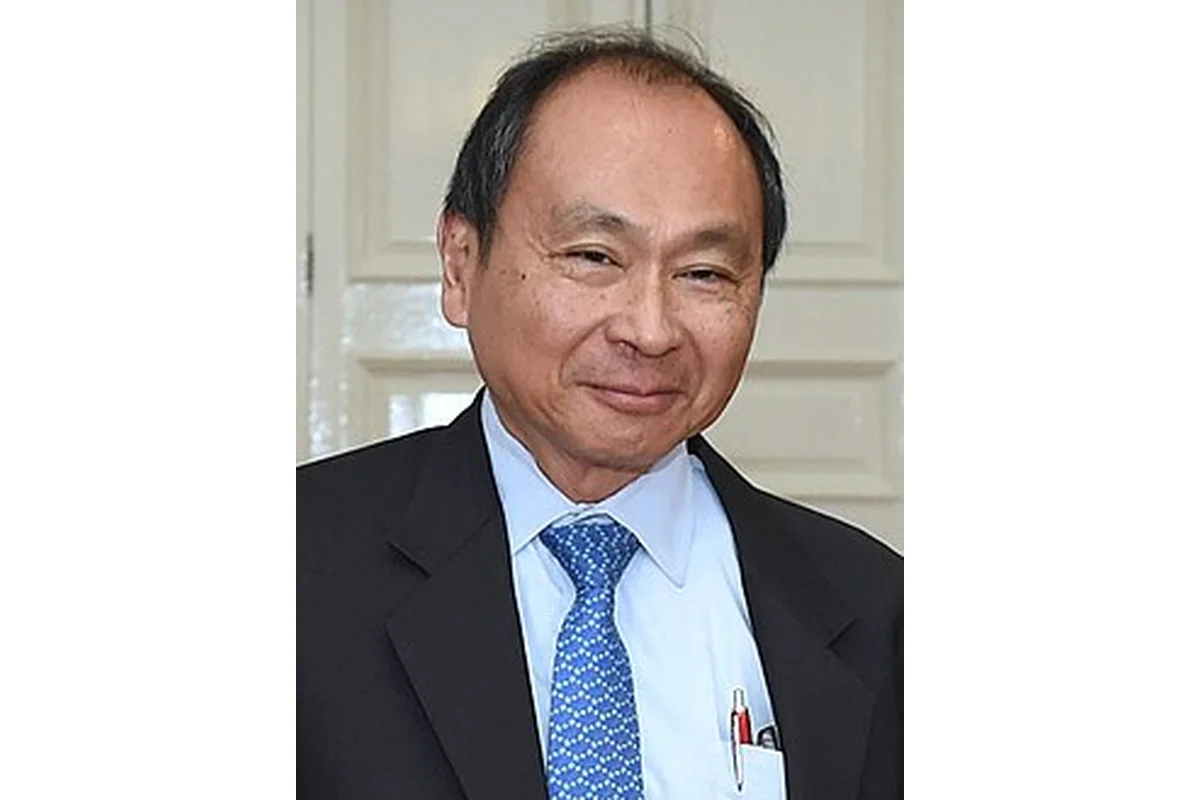
Francis Fukuyama Bio
Francis Yoshihiro Fukuyama (born October 27, 1952) is an American political scientist, political economist, and author best known for his 1992 book The End of History and the Last Man, which argued that liberal democracy and market capitalism may represent the culminating form of human government. Over a career spanning more than four decades, Fukuyama has held research and academic posts at the RAND Corporation, the Paul H. Nitze School of Advanced International Studies at Johns Hopkins University, George Mason University, and Stanford University, where he directs programs on democracy, development, and the rule of law. He has written widely on political development, state-building, governance, and identity politics, and remains one of the most widely cited public intellectuals in the field of comparative politics.
Early Life and Background
Francis Yoshihiro Fukuyama was born in the Hyde Park neighborhood of Chicago, Illinois. His paternal grandfather fled the Russo-Japanese War in 1905 and started a shop on the west coast before being incarcerated during World War II. His father, Yoshio Fukuyama, a second-generation Japanese American, was trained as a minister in the Congregational Church, received a doctorate in sociology from the University of Chicago, and taught religious studies. His mother, Toshiko Kawata Fukuyama, was born in Kyoto, Japan, and was the daughter of Shiro Kawata, founder of the Economics Department of Kyoto University and first president of Osaka City University.
Francis, whose Japanese name is Yoshihiro, grew up in Manhattan as an only child, had little contact with Japanese culture, and did not learn Japanese. In 1967, his family moved to State College, Pennsylvania, where he spent his later teenage years. His upbringing in academic and religious environments shaped his later interests in political philosophy and comparative governance.
Path to Political Science
Fukuyama received his Bachelor of Arts degree in classics from Cornell University, where he studied political philosophy under Allan Bloom. He initially pursued graduate studies in comparative literature at Yale University, going to Paris for six months to study under Roland Barthes and Jacques Derrida; however, he became disillusioned and switched to political science at Harvard University. There, he studied with Samuel P. Huntington and Harvey Mansfield, among others, and earned his Ph.D. in political science from Harvard for his thesis on Soviet threats to intervene in the Middle East.
In 1979, he joined the RAND Corporation, the global policy think tank, beginning a long career bridging scholarly research and policy analysis. This early exposure to defense and security analysis gave him practical insight into statecraft, which he would later combine with broad historical arguments about democracy and development.
Francis Fukuyama Career
Early Career (1979–1989)
During his years at the RAND Corporation, Fukuyama worked within the Political Science Department and contributed to policy debates of the early 1980s. His proximity to defense planning helped frame his later interest in how political institutions evolve and how states build effective bureaucracies. While at RAND, he began writing on themes that would lead to his breakthrough essay.
In the summer of 1989, Fukuyama published the article “The End of History?” in The National Interest, arguing that the worldwide spread of liberal democracies and free-market capitalism may represent the final step in humanity’s sociocultural evolution. The article drew immediate attention and set the stage for his first major book.
The End of History and the Last Man (1992–1999)
In 1992, Fukuyama expanded his essay into the book The End of History and the Last Man, which became an international bestseller and a touchstone of post-Cold War debate. He argued that the progression of human history as a struggle between ideologies was largely at an end, with the world settling on liberal democracy after the fall of the Berlin Wall in 1989. Critics, including Ralf Dahrendorf and Luciano Canfora, challenged the thesis, yet the work secured Fukuyama’s place as a major public intellectual.
Following the book’s success, Fukuyama continued to publish influential works, including Trust: The Social Virtues and the Creation of Prosperity and Our Posthuman Future: Consequences of the Biotechnology Revolution. In the latter, he qualified his original “end of history” thesis by warning that biotechnology could alter human nature and put liberal democracy at risk. He also taught as the Omer L. and Nancy Hirst Professor of Public Policy at George Mason University from 1996 to 2000, deepening his engagement with questions of governance.
Johns Hopkins and Neoconservative Debates (2000–2010)
Until July 2010, Fukuyama served as the Bernard L. Schwartz Professor of International Political Economy and Director of the International Development Program at the Paul H. Nitze School of Advanced International Studies of Johns Hopkins University in Washington, D.C. During this period he became an important figure in the rise of neoconservatism, contributing to the Reagan Administration’s formulation of the Reagan Doctrine and later co-signing a 1998 letter associated with the Project for the New American Century.
By mid-2004, Fukuyama had begun to distance himself from the neoconservative agenda of the Bush administration, citing its excessive militarism and embrace of unilateral armed intervention, particularly in the Middle East. He opposed the Iraq War and called for the resignation of Secretary of Defense Donald Rumsfeld. In 2006, he published America at the Crossroads, outlining his rationale for supporting the Bush administration and where he believed it was going wrong, and called for a “realistic Wilsonianism” that better matches American means to American ends.
Stanford University Era (2010–Present)
Since July 2010, Fukuyama has served as a senior fellow at the Freeman Spogli Institute for International Studies and the Mosbacher Director of the Center on Democracy, Development and the Rule of Law at Stanford University. In August 2019, he was named director of the Ford Dorsey Master’s in International Policy at Stanford. He also serves as a council member of the International Forum for Democratic Studies, founded by the National Endowment for Democracy, and is one of twenty-five leading figures on the Information and Democracy Commission launched by Reporters Without Borders.
At Stanford, Fukuyama published The Origins of Political Order in 2011 and Political Order and Political Decay in 2014, both developing a comparative theory of stable political systems built on a modern state, the rule of law, and accountability. In 2018 he published Identity: The Demand for Dignity and the Politics of Resentment, followed in 2022 by Liberalism and Its Discontents, in which he defended liberalism from critics on both the populist right and the progressive left. In 2020, he became chair of the editorial board of American Purpose, a magazine promoting liberal democracy.
Notable Events and Milestones
Fukuyama’s signature contribution remains the thesis of The End of History and the Last Man, which framed post-Cold War debates on democracy and capitalism. He endorsed Barack Obama in the 2008 presidential election, and he has continued to weigh in on major elections, including describing Joe Biden’s 2020 victory as evidence of the Western system’s ability to correct mistakes. In 2022, following Russia’s invasion of Ukraine, Fukuyama argued in American Purpose and Foreign Affairs for reconciling the nation-state with liberal universalism, and in 2023 he met with a delegation from the Azov Brigade at Stanford, expressing support for Ukraine.
Francis Fukuyama Family
Family Background and Lineage
Fukuyama’s paternal grandfather fled the Russo-Japanese War in 1905 and started a shop on the west coast before being incarcerated during World War II. His father, Yoshio Fukuyama, a second-generation Japanese American, was trained as a minister in the Congregational Church, received a doctorate in sociology from the University of Chicago, and taught religious studies. His mother, Toshiko Kawata Fukuyama, was born in Kyoto, Japan, and was the daughter of Shiro Kawata, founder of the Economics Department of Kyoto University and first president of Osaka City University. Francis Fukuyama is also the first cousin of crime novelist Joe Ide, whose first book he helped get published.
Personal Life
Fukuyama is married to Laura Holmgren, whom he met when she was a University of California, Los Angeles graduate student after he started working for the RAND Corporation. He dedicated his book Trust: The Social Virtues and the Creation of Prosperity to her. The couple lives in California with their three children, Julia, David, and John. Outside of his academic work, Fukuyama is a part-time photographer with an interest in early American furniture, which he reproduces by hand, and since the mid-1990s he has built his own personal computers as a hobby.