
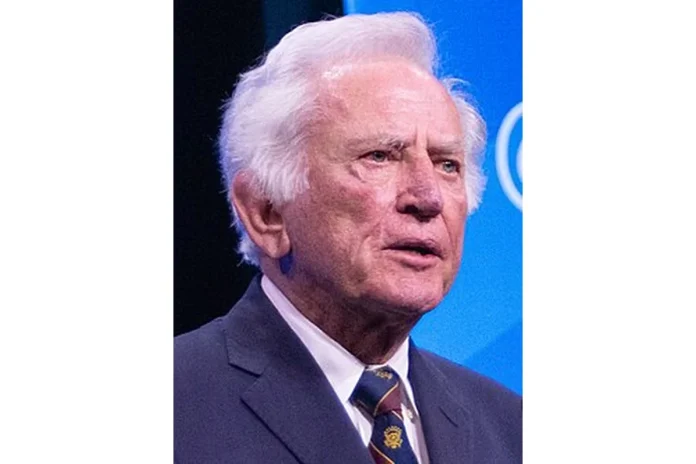
Gary Hart Bio
Gary Warren Hart, born on November 28, 1936, in Ottawa, Kansas, is an American politician, diplomat, and lawyer who represented Colorado in the United States Senate from 1975 to 1987. A member of the Democratic Party, Hart became nationally known as a leading candidate for the party’s presidential nomination in both 1984 and 1988, ultimately leaving the Senate to pursue the presidency. After his political campaigns, he built a long career in public policy, national security, and international diplomacy, including service as the United States Special Envoy for Northern Ireland.
Beyond politics, Hart earned advanced degrees from Yale and the University of Oxford, taught at several major universities, and authored books on American history and political thrillers. His career has spanned law, electoral politics, presidential campaigning, advisory work on homeland security, and international peacemaking, making him one of the most recognizable Democratic figures of the late twentieth century.
Early Life and Background
Gary Warren Hart was born in Ottawa, Kansas, the son of Nina Hartpence, née Pritchard, and Carl Riley Hartpence, a farm equipment salesman. As a young man, he worked as a laborer on the railroad, an experience that shaped his early understanding of working-class life in the American heartland. He and his father legally changed their last name from Hartpence to Hart in 1961, with Hart later explaining that the new name was easier to remember and better suited to public life.
Raised in the Church of the Nazarene, Hart received a scholarship to the church-affiliated Bethany Nazarene College in Bethany, Oklahoma, in 1954, and graduated with a Bachelor of Arts in philosophy in 1958. It was at Bethany Nazarene that he met his future wife, Oletha Lee Ludwig, marrying her in 1958. Initially intending to enter the Nazarene ministry, Hart went on to earn a Bachelor of Divinity from Yale Divinity School in 1961, followed by a Bachelor of Laws from Yale Law School in 1964, laying the foundation for his legal and political career.
Path to US Politics
After completing his legal training, Hart became an attorney for the United States Department of Justice from 1964 to 1965, and was admitted to the Colorado and District of Columbia bars in 1965. He then served as a special assistant to the solicitor of the United States Department of the Interior from 1965 to 1967, gaining firsthand experience with federal administrative law. He subsequently entered private law practice in Denver, Colorado, at the firm of Davis Graham and Stubbs, where he built a reputation as a capable young attorney with political ambitions.
Hart’s entry into national politics came when he managed Senator George McGovern’s successful campaign for the 1972 Democratic presidential nomination, and later McGovern’s unsuccessful general election campaign against President Richard Nixon. The experience gave Hart deep connections inside the Democratic Party and a clear sense of modern campaign strategy. In 1974, he returned to Colorado and challenged two-term Republican incumbent Senator Peter Dominick, winning the seat in a general election decided by a wide margin and immediately earning a reputation as a rising star in the Democratic Party.
Gary Hart Career
Early Career (1975–1980)
Entering the Senate in 1975, Hart won seats on the Armed Services Committee, the Environment and Public Works Committee, and the Senate Intelligence Committee. From 1975 to 1976, he served on the post-Watergate Church Committee that investigated abuses by the Central Intelligence Agency, the National Security Agency, the Federal Bureau of Investigation, and the Internal Revenue Service. He also chaired the Senate Subcommittee on Nuclear Regulation and led the Senate investigation into the 1979 Three Mile Island accident, flying over the damaged Pennsylvania reactor with Senator Alan Simpson during the crisis.
Hart won reelection in 1980 in a surprisingly close race against Colorado Secretary of State Mary Estill Buchanan, capturing 50.2 percent of the vote to her 48.7 percent. During this period, he also applied for and received a commission in the United States Naval Reserve’s Standby Reserve program, eventually serving with the Sixth Fleet in 1981. In 1984, he co-sponsored the Semiconductor Chip Protection Act with Senator Charles Mathias, a law that created new intellectual property protections for integrated circuits and helped shield Silicon Valley designs from foreign copying, earning him the nickname Atari Democrat.
1984 Presidential Campaign Breakthrough (1983–1984)
Hart announced his candidacy for the 1984 Democratic presidential nomination in February 1983. Though largely unknown to general voters, he pursued an unusually early and intensive grassroots strategy in New Hampshire, beginning a months-long canvassing tour in late September 1983 that drew national media attention. After a respectable 16 percent showing in the Iowa caucus, Hart stunned the political world by defeating former Vice President Walter Mondale by ten percentage points in the New Hampshire primary, instantly becoming the main challenger for the nomination.
Hart’s media campaign, produced by Raymond Strother, emphasized new ideas and reform, but he struggled to overcome Mondale’s financial and organizational advantages, especially among labor unions in the Midwest and industrial Northeast. His campaign was chronically in debt, ending with a final shortfall of about 4.75 million dollars, and Mondale’s famous question Where’s the beef, aimed at Hart’s platform, became one of the defining moments of the race. Despite winning several western and New England states on Super Tuesday, Hart fell short in the delegate count, and Mondale secured the nomination at the 1984 Democratic National Convention in San Francisco. Hart received a 15-minute standing ovation for his concession speech, declaring, This is one Hart you will not leave in San Francisco.
Post-Senate and 1988 Presidential Era (1985–1988)
Hart declined to seek reelection to the Senate in 1986, leaving office at the end of his second term with the stated intention of running for president again. He officially entered the 1988 race on April 13, 1987, and after New York Governor Mario Cuomo declined to run, Hart emerged as the clear front-runner for the Democratic nomination. His campaign, however, was soon overtaken by reports from the Miami Herald about his relationship with Donna Rice, and on May 8, 1987, Hart suspended his campaign, famously stating, I said that I bend, but I don’t break, and believe me, I’m not broken.
Hart re-entered the race in December 1987 on the steps of the New Hampshire Statehouse, declaring, Let’s let the people decide, and briefly rose near the top of national polls. After weak showings in the New Hampshire primary and the Super Tuesday contests of March 1988, in which he never exceeded about five percent of the vote, he withdrew from the campaign for the second time. The 1988 Democratic nomination ultimately went to Massachusetts Governor Michael Dukakis, who lost the general election to Vice President George H. W. Bush in a decisive defeat.
Public Policy and Diplomatic Era (1989–Present)
After leaving electoral politics, Hart resumed his law practice and became deeply involved in public policy on national security and homeland defense. He co-chaired the United States Commission on National Security for the 21st Century, also known as the Hart-Rudman Commission, which in 1998 warned of possible terrorist attacks on American soil years before the September 11 attacks. He later served as vice chair of the Advisory Council for the United States Secretary of Homeland Security and as a member of the Homeland Security Advisory Council, and founded the American Security Project in 2007 to advance bipartisan security policy.
In October 2014, President Barack Obama and Secretary of State John Kerry named Hart the United States Special Envoy for Northern Ireland, a position in which he drew on his long interest in international peace processes. He also taught at the University of Colorado at Denver as an endowed professor beginning in 2006, lectured at Yale, Oxford, and the University of California, and contributed frequently to The Huffington Post on energy, foreign policy, and homeland security. Hart has continued to write and speak publicly on national security, energy independence, and the future of the Democratic Party.
Notable Events and Milestones
Hart’s career is marked by several defining moments, including his role on the Church Committee investigating intelligence abuses, his leadership of the Senate inquiry into the Three Mile Island accident, and his co-sponsorship of the Semiconductor Chip Protection Act of 1984. His 1984 New Hampshire primary victory over Walter Mondale is widely regarded as a milestone in modern presidential campaigning, demonstrating the power of early retail politicking. Equally memorable is his May 1987 press conference suspending the 1988 campaign, a moment that reshaped the relationship between personal conduct, media coverage, and presidential politics in the modern era.
Gary Hart Family
Family Background and Personal Life
Gary Warren Hart was born to Carl Riley Hartpence, a farm equipment salesman, and Nina Hartpence, née Pritchard, in Ottawa, Kansas. He married Oletha Lee Ludwig in 1958, having met her while both were students at Bethany Nazarene College, and the couple had two children, a son named John Hart and a daughter named Andrea Hart. Lee Ludwig Hart remained married to Gary Hart for more than six decades until her death on April 9, 2021, at the age of 85.
Hart’s extended family has also been touched by public service; he and his family have remained largely private about personal matters, though his son John accompanied him to Ireland after his 1987 withdrawal from the presidential race. Hart’s experiences of family separation during the height of his political career, including brief separations from his wife in 1979 and 1981, were widely discussed in the press during his 1984 campaign. Despite these public challenges, Hart has credited his family with grounding his long career in law, politics, and diplomacy.