
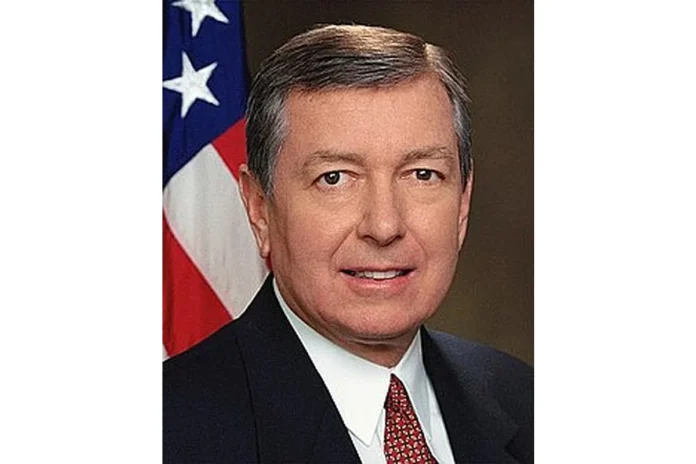
John Ashcroft Bio
John David Ashcroft, born on May 9, 1942, is an American lawyer, lobbyist, and former politician who built one of the most extensive state-level political records in Missouri history. A member of the Republican Party, he served as the 79th United States Attorney General under President George W. Bush from 2001 to 2005, following earlier terms as Missouri State Auditor, Attorney General, and Governor. After leaving public office, he founded The Ashcroft Group, a Washington, D.C. consulting firm, and has remained active as a lobbyist, corporate board member, and law professor.
Ashcroft first gained national attention for his staunch conservative positions on social issues and his support of expanded law enforcement powers following the September 11, 2001 attacks. As Attorney General, he became a leading proponent of the USA PATRIOT Act and post-9/11 security measures, decisions that drew both praise and sharp criticism. Beyond politics, he is also a published author, gospel singer, and lifelong member of the Assemblies of God church.
Early Life and Background
John David Ashcroft was born in Chicago, Illinois, on May 9, 1942. He is the son of James Robert Ashcroft, a minister who later served as president of Evangel University and Central Bible College, and Grace P. Ashcroft, née Larsen, a homemaker. His maternal grandparents were of Norwegian descent, while his paternal grandfather was of Irish origin. Because of his father’s religious work, the family later moved to Willard, Missouri, where Ashcroft spent most of his childhood near Springfield.
He grew up in a deeply religious household shaped by his father’s leadership in the Assemblies of God denomination. He graduated from Hillcrest High School in 1960 and went on to attend Yale University, where he became a member of the St. Elmo Society and earned a Bachelor of Arts degree in 1964. He later received his Juris Doctor from the University of Chicago Law School in 1967, setting the foundation for a career in law and public service.
After completing law school, Ashcroft briefly taught business law and served as an administrator at Southwest Missouri State University. During the Vietnam War era, he avoided military service through a series of student and occupational deferments tied to his teaching role. These early experiences in education and faith-based community work influenced his later political philosophy and policy approach.
Path to US Politics
Ashcroft’s entry into public life began in Missouri state government, where he was mentored by John Danforth, a prominent Republican attorney general and later U.S. Senator. Danforth hired Ashcroft as an assistant state attorney general, providing him with practical legal and political experience. When Danforth vacated the attorney general post in 1976 to run for the U.S. Senate, Ashcroft successfully campaigned to replace him.
Before that, in 1972, Ashcroft had run for a U.S. House seat in southwest Missouri and narrowly lost the Republican primary to Gene Taylor. Missouri Governor Kit Bond then appointed him as State Auditor in 1973. He lost his bid for re-election as auditor in 1974 but rebounded quickly, winning the attorney general race in 1976 and beginning a long rise through Missouri’s executive offices. His path combined legal credentials, party loyalty, and steady electoral success.
John Ashcroft Career
Early Career (1973–1984)
Ashcroft’s first statewide office came in 1973 when Governor Kit Bond appointed him Missouri State Auditor, a position he held until 1974. After losing a re-election bid to George W. Lehr, who questioned his accounting credentials, he shifted focus to the attorney general’s office. In 1976, he won the seat vacated by his mentor, John Danforth, and was re-elected in 1980 with 64.5 percent of the vote, carrying 96 of Missouri’s 114 counties.
During his tenure as attorney general, Ashcroft became known for challenging federal court-ordered school desegregation plans in St. Louis and Kansas City, a stance that led a federal judge to threaten him with contempt of court. He also authored the leading amicus curiae brief in the U.S. Supreme Court case Sony Corp. of America v. Universal City Studios, Inc., supporting home video recording for personal use. These years established his reputation as a conservative legal combatant willing to take on the federal judiciary.
Governorship of Missouri (1985–1993)
In 1984, Ashcroft won the Missouri governorship by defeating Democratic Lieutenant Governor Ken Rothman, capturing 57 percent of the vote and carrying 106 counties in what was then the largest Republican gubernatorial victory in state history. He won re-election in 1988 against Betty Cooper Hearnes by an even wider margin, taking 64 percent of the vote in the largest gubernatorial landslide in Missouri since the Civil War. He became the first Republican in Missouri history to be elected to two consecutive terms as governor.
During his second term, Ashcroft served as chairman of the National Governors Association from 1991 to 1992. His governorship emphasized conservative fiscal and social policies, and he gained a reputation for opposing abortion and busing for school desegregation. His two-term record cemented his standing as the dominant Republican figure in Missouri politics and paved the way for his next move to federal office.
U.S. Senate from Missouri (1995–2001)
Following John Danforth’s retirement, Ashcroft won election to the U.S. Senate in 1994, defeating Democratic Congressman Alan Wheat with 59.8 percent of the vote. As a senator, he aligned with conservative causes and briefly explored a run for the U.S. presidency in 1998 before deciding to seek re-election. He easily won his Republican primary and prepared for a competitive general election campaign against Democratic Governor Mel Carnahan.
The 2000 race took a dramatic turn when Carnahan died in a plane crash three weeks before Election Day. Under Missouri law, his name remained on the ballot, and his widow, Jean Carnahan, pledged to serve if elected. Ashcroft suspended campaigning out of respect but later resumed. Carnahan won the seat posthumously 51 percent to 49 percent, making Ashcroft the first sitting U.S. Senator to lose re-election to a deceased candidate.
U.S. Attorney General Era (2001–2005)
After his Senate loss, President-elect George W. Bush nominated Ashcroft to be the 79th U.S. Attorney General. He was confirmed by the Senate on a 58–42 vote, with most Democrats opposing him over his views on abortion and busing. U.S. Supreme Court Justice Clarence Thomas administered his oath of office, a ceremony that mirrored a similar anointing performed by his late father.
Following the September 11, 2001 attacks, Ashcroft became one of the most prominent voices in support of the USA PATRIOT Act, defending expanded surveillance and detention powers. He also authorized aggressive interrogation practices, issued a one-paragraph opinion re-authorizing the use of torture after internal legal objections, and pushed voter fraud investigations that critics argued were politically motivated. In March 2004, he ruled President Bush’s domestic intelligence program illegal while hospitalized, an act of resistance that led the White House to attempt to override him at his hospital bedside. He resigned in February 2005 and was succeeded by Alberto Gonzales.
Consultant and Lobbyist Years (2005–Present)
Shortly after leaving the Justice Department, Ashcroft founded The Ashcroft Group, a Washington, D.C. consulting and lobbying firm. The firm grew quickly, reporting $269,000 in initial year-end earnings and later receiving $1.4 million in lobbying fees over a six-month period. It counted among its clients Oracle Corporation, Israel Aircraft Industries International, and the National Association of Broadcasters, and operated an affiliated law firm, the Ashcroft Law Firm.
In 2011, Ashcroft joined the board of Xe Services, the private military company formerly known as Blackwater, which rebranded as Academi later that year. He has also served as a professor at Regent University School of Law, a conservative Christian institution affiliated with the late televangelist Pat Robertson, and has been a member of the Federalist Society. His Ashcroft Law Firm has represented clients including Russian arms trafficker Viktor Bout and the government of Qatar.
John Ashcroft Family
Family Background and Religious Roots
Ashcroft was raised in a devout Assemblies of God household shaped by his father James Robert Ashcroft, a minister who led congregations in the Springfield, Missouri area. His father also served as president of Evangel University from 1958 to 1974 and as joint president of Central Bible College from 1958 to 1963. These institutions remain central to the Pentecostal educational world in the United States, and their influence is visible in Ashcroft’s lifelong religious commitments.
His mother, Grace P. Ashcroft, was a homemaker of Norwegian and Irish heritage. The family’s ministerial background gave Ashcroft deep ties to evangelical networks that have supported his political career, including his friendships with conservative Christian leaders. He has remained a member of the Assemblies of God church throughout his adult life and has often spoken publicly about his faith.
Personal Life
John Ashcroft has been married to Janet E. Ashcroft since 1967, and the couple has three children. Their son, Jay Ashcroft, followed his father into public service and served as Missouri’s Secretary of State from 2017 to 2025, before running unsuccessfully for governor in 2024. The Ashcrofts have long been known for their shared love of music, including John Ashcroft’s brief recording of a gospel album with Democratic Missouri legislator Max Bacon in the 1970s.
During his time in the U.S. Senate, Ashcroft joined Republican colleagues Trent Lott, Larry Craig, and Jim Jeffords to form The Singing Senators, a barbershop quartet that performed at social events. He also composed patriotic and religious songs, including a piece titled “Let the Eagle Soar,” which he performed at theological events. Ashcroft does not drink alcohol, a personal choice consistent with his religious background.