

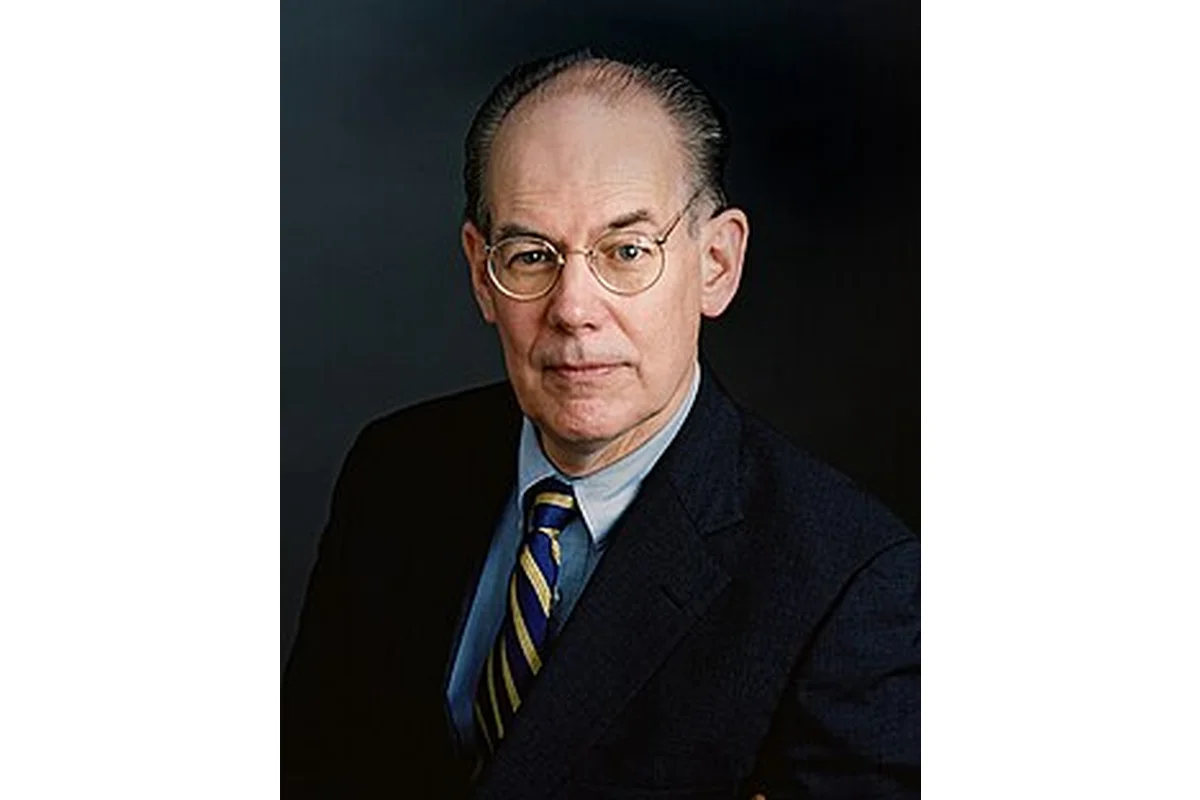
John Mearsheimer Bio
John Joseph Mearsheimer (born December 14, 1947) is an American political scientist and international relations scholar who is the R. Wendell Harrison Distinguished Service Professor of Political Science at the University of Chicago. He is best known for developing the neorealist school of offensive realism and for major works including The Tragedy of Great Power Politics and The Israel Lobby and U.S. Foreign Policy. Mearsheimer’s research addresses great-power competition, deterrence, and the limits of liberal internationalism, and his views on China, NATO expansion, and the causes of the Russo-Ukrainian conflict have been influential and controversial in both academic and policy debates.
Early Life and Background
John Joseph Mearsheimer was born on December 14, 1947, in Brooklyn, New York City, as one of five children to Thomas Joseph Mearsheimer (1918–2007) and Ruth Margaret Baumann (1922–2011), in a family of German and Irish descent. His father was a civil engineer and a colonel in the United States Air Force Reserve. A graduate of the United States Military Academy, Thomas Mearsheimer served in the United States Army Air Corps during World War II and continued with the Air Force Reserve during the Korean and Vietnam Wars. As a civil engineer, he worked for various railroads and served as the chief engineer of the Grand Central.
When he was eight, Mearsheimer moved with his family to the village of Croton-on-Hudson, New York, a suburb in Westchester County. At 17, he enlisted in the United States Army, and after one year as an enlisted man, he obtained an appointment to the United States Military Academy at West Point, which he attended from 1966 to 1970. He received a Bachelor of Science degree from West Point in 1970 and went on to serve five years in the United States Air Force, rising from Second Lieutenant to captain before resigning his commission in 1975.
Path to Political Science
While serving in the Air Force, Mearsheimer earned a Master of Arts in international relations from the University of Southern California in 1974. Not satisfied with his military career, he resigned and pursued further graduate studies at Cornell University in Ithaca, New York, earning a Master of Arts in 1978 and a Ph.D. in government in 1981. He concentrated his studies in international relations and held a peace studies fellowship at Cornell from 1978 to 1979. During the summer of 1978, he interned at the Arms Control and Disarmament Agency.
From 1979 to 1980, Mearsheimer was a research fellow at the Brookings Institution in Washington, DC, after receiving a Hubert H. Humphrey doctoral fellowship. He then served as a postdoctoral fellow and research associate at Harvard University’s Center for International Affairs from 1980 to 1982. These early academic appointments shaped his enduring focus on great-power competition, conventional deterrence, and security policy.
John Mearsheimer Career
Early Career (1982–1995)
Mearsheimer joined the faculty of the Department of Political Science at the University of Chicago in 1982. He was appointed assistant professor in 1982, associate professor in 1984, and full professor in 1987. His first book, Conventional Deterrence (1983), won the Edgar S. Furniss Jr. Book Award from the Mershon Center for International Security Studies. He served as chair of the Department of Political Science from 1989 to 1992 and was co-chairman of the American Political Science Association’s Commission on History, Social Science and International Security Affairs from 1987 to 1990.
During the early 1990s, Mearsheimer extended his research into nuclear strategy with Nuclear Deterrence: Ethics and Strategy (1985) and into military history with Liddell Hart and the Weight of History (1988). In January and early February 1991, he published two op-eds in the Chicago Tribune and the New York Times predicting that the war to liberate Kuwait would be quick and lead to a decisive U.S. victory with less than 1,000 American casualties, a forecast that proved accurate.
Offensive Realism Breakthrough (1996–2010)
Mearsheimer was appointed the R. Wendell Harrison Distinguished Service Professor of Political Science in 1996 and has held that chair ever since. In his landmark 2001 book The Tragedy of Great Power Politics, he laid out his theory of offensive realism, arguing that great powers seek regional hegemony because the anarchic structure of the international system creates strong incentives to gain power at the expense of competitors. The book won the Lepgold Book Prize and became a defining text in the study of international relations.
In 2007, Mearsheimer co-authored The Israel Lobby and U.S. Foreign Policy, which argued that the Israel lobby wields disproportionate influence over U.S. Middle East policy. The book became a New York Times Best Seller and ignited intense scholarly and public debate. By the end of the decade, a 2017 survey of U.S. international relations faculty ranked him third among scholars whose work had the greatest influence on the field in the past 20 years.
University of Chicago Era (2011–Present)
In Why Leaders Lie (Oxford University Press, 2011), Mearsheimer analyzed lying in international politics, concluding that leaders do not lie very often to other countries and that democratic leaders are actually more likely than autocrats to lie to their own people. He followed this with The Great Delusion: Liberal Dreams and International Realities (Yale University Press, 2018), a sweeping critique of the post-Cold War liberal international order in which he argued that U.S.-led efforts to spread democracy were bound to provoke nationalist resistance and embroil Washington in disastrous military adventures.
Mearsheimer has also become one of the most prominent commentators on the causes of the Russo-Ukrainian War. Beginning with his 1993 article “The Case for a Ukrainian Nuclear Deterrent” and continuing through his 2014 essay “Why the Ukraine Crisis is the West’s Fault,” he has argued that NATO and EU expansion provoked Russia and bear primary responsibility for the conflict. In interviews with The New Yorker in 2022 and 2025, he reiterated that view, calling for Ukraine to remain a neutral buffer state. His positions on Ukraine have drawn both praise for clarity and sharp criticism from scholars such as Michael McFaul, Stephen Sestanovich, Anne Applebaum, and Filip Kostelka.
Notable Events and Milestones
A defining moment in Mearsheimer’s academic life came in October 1991, when, as chair of Chicago’s political science department, he led the campaign to demand an apology from visiting professor Elisabeth Noelle-Neumann for her wartime writings for the Nazi newspaper Das Reich. His public statement that he believed she was an anti-Semite drew national attention and reaffirmed his willingness to confront difficult historical questions.
John Mearsheimer Awards
John Mearsheimer has received numerous awards for teaching, scholarship, and public service over more than four decades at the University of Chicago and beyond.
Teaching Awards
Mearsheimer received the Clark Award for Distinguished Teaching as a graduate student at Cornell in 1977 and the Morris Abrams Award in International Relations in 1980. In 1985, he won the Quantrell Award for Excellence in Undergraduate Teaching at the University of Chicago. He received a grant from the American Philosophical Society in 1984 and was a George Kistiakowsky scholar at the American Academy of Arts and Sciences from 1986 to 1987.
Scholarly Honors and Distinctions
In 1993–1994, Mearsheimer was selected as a Phi Beta Kappa Visiting Scholar, giving talks at eight colleges and universities. During 1998–1999, he served as the Whitney H. Shepardson Fellow at the Council on Foreign Relations in New York City. He was elected a member of the American Academy of Arts and Sciences in 2003, and in 2020 he received the American Political Science Association James Madison Award, presented every three years to a political scientist who has made distinguished scholarly contributions. The award committee described him as one of the most cited International Relations scholars in the discipline.
John Mearsheimer Family
Family Background and Academic Lineage
Mearsheimer was raised in a close-knit family of German and Irish descent. His father, Thomas Joseph Mearsheimer, was a civil engineer and a colonel in the United States Air Force Reserve, while his mother, Ruth Margaret Baumann, raised the couple’s five children. The family’s military and engineering traditions shaped Mearsheimer’s decision to attend the United States Military Academy at West Point, the launching point for his academic career in international relations.
Personal Life
John Joseph Mearsheimer married Mary T. Cobb in 1970, and the couple has three children, a daughter and two sons. He has said that he holds very liberal views on gay rights and gay marriage, and he has expressed support for gender equality. In 2019, he stated that his preferred candidate in the 2020 Democratic Party presidential primaries was Bernie Sanders and identified economic inequality as the greatest problem faced by the United States.