

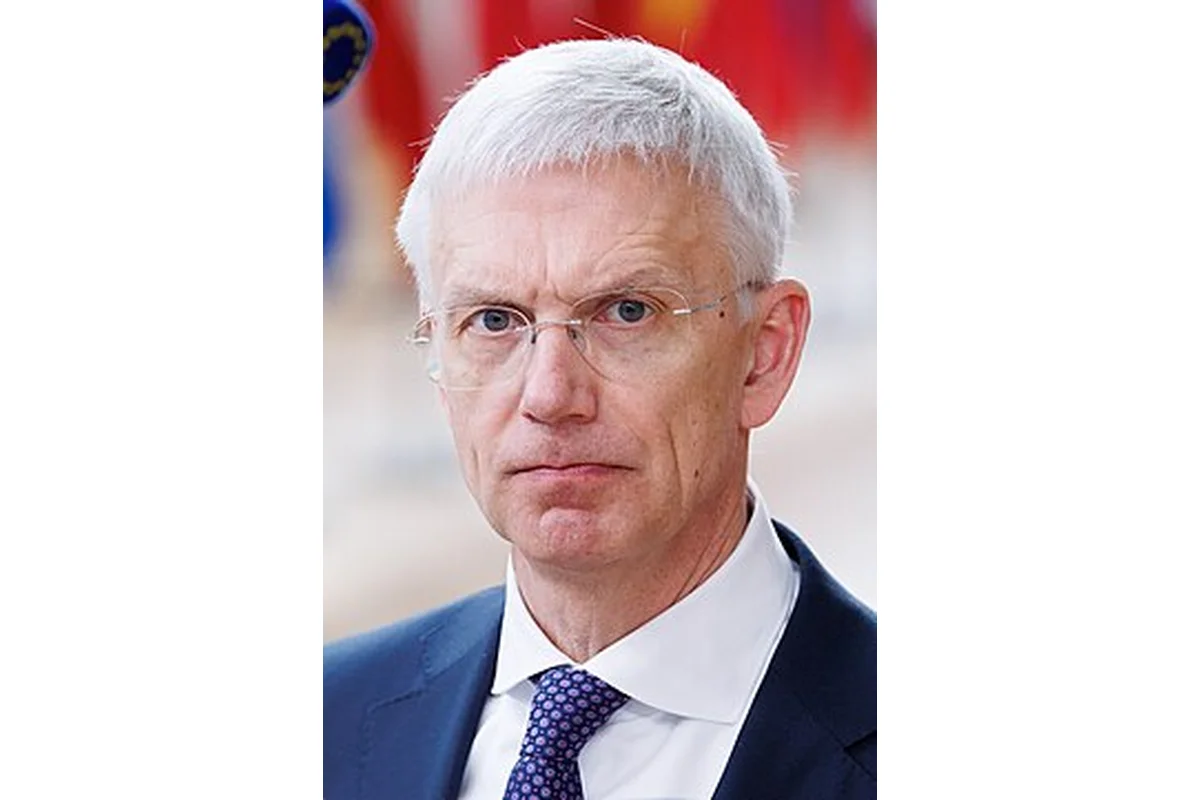
Krišjānis Kariņš Bio
Arturs Krišjānis Kariņš (born 13 December 1964) is a Latvian and American politician, linguist, and businessman who served as the Prime Minister of Latvia from 23 January 2019 until 15 September 2023. Born in Wilmington, Delaware to Latvian refugee parents, he completed undergraduate and doctoral studies in linguistics at the University of Pennsylvania before relocating to Latvia and founding a frozen-food company. A co-founder of the New Era Party, Kariņš later served as Minister for Economics, Member of the European Parliament, and leader of the New Unity party. As prime minister he headed a five-party coalition, led Latvia’s response to the COVID-19 pandemic, and addressed regional security challenges following Russia’s 2022 invasion of Ukraine before resigning in August 2023 amid coalition conflicts.
Early Life and Background
Kariņš was born in Wilmington, Delaware, into a Latvian American family. His parents had fled the Soviet re-occupation of Latvia in 1944 as child refugees, later meeting and marrying in Sweden before migrating to the United States. His father, Uldis Kariņš, was a civil engineer who in 1973 founded Karins and Associates, an engineering, planning and surveying firm based in Delaware that grew by acquiring other companies throughout the Mid-Atlantic region.
According to Kariņš, he and his older sister were the only two ethnic Latvian children in their elementary school. The family was active in Delaware’s Latvian community, regularly attending Latvian church services, singing in Latvian choirs, and participating in Latvian summer camps, including Garezers in Michigan. Throughout his youth he played guitar and drums in a Latvian band that performed at weddings and community events across the United States. He also took part in demonstrations in Washington, D.C., against the Soviet occupation of Latvia.
Path to Politics
Kariņš first visited Latvia in 1984 and spent subsequent summers in the country before relocating there full-time in 1997. After graduating from high school, he studied at the Münster Latvian Gymnasium in 1983, where one of his teachers was Egils Levits, who later became President of Latvia. From 1984 to 1986 he studied at St. John’s College in Annapolis, Maryland, before transferring to a linguistics program at the University of Pennsylvania, where he graduated summa cum laude in 1988 and completed a Ph.D. in linguistics in 1996, specializing in automatic speech recognition.
After completing his doctorate, Kariņš moved to Latvia intending to teach, but was denied an academic position due to a lack of teaching experience. He founded Lāču ledus, a producer and distributor of ice and frozen foods, which he led until 2002. He later said that negative experiences working with the Latvian bureaucracy during his business career were his original inspiration for entering Latvian politics. In 1999 he also briefly served as president of an automobile and office supplies company called Formula.
Krišjānis Kariņš Career
Early Career (2002–2009)
In the early 2000s, Einars Repše invited Kariņš to take part in founding the New Era Party, and Kariņš helped write the party’s original platform. He was elected to the Saeima on the party’s ticket in October 2002, with New Era emerging as the single largest party in parliament. While serving in the Saeima, he sat on the education, culture, and science committee as well as the constitutional committee, and chaired the New Era parliamentary faction from 2002 to 2004.
Following the resignation of Prime Minister Einars Repše in early 2004, Kariņš was discussed as a possible successor but was passed over by President Vaira Vīķe-Freiberga. He instead became Minister for Economics in the First Kalvītis cabinet, serving from December 2004 to April 2006, before New Era left the governing coalition in April 2006 amid internal conflicts. He was re-elected to the Saeima in October 2006 and, in March 2007, became one of two co-leaders of New Era together with Repše.
European Parliament and Party Leadership (2009–2018)
In July 2009 Kariņš became a Member of the European Parliament, serving on the Committee on Industry, Research and Energy and later as a substitute on the Committee on Economic and Monetary Affairs. He sat with the European People’s Party, the largest political grouping in the Parliament, and was re-elected in the 2014 European Parliament election. During a 2015 interview he argued in favour of Latvia accepting its proposed quota of refugees as part of the European migrant crisis response.
When New Era voted to merge with the Unity party in July 2011, Kariņš became a member of Unity and remained with the party when it was renamed New Unity in April 2018. On 23 April 2018 he was announced as New Unity’s candidate for prime minister for the 2018 Latvian parliamentary election. Despite polls predicting as late as July that New Unity would not reach the 5 percent threshold, the party entered the Saeima on 6 October as the smallest of seven parties, with eight seats.
Prime Minister Era (2019–2023)
On 7 January 2019, President Raimonds Vējonis tasked Kariņš with forming the next government after earlier nominees failed to build a coalition. He took office on 23 January 2019 at the head of a broad five-party centre-right coalition and survived a 58–33 vote of no confidence on 11 April 2019. During his tenure he led Latvia’s response to the COVID-19 pandemic, declaring multiple states of emergency between March 2020 and October 2021 and implementing a month-long lockdown in October 2021 in response to requests from medical professionals.
Throughout his term Kariņš stressed a western-oriented foreign policy and expressed caution regarding Russia’s intentions. He supported Latvia’s delivery of FIM-92 Stinger surface-to-air missiles to Ukraine in February 2022 and announced Latvia’s readiness to take in 10,000 Ukrainian refugees following Russia’s invasion. He also navigated the 2021 Belarus–European Union border crisis, joined regional statements blaming Belarus for weaponizing migration, and approved additional restrictions on the entry of Russian citizens into Latvia in September 2022.
Foreign Minister and Post-Government Role (2023–2024)
Shortly after stepping down as prime minister, Kariņš joined the government of Evika Siliņa as foreign minister in September 2023. On 28 November 2023 he announced his intention to seek the nomination to become the next Secretary General of NATO, citing the alliance’s need for a consensus builder committed to higher defence spending. He also publicly accused Hamas of using Palestinian civilians as human shields during the Gaza war.
On 28 March 2024, Kariņš announced that he was resigning as foreign minister effective 10 April following a decision by the Latvian prosecutor general’s office to initiate criminal proceedings over the alleged misuse of public funds in connection with private aviation services used during his prime ministership. Baiba Braže was confirmed as Minister of Foreign Affairs in his place, and Kariņš returned to work in the Saeima before announcing the suspension of his mandate at the end of August 2024.
Notable Events and Milestones
Among the signature moments of Kariņš’s tenure was his appointment in January 2019 as a compromise candidate after larger parties failed to form a coalition, his leadership of Latvia through three COVID-19 states of emergency between 2020 and 2021, and his address to the Riga StratCom Dialogue in May 2022 declaring that Russia must lose its war in Ukraine. He also visited Kyiv on 16 March 2023 to meet with President Volodymyr Zelenskyy, reinforcing Latvia’s support for Ukraine’s European integration.
Krišjānis Kariņš Family
Family Background and Political Lineage
Kariņš comes from a Latvian exile family shaped by the Soviet occupation. Both of his parents fled Latvia in 1944 as child refugees, later meeting and marrying in Sweden before settling in the United States. His father, Uldis Kariņš, built a career as a civil engineer in Delaware, founding Karins and Associates in 1973 and growing the firm through acquisitions across the Mid-Atlantic region.
Personal Life
Kariņš is married to Anda Kariņa, a general practitioner doctor, and the couple has four children. Aside from his native Latvian and English, he speaks fluent German and French, with some knowledge of Russian. In a January 2020 meeting in Minsk with President Alexander Lukashenko, he explained that he understands Russian better than he speaks it and therefore uses an interpreter to avoid mistakes.