
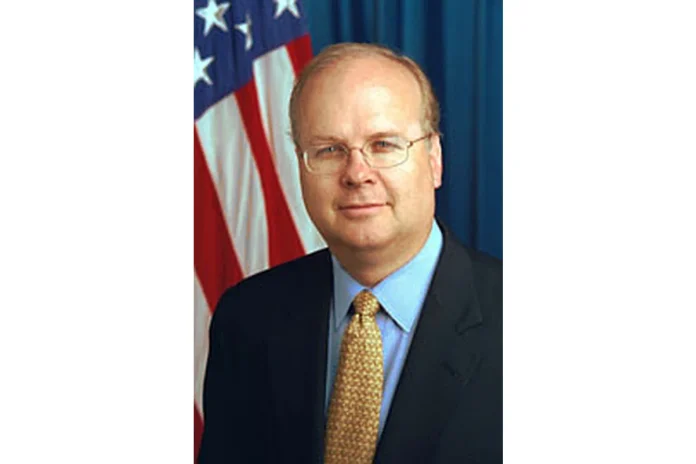
Karl Christian Rove Bio
Karl Christian Rove (born December 25, 1950) is an American Republican political consultant, policy advisor, and lobbyist who became one of the most influential strategists of his generation. He is widely known by the nickname “The Architect,” a label first used publicly by George W. Bush in his 2004 victory speech to credit Rove’s role in his presidential campaigns. Rove is also a former Senior Advisor and Deputy Chief of Staff in the George W. Bush administration, and a longtime political commentator on television and in print.
Beyond his White House service, Rove has been a prolific campaign operative, credited with victories in hundreds of state and federal races across the South and Southwest. After leaving government, he became a familiar presence on cable news and a leading voice in Republican politics through outside political organizations and opinion writing.
Early Life and Background
Karl Christian Rove was born on Christmas Day in Denver, Colorado, the second of five children, and was raised in Sparks, Nevada. His parents separated when he was 19 years old, and the man he knew as his father was a geologist. In 1965, his family moved to Salt Lake City, where Rove attended Olympus High School and developed a passion for debate and politics.
As a high school student, Rove was elected student council president in both his junior and senior years, and he served as Chairman of the Utah Federation of Teenage Republicans. He also volunteered for Republican Senate campaigns in the state. Rove has spoken of the influence of his high school debate coach and a University of Utah political science professor, J.D. Williams, who became a mentor during his teenage years.
Rove’s early life was marked by personal difficulties, including his mother’s struggles with depression and her death by suicide in 1981. He also later learned that he and his older brother had a different birth father than the man who raised them. These experiences shaped his determination to pursue politics as a full-time vocation.
Path to US Politics
Rove’s political career began in earnest in 1968, when he chaired the Olympus High School campaign for U.S. Senator Wallace F. Bennett’s reelection in Utah. In June 1971, he dropped out of the University of Utah to become the executive director of the College Republican National Committee, a paid position that launched him into national conservative politics.
Through the College Republicans, Rove traveled the country teaching weekend seminars for campus conservatives and became an active participant in Richard Nixon’s 1972 presidential campaign. He later enrolled briefly at the University of Maryland, College Park, before withdrawing from classes. Rove also attended George Mason University and has stated that he lacked only a math course and a foreign language requirement to earn a degree.
In 1976, Rove left Washington, D.C., to work in Virginia politics as Finance Director for the Republican Party of Virginia, a role in which he discovered the power of direct mail fundraising. He moved to Texas in January 1977 to take a job as a legislative aide for Texas Republican state representative Fred Agnich, setting the stage for decades of work in Lone Star State politics.
Karl Christian Rove Career
Early Career (1977–1991)
After arriving in Texas, Rove quickly became a sought-after political operative. In 1977, he joined the Fund for Limited Government, a political action committee in Houston headed by James A. Baker III, and worked on Bill Clements’s 1978 Texas gubernatorial campaign, which made Clements the first Republican governor of Texas in more than a century. Rove later served in the Clements administration as deputy executive assistant.
In 1981, Rove founded Karl Rove & Co., a direct mail consulting firm in Austin, and operated it until 1999. During that period, he was involved in hundreds of state and federal campaigns, working for candidates such as Phil Gramm, Thomas R. Phillips, Kay Bailey Hutchison, and Rick Perry. An Atlantic Monthly profile estimated that Rove was the primary strategist for 41 statewide, congressional, and national races, with 34 victories. He also served as an adviser to George H. W. Bush’s 1980 presidential campaign and the Reagan-Bush ticket in 1984.
George W. Bush Era Breakthrough (1993–2000)
Rove’s national profile rose dramatically when he helped engineer George W. Bush’s 1994 victory over incumbent Democratic Governor Ann Richards in Texas. The win was followed by a successful 1998 reelection campaign, in which the Bush committee paid Rove’s firm and a related list company nearly $2.8 million. Rove then took a leave from his consulting business to manage Bush’s 2000 presidential campaign, a hard-fought contest decided by the Supreme Court.
Beyond Bush, Rove worked on Republican Senate bids in the 1990s, including John Ashcroft’s 1994 Senate win in Missouri and Phil Gramm’s earlier Senate victories. He also ran the controversial 1994 Alabama Supreme Court campaign that put a Republican on that bench for the first time in more than a century. In his 2004 victory speech, Bush publicly credited Rove as “the architect” of his victories, a nickname that stuck.
White House Era (2001–2007)
When George W. Bush took office in January 2001, Rove was appointed Senior Advisor to the President, later adding the title of Deputy Chief of Staff after the 2004 reelection. He also headed the White House Office of Political Affairs, the Office of Public Liaison, and the White House Office of Strategic Initiatives, making him a central figure in the administration’s political and communications operations.
Rove played a leading role in the lead-up to the 2003 invasion of Iraq, chairing the White House Iraq Group in 2002 and 2003 and helping to coordinate public messaging about the Hussein regime’s alleged weapons of mass destruction. He also became entangled in the Valerie Plame CIA leak investigation; in 2006, prosecutors announced they would not charge Rove with any wrongdoing. Rove resigned from the White House on August 31, 2007, saying simply, “I just think it’s time to leave.”
Post-White House Activities (2008–Present)
After leaving government, Rove became a political analyst for Fox News, a columnist for Newsweek and The Wall Street Journal, and a leading voice in Republican outside spending. In 2010, he co-founded American Crossroads, a Republican 527 organization, and later helped launch the Conservative Victory Project. He also published his memoir, Courage and Consequence, in March 2010 and a history, The Triumph of William McKinley, in 2015.
Rove returned to academic life in the fall of 2021 as a guest professor at the University of Texas at Austin, where he taught a course on modern American political campaigns. He continues to write, lecture, and advise Republican candidates and causes, and he has been credited with playing a significant role in shaping the modern use of data and direct mail in GOP campaigns.
Notable Events and Milestones
Among the signature events of Rove’s career are his central role in George W. Bush’s 2000 and 2004 presidential victories, his chairmanship of the White House Iraq Group, and his survival of the CIA leak investigation that led to the conviction of I. Lewis “Scooter” Libby. He is also remembered for his 2010 founding of American Crossroads, a 527 group that became a major player in Republican outside spending after the Citizens United decision.
Karl Christian Rove Family
Family Background and Personal Lineage
Rove was raised in a turbulent household shaped by his mother’s long battle with depression and his parents’ eventual divorce. He later learned that he and his older brother had a different biological father than the man who raised them. His mother died by suicide in 1981, an event that Rove has cited as a formative and painful experience in his life.
Personal Life
Rove has been married three times. He married Houston socialite Valerie Mather Wainwright in 1976, divorcing in 1980. In 1986, he married Darby Tara Hickson, a graphic designer and breast cancer survivor, with whom he has one son, Andrew Madison Rove, who attended Trinity University in San Antonio, Texas. Rove and Hickson divorced in December 2009. In June 2012, Rove married lobbyist Karen Johnson in Austin, Texas, in a ceremony attended by George W. Bush and Steve Wynn. Rove resides in the Georgetown section of Washington, D.C., and also maintains a home near Austin, Texas. He is a practicing Christian who has attended Episcopal and Anglican churches.