

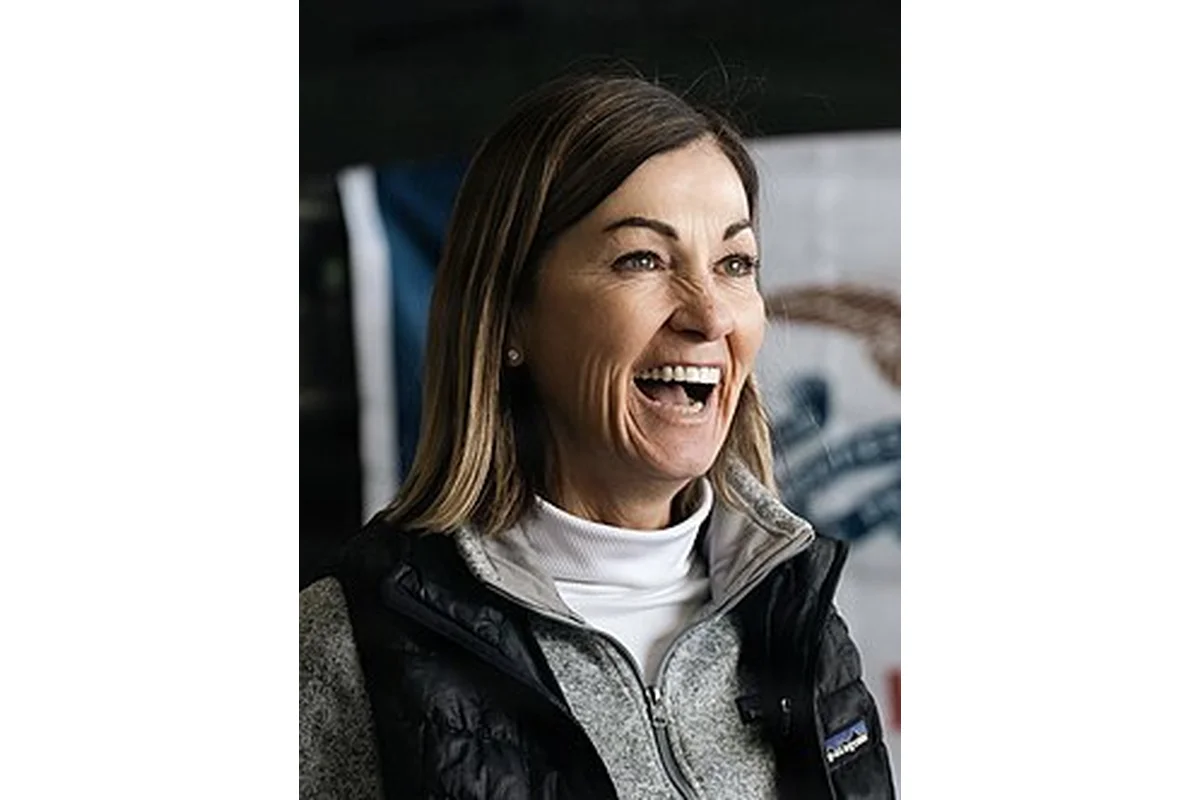
Kim Reynolds Bio
Kimberly Kay Reynolds is an American politician serving as the 43rd governor of Iowa. A Republican, she became the first woman to hold Iowa’s governorship in May 2017 when she succeeded Terry Branstad. Reynolds earlier served as lieutenant governor under Branstad from 2011 to 2017, after a partial term in the Iowa Senate and four terms as Clarke County treasurer. Her tenure as governor has focused on conservative policy priorities, including education, public health, and social issues, and she won full terms in 2018 and 2022.
Early Life and Background
Kim Reynolds was born Kimberly Kay Strawn in 1959 in St. Charles, Iowa, a small rural community. She graduated from the Interstate 35 Community School District in 1977. Growing up in small-town Iowa shaped her early understanding of community life and public service, and she remained connected to her hometown throughout her political rise.
After high school, Reynolds attended Northwest Missouri State University, taking classes in business, consumer sciences, and clothing sales and design without earning a degree. She later studied at Southeastern Community College in the late 1980s and then took accounting classes at Southwestern Community College between 1992 and 1995. In 2012, she enrolled in the bachelor of public administration program at Upper Iowa University, and in December 2016, shortly before becoming governor, Iowa State University awarded her a Bachelor of Liberal Studies degree with concentrations in political science, business management, and communications.
Path to US Politics
Reynolds’s political path began locally in 1994, when she was elected Clarke County treasurer and went on to serve four terms in that office. While serving as treasurer, she was selected to join the American Council of Young Political Leaders on a trip to Taipei, Taiwan, an experience that broadened her exposure to government and policy at an international level.
On November 4, 2008, Reynolds was elected to represent the 48th district in the Iowa Senate, defeating Democratic nominee Ruth Smith and independent candidate Rodney Schmidt. In 2010, she endorsed a ban on same-sex marriage in Iowa. That same year, on June 25, Republican gubernatorial nominee Terry Branstad selected Reynolds as his running mate for lieutenant governor, and the Branstad–Reynolds ticket won the general election on November 2, 2010.
Kim Reynolds Career
Early Career (1994–2010)
Kim Reynolds’s early political career was built at the local level, beginning with her 1994 election as Clarke County treasurer. She served four terms in that role, gaining administrative experience managing county finances and engaging with voters in a rural Iowa setting. Her steady work in the treasurer’s office helped establish her reputation as a reliable Republican figure in Clarke County.
Her move to state politics came in 2008, when she was elected to represent the 48th district in the Iowa Senate. Reynolds served a partial term in the Senate from 2009 to 2011, focusing on issues important to her rural district. In 2010, she endorsed a state ban on same-sex marriage, signaling her conservative stance on social issues.
Lieutenant Governor Breakthrough (2011–2017)
Reynolds was sworn in as the 46th lieutenant governor of Iowa on January 14, 2011, after resigning her Senate seat on November 12, 2010. As lieutenant governor, she co-chaired the Governor’s Science, Technology, Engineering and Math (STEM) Advisory Council, the Iowa Partnership for Economic Progress board, and the Military Children Education Coalition. She also served as Branstad’s representative on the board of the Iowa State Fair.
In July 2015, Reynolds was elected chair of the National Lieutenant Governors Association, a recognition of her standing among state-level leaders. Her six years as lieutenant governor gave her deep experience in Iowa’s executive branch, preparing her for the governorship. On May 24, 2017, Reynolds became the 43rd governor of Iowa upon Branstad’s resignation to become the United States Ambassador to China, making her the first woman to hold the office.
Governor of Iowa Era (2017–Present)
Reynolds began her first full term on January 18, 2019, after winning the 2018 general election by defeating Democrat Fred Hubbell and Libertarian Jake Porter, 50% to 48%. Her early tenure included proposed cuts to Medicaid, an energy efficiency policy revamp, and the signing of a restrictive fetal heartbeat abortion bill in May 2018 that was later struck down. Through her judicial appointments, Reynolds shifted the Iowa Supreme Court to the right. In 2020, she faced significant backlash for her handling of the COVID-19 pandemic, including opposition to mask mandates, the implementation of the TestIowa program, and the receipt of the lowest approval rating of any U.S. governor.
Reynolds was reelected in 2022, defeating Democratic nominee Deidre DeJear 58% to 40%. She delivered the Republican response to President Joe Biden’s 2022 State of the Union Address. Her second term saw the signing of the Students First Act, which created private school vouchers, a six-week abortion ban in 2023, and legislation in 2023 banning gender-affirming medical care for minors. In 2024, she signed a bill allowing state law enforcement to arrest undocumented migrants under certain conditions. On April 11, 2025, Reynolds announced she will not seek reelection in 2026.
Notable Events and Milestones
A defining milestone in Reynolds’s career was becoming Iowa’s first female governor in 2017, a historic achievement in a state that had never elected a woman to the office. Her decision not to appeal a 2019 court ruling striking down the fetal heartbeat bill marked a notable moment in her approach to abortion policy. Reynolds also drew national attention with her 2020 COVID-19 response, which included the lowest approval rating of any governor in the nation.
Kim Reynolds Career Wins
Kim Reynolds has built a steady record of electoral victories across her political career, from county-level races to statewide wins as governor of Iowa.
Statewide Election Highlights
Reynolds was first elected Clarke County treasurer in 1994 and served four terms in that office, establishing a foundation of voter support in her home county. In 2008, she won election to the 48th district seat in the Iowa Senate, and in 2010, she was elected lieutenant governor alongside Terry Branstad, beginning a long partnership in Iowa’s executive branch.
Reynolds’s first full gubernatorial victory came in 2018, when she defeated Democrat Fred Hubbell 50% to 48%, becoming the first woman elected governor of Iowa. She won nearly the entire state west of Des Moines and dominated the 4th congressional district with 59% of the vote. Reynolds was reelected in 2022 in a decisive win, defeating Deidre DeJear 58% to 40%.
Other Wins and Achievements
Beyond electoral wins, Reynolds achieved several institutional milestones, including her election as chair of the National Lieutenant Governors Association in 2015 and her appointment by President Donald Trump to co-chair the National Governors Association. She also delivered the 2022 Republican response to the State of the Union, a high-profile national platform. On signing major legislation, she enacted the Students First Act, expanded felon voting rights through an executive order in 2020, and signed a bill in 2025 eliminating gender identity as a protected class from the Iowa Civil Rights Act, making Iowa the first U.S. state to take such a step.
Kim Reynolds Family
Family Background and Personal Lineage
Kim Reynolds was born into a small-town Iowa family in St. Charles, and her roots in rural Iowa shaped her political identity. She married Kevin Reynolds in 1982, and the couple has three children. Kevin Reynolds was diagnosed with lung cancer in September 2023, a moment that drew public attention to her family life.
Personal Life
Reynolds is a practicing Christian who attends the Lutheran Church of Hope. In her public statements, she has spoken openly about her recovery from alcoholism following two DUI charges in 1999 and 2000, saying she sought inpatient treatment and had been sober for nearly 17 years by 2017. She has cited this experience as an important turning point in her life and has framed her 2020 executive order restoring felon voting rights in part through the lens of her own second chances.