
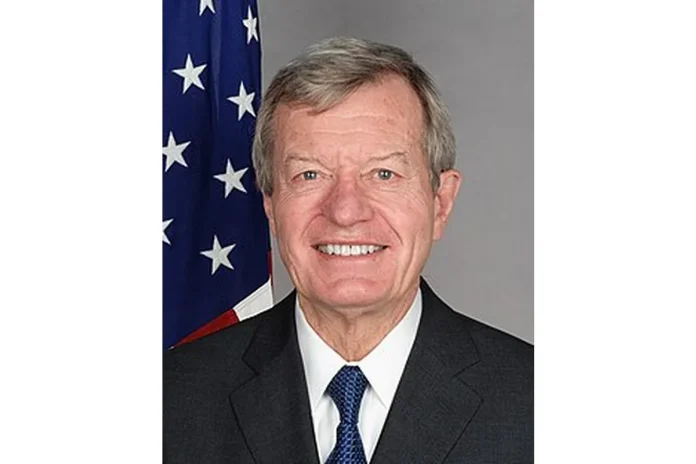
Max Baucus Bio
Maxwell Sieben Baucus (born December 11, 1941) is an American politician, attorney, and diplomat who represented Montana in the United States Senate from 1978 to 2014. A member of the Democratic Party, he became Montana’s longest-serving senator during more than 35 years in office. Baucus is widely recognized for chairing the powerful Senate Finance Committee and for his central role in shaping federal tax and health care policy debates, including negotiations over the Affordable Care Act. After leaving the Senate, President Barack Obama appointed him as the 11th United States Ambassador to the People’s Republic of China, a post he held from 2014 to 2017.
Earlier in his career, Baucus served in the U.S. House of Representatives from 1975 to 1978 and in the Montana House of Representatives from 1973 to 1974. His decades-long tenure drew both praise for legislative deal-making and criticism for his close ties to the health insurance and pharmaceutical industries. Today he is remembered as one of Montana’s most influential political figures of the modern era.
Max Baucus Early Life and Background
Early Life and Background
Maxwell Sieben Enke was born on December 11, 1941, in Helena, Montana. His mother, Jean Sheriff, was a historian and rancher, and his father, Stephen Enke, was a demographer and economist originally from British Columbia, Canada, of German and Scottish descent. His mother had English and German ancestry. After his parents separated, his mother returned with the young Max to Helena, where he was raised in a household tied to ranching and public service.
His mother later married John J. Baucus, and both she and her son took the Baucus surname. Baucus grew up on the family ranch founded by his great-grandfather in 1897 and graduated from Helena High School in 1959. He attended local public schools in Helena before continuing his education out of state. These early years in Montana shaped his lifelong connection to the state’s land and communities.
After high school, Baucus attended Carleton College in Minnesota for one year before transferring to Stanford University. At Stanford, he earned a Bachelor of Arts degree in economics in 1964 and was a member of the Sigma Alpha Epsilon fraternity. He remained at Stanford for law school, graduating with a Juris Doctor in 1967. His strong academic training in economics and law laid the foundation for his later work on tax, trade, and health care policy in the U.S. Senate.
Path to US Politics
Following law school, Baucus spent two years working as a staff attorney for the Civil Aeronautics Board and then two more years as a lawyer at the Securities and Exchange Commission in Washington, D.C. These early roles in federal agencies gave him direct experience with regulatory policy and government operations. In 1971, he returned to Montana to serve as executive director of the state’s Constitutional Convention and opened a law office in Missoula.
Baucus’s entry into elected office came quickly. In November 1972, he was elected to the Montana House of Representatives as a state representative from Missoula. Just two years later, in November 1974, he won a seat in the United States House of Representatives, representing Montana’s 1st congressional district, and was re-elected in 1976. His rapid rise from state legislator to congressman positioned him for a successful run at the U.S. Senate.
In 1978, Baucus won election to the United States Senate for the term beginning January 3, 1979. He was subsequently appointed to the seat by Montana’s Democratic Governor Thomas Lee Judge on December 15, 1978, filling the brief vacancy created by Senator Paul G. Hatfield’s resignation. This began what would become the longest Senate tenure in Montana history.
Max Baucus Career
Early Career (1973–1978)
Baucus began his political career in the Montana House of Representatives, where he served from 1973 to 1974. His work as a state legislator gave him firsthand experience with Montana’s laws and voters, and it helped him build a reputation as a capable young Democrat in a rural western state. In 1974, he successfully campaigned for Montana’s 1st congressional district seat in the U.S. House of Representatives.
He was re-elected to the U.S. House in 1976, serving until 1978. During his time in the House, Baucus focused on issues relevant to his Montana constituents, including agriculture, natural resources, and rural economic development. His strong performance and growing statewide name recognition set the stage for his transition to the U.S. Senate.
U.S. Senate Era (1978–2014) Breakthrough
Baucus’s Senate career began in earnest in 1979, and he quickly became a moderate voice within the Democratic caucus. As a senator, he was known for his conservative positions on taxes, the environment, health care, and gun control, and he frequently broke with his own party on key votes. The website That’s My Congress gave him a 23 percent rating on progressive issues, while NARAL Pro-Choice America’s political action committee endorsed him during his 2008 re-election campaign.
He became chairman of the influential Senate Finance Committee, the Senate Committee on Agriculture, Nutrition and Forestry, and the Senate Committee on Environment and Public Works, and he also served as chairman of the Joint Committee on Taxation and the Subcommittee on Transportation and Infrastructure. He played an influential role in debates over health care reform and the passage of major tax legislation. He cast a pivotal vote in 1994 in favor of Senator Dianne Feinstein’s Assault Weapons Ban, and in 2013 he was one of four Democrats to vote against the Manchin-Toomey Amendment to expand background checks for gun buyers.
U.S. Senate Era (1978–2014) Continued
Baucus’s re-election bids were marked by both large fundraising operations and decisive victories. In 2002, his opponent, state senator Mike Taylor, dropped out of the race after a Democratic Senatorial Campaign Committee ad drew national attention, and Baucus won with 63 percent of the vote. In 2008, Baucus won re-election in a landslide with 73 percent of the vote, carrying every county in the state. His 2008 campaign raised about $11.6 million, with only 13 percent of that sum coming from Montana donors.
As chairman of the Senate Finance Committee, Baucus played a leading role in the debate over the Affordable Care Act. He called early meetings with representatives of pharmaceutical groups, insurance companies, and hospitals, and he later admitted in June 2009 that ruling out a single-payer plan had been a mistake. President Barack Obama expressed deep frustration with Baucus during the negotiations, though Baucus was widely recognized for spending two years of his life working on the health care bill. On April 23, 2013, Baucus announced that he would not seek a seventh term.
U.S. Ambassador to China Era (2014–2017)
On December 20, 2013, President Barack Obama announced his intent to nominate Baucus to serve as the 11th United States Ambassador to the People’s Republic of China, succeeding Gary Locke. The Senate confirmed him on February 6, 2014, by a vote of 96–0, with Baucus himself voting “Present.” Vice President Joe Biden swore him in on February 21, 2014, ending the ambassadorship of Gary Locke.
Baucus’s tenure as ambassador was historic in some respects, as he could not speak Mandarin Chinese, which was unusual for the position. He ended his ambassadorship in January 2017 when President Donald Trump nominated Iowa Governor Terry Branstad to serve as the next ambassador to China. After returning to the United States, Baucus served on the Board of Advisors to Group until May 2019.
Notable Events and Milestones
One of the most defining moments of Baucus’s career was his central role in the negotiations over the Affordable Care Act, during which President Obama considered physically shaking him to make a point. He was also widely cited for his close ties to the health insurance and pharmaceutical industries, and a 2006 Public Citizen study found that he and former Senate Majority Leader Bill Frist had taken in more special-interest money than any other senators. The tragedy of losing his nephew, Marine Cpl. Phillip E. Baucus, in combat in Al Anbar Governorate in July 2006 deeply affected him and his family.
Max Baucus Career Wins
Baucus won multiple Senate re-election campaigns by wide margins, with his 2002 victory at 63 percent and his 2008 landslide at 73 percent. He also won his House races in 1974, 1976, and his 1978 Senate race, all of which contributed to his record as Montana’s longest-serving U.S. senator. He successfully secured Senate confirmation as U.S. Ambassador to China in 2014 by a 96–0 vote.
U.S. Senate Highlights
Baucus’s first Senate victory came in 1978, when he won the seat vacated by Paul G. Hatfield. He went on to win re-election in 1984, 1990, 1996, 2002, and 2008, with the 2008 race standing out as a landslide in which he carried every county in Montana. His 2008 campaign raised a record $11.6 million for a Montana Senate race, and his 73 percent share of the vote was among the strongest showings of his career.
Other Wins & Achievements
Beyond his Senate victories, Baucus was a leader in passing major legislation through the Senate Finance Committee and was instrumental in the Montana Legacy Project, a large conservation initiative. He earned a 79 percent rating from the League of Conservation Voters in 2012 and a 74 percent pro-business voting record from the United States Chamber of Commerce. His confirmation as U.S. Ambassador to China in 2014 by a unanimous Senate vote was also a major career milestone.
Max Baucus Family
Family Background and Political Lineage
Baucus was born Maxwell Sieben Enke to Jean Sheriff, a historian and rancher, and Stephen Enke, a demographer and economist. After his parents separated, his mother married John J. Baucus, and both she and her son adopted the Baucus surname. The family ranch in Montana was founded by Baucus’s great-grandfather in 1897, and Baucus later bought half of his mother’s house on that property in 2002.
Personal Life
Baucus married his first wife, Ann Geracimos, in 1975, and the couple had one son before divorcing in 1982. He later married Wanda Minge in 1984, and they divorced in 2009 after 25 years of marriage. On July 2, 2011, Baucus married Melodee Hanes, his former office manager, at the Sieben Ranch in Montana. Baucus is also an avid outdoorsman who has completed a 50-mile ultramarathon and has crewed for endurance runner Nikki Kimball at the 100-mile Western States Endurance Run.