

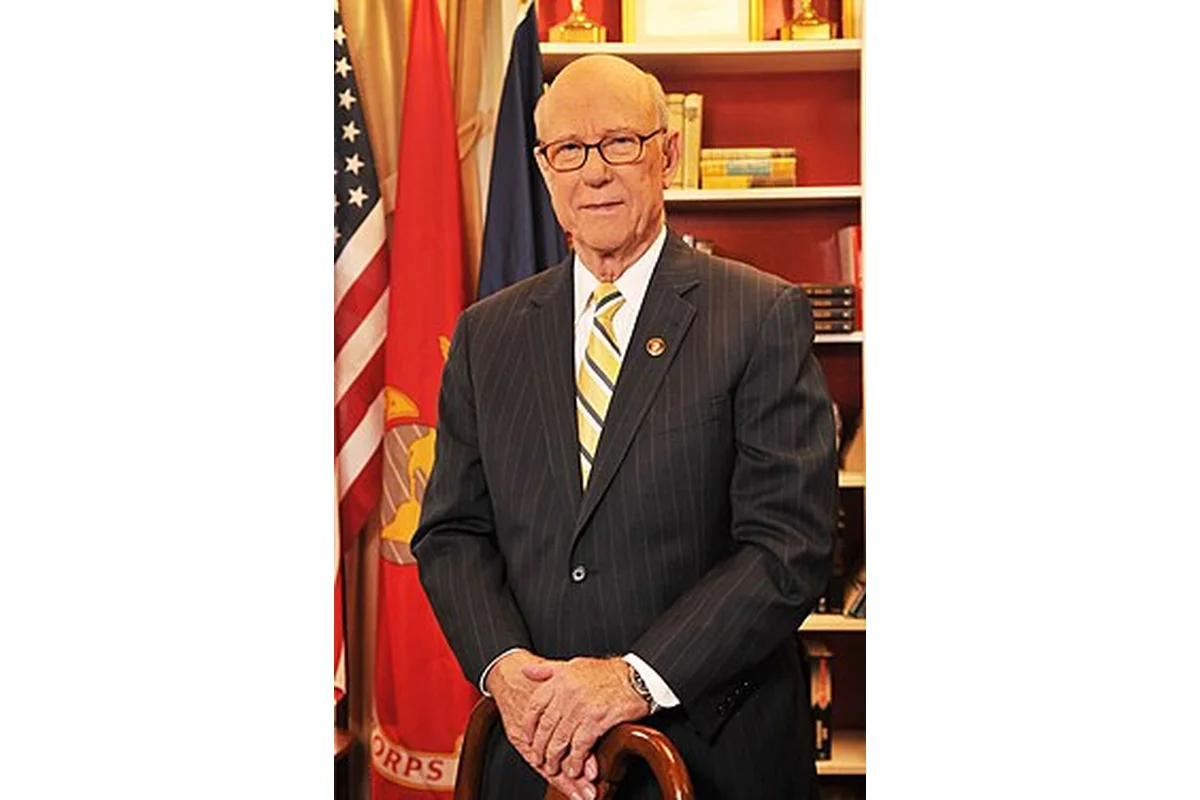
Pat Roberts Bio
Charles Patrick “Pat” Roberts (born April 20, 1936) is a retired American politician and journalist who represented Kansas in the United States Congress for four decades. A Republican, Roberts served eight terms in the U.S. House of Representatives from 1981 to 1997 and was then elected to the U.S. Senate in 1996, where he served from 1997 until 2021. During his long career he chaired the House Agriculture Committee, the Senate Select Committee on Intelligence, and the Senate Committee on Agriculture, Nutrition and Forestry.
Before entering politics, Roberts served as a First Lieutenant in the U.S. Marine Corps and worked as a newspaper reporter in Arizona. A graduate of Kansas State University in journalism, he built a reputation in agricultural and national security policy and became the longest-serving member of the Kansas congressional delegation.
Early Life and Background
Roberts was born on April 20, 1936, in Topeka, Kansas, the son of C. Wesley Roberts and Ruth B. Roberts (née Patrick). His father served for four months as Chairman of the Republican National Committee under President Dwight D. Eisenhower, giving the younger Roberts a direct connection to national Republican politics from an early age. His great-grandfather, J.W. Roberts, founded the Oskaloosa Independent, the second-oldest newspaper in Kansas, which helped shape the family’s longstanding interest in journalism and civic life.
Roberts graduated in 1954 from Holton High School in Holton, Kansas, and went on to earn a Bachelor of Arts degree in journalism from Kansas State University in 1958, where he joined the Pi Kappa Alpha fraternity. After college, he served as an officer in the U.S. Marine Corps from 1958 to 1962, reaching the rank of First Lieutenant. This combination of military discipline and midwestern roots gave Roberts a strong public-service foundation before he ever ran for office.
Path to US Politics
Following his Marine Corps service, Roberts became a reporter and editor for several Arizona newspapers between 1962 and 1967, building a profile as a working journalist. In 1967, he joined the staff of Republican Kansas Senator Frank Carlson, transitioning from the newsroom into government work. Two years later, in 1969, he became administrative assistant to Kansas 1st District Congressman Keith Sebelius, a position that placed him at the center of Kansas political life and prepared him for his own future campaigns.
Roberts spent the late 1970s working on Capitol Hill, learning the legislative process from the staff side. When Keith Sebelius announced his retirement, Roberts was well-positioned to run for the seat. He won the Republican primary in 1980 in the heavily Republican 1st District, an outcome that was tantamount to general-election victory, and entered Congress with strong institutional knowledge of the district and its agricultural concerns.
Pat Roberts Career
Early Career (1981–1997)
Pat Roberts was elected to the U.S. House of Representatives in 1980 to succeed 1st District Congressman Keith Sebelius, the man for whom he had previously worked. He was re-elected seven times without serious difficulty, never receiving less than 60 percent of the vote, and he ran unopposed in 1988. Throughout his House tenure, he focused on agricultural policy, defense, and intelligence matters, earning a reputation as a serious legislator on farm and national security issues.
Roberts served as Chairman of the House Agriculture Committee from 1995 to 1997, a role that elevated his profile in farm country and across rural America. He was also a senior member of the House Permanent Select Committee on Intelligence, work that laid the groundwork for his later chairmanship of the Senate Intelligence Committee. By the time he left the House, Roberts was widely viewed as one of the most experienced agricultural-policy voices in Congress.
Senate Career Breakthrough (1997–2021)
After Republican Senator Nancy Kassebaum declined to seek a fourth term, Roberts ran to succeed her and easily won the 1996 Republican primary with 78 percent of the vote. In the general election, he defeated Democratic State Treasurer Sally Thompson by roughly 62 percent to 34 percent, aided by the presence of former Kansas Senator Bob Dole at the top of the ticket. Although Roberts stated during the campaign that he planned to serve only two Senate terms, he ultimately served four, becoming the longest-serving member of the Kansas delegation.
Roberts was elected to the U.S. Senate in 1996 and served from 1997 to 2021. He was responsible for the Senate Intelligence Committee’s investigation into the intelligence failures prior to the 2003 invasion of Iraq, and the first half of the Senate Report on Pre-war Intelligence on Iraq was released on July 9, 2004. The 2004 Intelligence Authorization Act created the Pat Roberts Intelligence Scholars Program, which links undergraduate and graduate students with U.S. security and intelligence agencies. Roberts later rose to chair the Senate Committee on Agriculture, Nutrition and Forestry from 2014 through the 116th Congress, and he served as chairman of the Dwight D. Eisenhower Memorial Commission, dedicating the memorial on September 17, 2020.
Notable Events and Milestones
Roberts is the first person to chair both the House Agriculture Committee and the Senate Agriculture, Nutrition and Forestry Committee, a distinction that cemented his reputation as a leading agricultural-policy legislator. He gained national attention during the 2016 debate over the Supreme Court vacancy created by the death of Justice Antonin Scalia, when he argued that the Senate should not consider a nominee in an election year, and later supported an immediate vote on the nominee chosen to fill the vacancy created by the death of Justice Ruth Bader Ginsburg in 2020. On January 4, 2019, he announced that he would not seek reelection in 2020, and was succeeded by Representative Roger Marshall of Great Bend on January 3, 2021.
Pat Roberts Career Wins
Across four decades in Congress, Pat Roberts compiled a long record of electoral victories in Kansas, a heavily Republican state where his primary challenges were often his most competitive contests. He served eight terms in the U.S. House and four terms in the U.S. Senate, winning every general-election race he entered.
U.S. House Highlights
Roberts won his first House race in 1980 and was re-elected seven times without serious difficulty, never receiving less than 60 percent of the vote, and he ran unopposed in 1988. His consistent margins reflected the 1st District’s strong Republican lean and his own reputation for constituent service. By 1997, he had become one of the longest-serving members of the Kansas House delegation.
U.S. Senate Highlights
Roberts was first elected to the U.S. Senate in 1996, defeating Sally Thompson with about 62 percent of the vote. He won his 2002 re-election against Tom Oyler in the primary and faced only minor-party challengers in the general election, capturing roughly 82 percent. In 2008, he defeated former Congressman Jim Slattery with about 60 percent of the vote, and in his most competitive race, the 2014 primary against physician Milton R. Wolf, he prevailed with about 48 percent to Wolf’s 41 percent before winning the general election with 53 percent of the vote against Independent Greg Orman.
Pat Roberts Family
Family Background and Political Lineage
Roberts was born into a family with deep roots in Kansas politics and journalism. His father, C. Wesley Roberts, served for four months as Chairman of the Republican National Committee under President Dwight D. Eisenhower. His great-grandfather, J.W. Roberts, founded the Oskaloosa Independent, the second-oldest newspaper in Kansas, giving the family a multi-generational presence in both the media and political life of the state.
Personal Life
Roberts married Franki Fann in 1969, and the couple has three adult children: David, Ashleigh, and Anne-Wesley. The family has resided in Alexandria, Virginia, during his years in the Senate. Roberts, who served as a Marine Corps officer earlier in his career, has long been associated with a disciplined, military-influenced approach to public service.