
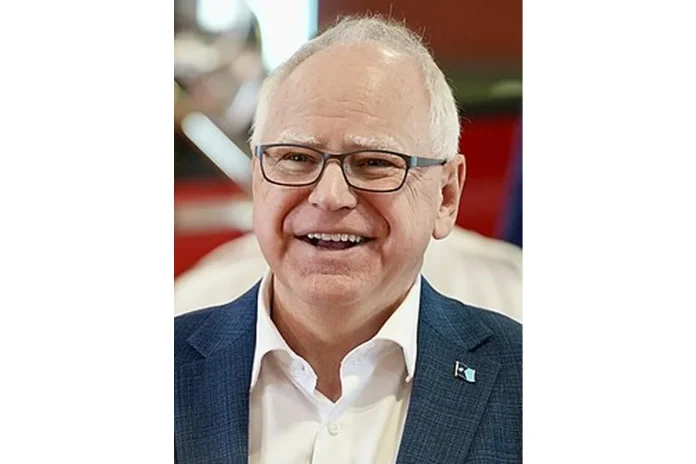
Tim Walz Bio
Timothy James Walz (born April 6, 1964) is an American politician, former educator, and Army National Guard veteran serving since 2019 as the 41st governor of Minnesota. A member of the Minnesota Democratic–Farmer–Labor Party (DFL), he represented Minnesota’s 1st congressional district in the United States House of Representatives from 2007 to 2019 and was the Democratic nominee for vice president in 2024. Before entering elected office, Walz taught high school social studies and coached football, and he served 24 years in the National Guard, reaching senior enlisted ranks.
As governor of Minnesota, Walz has focused on education funding, veterans’ services, public health, criminal justice reform, and progressive state legislation passed during periods of DFL legislative control. He was reelected in 2022 and briefly sought a third term in 2026 before withdrawing from the race.
Early Life and Background
Timothy James Walz was born on April 6, 1964, in West Point, Nebraska, a small community in the eastern part of the state. He is the son of James Frederick Walz, a Korean War veteran who used the G.I. Bill to earn his education degree, and Darlene Rose Reiman. He grew up in a working-class household and graduated from Butte High School in 1982.
With his father’s encouragement, Walz enlisted in the Army National Guard two days after turning 17, beginning a military career that would last 24 years. After high school, he worked in a factory while completing his college studies, an experience that informed his later interest in labor and rural economic issues. He earned a Bachelor of Science degree from Chadron State College in Nebraska.
Walz later earned a Master of Science in experiential education from Minnesota State University, Mankato, in 2002, writing his master’s thesis on Holocaust education. He has described his early years in rural Nebraska as formative to his political views on working families, veterans’ issues, and the importance of public education.
Path to US Politics
After graduating from Chadron State College, Walz accepted a one-year teaching position with WorldTeach at Foshan No.1 High School in Guangdong, China, arriving in August 1989 following the Tiananmen Square protests. Upon returning to the United States, he became a teacher and football coach in Alliance, Nebraska, a town of about 10,000 in the western part of the state. In 1993, he was named an Outstanding Young Nebraskan by the Nebraska Junior Chamber of Commerce.
In 1996, Walz and his wife moved to Mankato, Minnesota, where he worked as a geography teacher and football coach at Mankato West High School. The football team had lost 27 straight games when he joined the coaching staff as a defensive coordinator; three years later, in 1999, the team won its first state championship. That same year, he agreed to serve as the faculty advisor for the school’s first gay–straight alliance.
Walz’s transition to electoral politics began in the mid-2000s. On February 10, 2005, he filed to run for the United States House of Representatives from Minnesota’s 1st congressional district, a mostly Republican-leaning seat. A centerpiece of his campaign was opposition to the Iraq War, and he won the 2006 general election with 53 percent of the vote, defeating six-term Republican incumbent Gil Gutknecht.
Tim Walz Career
Early Career (2007–2010)
Walz was sworn into the United States House of Representatives in January 2007, representing Minnesota’s 1st congressional district. His victory made him one of the few Democrats to flip a Republican seat that year, and he was reelected in 2008 with 63 percent of the vote, becoming only the second non-Republican to win a second full term in the district.
He won a third term in 2010 with 49 percent of the vote in a competitive three-way race against Republican state representative Randy Demmer and independent candidate Steve Wilson. Throughout these early terms, Walz positioned himself as a moderate focused on constituent service and veterans’ affairs, areas that would become his legislative signature.
Congressional Tenure (2011–2019)
Walz was reelected to the House in 2012 and 2014 by comfortable margins, building a record on agricultural, education, and military issues relevant to his largely rural southern Minnesota district. In 2016, he was narrowly reelected to a sixth term, defeating Republican Jim Hagedorn by 0.7 percent, or roughly 2,500 votes, even as his district overwhelmingly supported Donald Trump in the concurrent presidential election.
From 2017 to 2019, Walz served as the ranking member of the House Veterans Affairs Committee, a position that elevated his profile on issues affecting service members and their families. During this period, he also received an A grade from the National Rifle Association Political Victory Fund and was endorsed by the organization multiple times, though he later distanced himself from the group after the 2018 Parkland school shooting.
In March 2017, after incumbent Governor Mark Dayton announced he would not seek another term, Walz launched his campaign for governor of Minnesota. He won the August 2018 Democratic primary with 41.6 percent of the vote and went on to defeat Republican Hennepin County commissioner Jeff Johnson in the general election, 53.84 percent to 42.43 percent. He was sworn in as the 41st governor of Minnesota on January 7, 2019, at the Fitzgerald Theater in Saint Paul.
Governorship (2019–Present)
Walz was reelected in 2022, defeating Republican Scott Jensen 52.3 percent to 44.6 percent in the November general election. His first term was dominated by the state response to the COVID-19 pandemic and the unrest following the 2020 murder of George Floyd, during which he activated the Minnesota National Guard and signed bipartisan police reform legislation in July 2020.
During his second term, with DFL majorities in both chambers for the first time since 2013–2015, Walz signed a sweeping package of progressive reforms, including the Protect Reproductive Options Act codifying abortion rights, the legalization of recreational cannabis, universal gun background checks and red-flag laws, free school meals for all students, a $2.2 billion increase in K-12 education funding, and a measure requiring Minnesota to obtain all of its electricity from carbon-free sources by 2040.
On August 6, 2024, Vice President Kamala Harris announced Walz as her running mate in the 2024 presidential election. The Democratic ticket was defeated by the Republican nominees Donald Trump and JD Vance. Walz briefly launched a campaign for a third gubernatorial term in 2025 before withdrawing in January 2026 amid ongoing investigations into fraud in state-funded social services.
Notable Events and Milestones
Among the signature moments of Walz’s career are his 2006 upset victory over six-term incumbent Gil Gutknecht, his role in leading the state’s response to the George Floyd protests in 2020, the signing of a comprehensive police reform bill in July 2020, his appointment as chairman of the Democratic Governors Association in 2023, and his selection as the Democratic vice-presidential nominee in 2024.
Tim Walz Career Wins
Tim Walz has compiled a substantial record of electoral victories over more than two decades in public life, including six consecutive wins in a competitive congressional district and two gubernatorial elections. He has been recognized for his work on veterans’ affairs, education funding, and progressive policy reform, earning awards such as the Golden Triangle Award from the National Farmers Union in 2017.
Congressional and Gubernatorial Highlights
Walz won his first congressional race in 2006, defeating six-term Republican Gil Gutknecht with 53 percent of the vote. He went on to win five more House races, culminating in a narrow 2016 victory over Jim Hagedorn by fewer than 2,600 votes. In 2018, he won the governorship with 53.84 percent of the vote, and in 2022, he secured a second term with 52.3 percent of the vote against Scott Jensen.
Other Wins and Achievements
Beyond electoral victories, Walz has earned recognition for his policy achievements, including the Golden Triangle Award from the National Farmers Union in 2017 for leadership on rural and agricultural issues. In 2021, President Joe Biden appointed him as co-chairman of the bipartisan Council of Governors, and in 2023, he was named chair of the Democratic Governors Association.
Tim Walz Family
Family Background and Public Service Lineage
Tim Walz is the son of James Frederick Walz, who served in the Korean War and used the G.I. Bill to pursue his education, and Darlene Rose Reiman. His father encouraged him to enlist in the National Guard, citing the educational opportunities the military provided. Walz’s younger brother, Craig, worked as a high school science teacher in St. Charles, Minnesota, while his older brother, Jeff, served as an assistant principal in Florida, and his older sister, Sandy Dietrich, was a former teacher from Alliance, Nebraska. He is a distant cousin of Nebraska state senator Lynne Walz.
Personal Life
Walz met his wife, Gwen Whipple, while both were teaching in Nebraska, and the two married on June 4, 1994. Raised Catholic, Tim converted to Lutheranism after his marriage and has identified with Pilgrim Lutheran Church in St. Paul. The family lived in Mankato, Minnesota, for nearly 20 years before relocating to the Minnesota Governor’s residence in 2019.
Tim and Gwen Walz have two children: a daughter, Hope, born in 2001, and a son, Gus, born in 2006, both born after years of fertility treatment at the Mayo Clinic. Hope graduated from Montana State University in 2023, and Gus, who has been diagnosed with non-verbal learning disorder, ADHD, and an anxiety disorder, gained national attention at the 2024 Democratic National Convention. The family also has a Labrador retriever named Scout, adopted after the 2018 gubernatorial election, and a cat named Honey.