

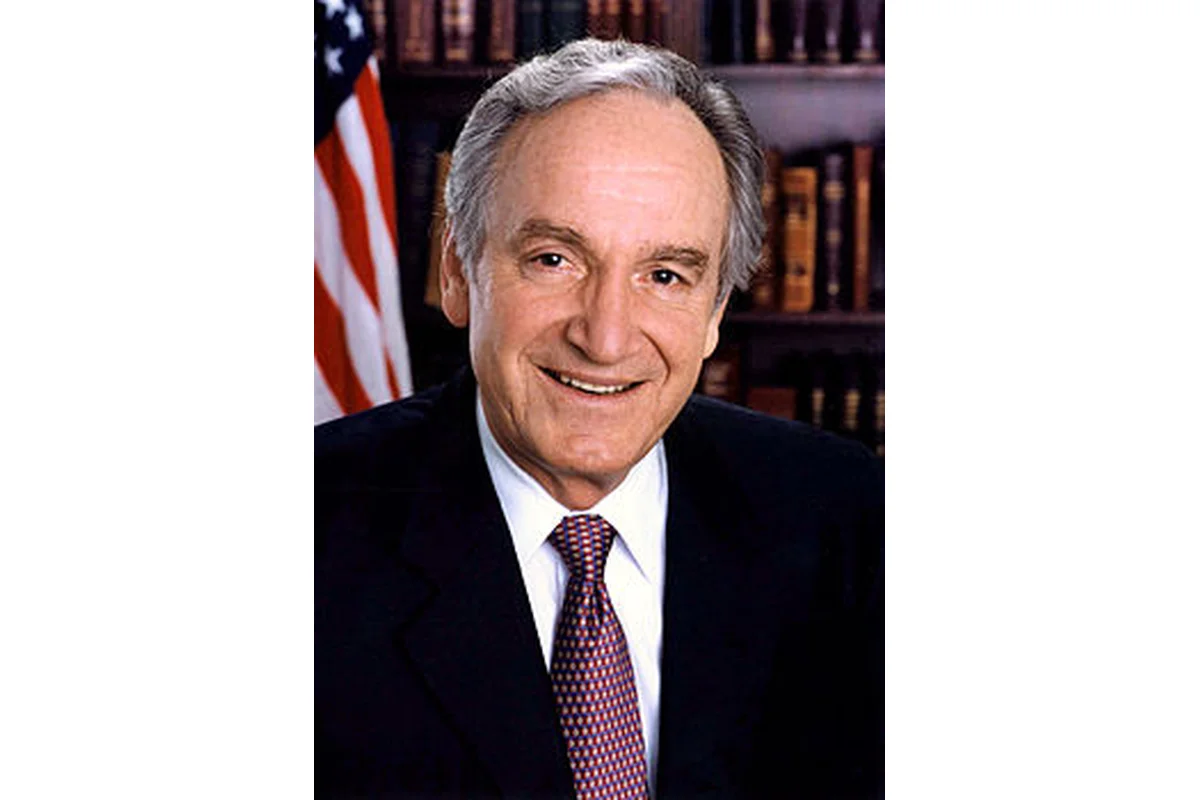
Tom Harkin Bio
Thomas Richard Harkin (born November 19, 1939) is an American lawyer, author, and Democratic politician who represented Iowa in the United States Congress for four decades. He served as a United States Senator from 1985 to 2015 and represented Iowa’s 5th congressional district in the U.S. House of Representatives from 1975 to 1985. A retired Navy commander and former active-duty jet pilot, Harkin is widely recognized as the chief Senate sponsor of the Americans with Disabilities Act of 1990.
Early Life and Background
Thomas Richard Harkin was born on November 19, 1939, in Cumming, Iowa, a small rural community in Warren County. His father, Patrick Francis Harkin, was an Irish American coal miner, and his mother, Franciska Frances Valentine (née Berčič), was a Slovene immigrant who passed away when Tom was ten years old. Harkin was raised in his childhood home along with his five siblings, and the household had no hot running water or furnace.
Through his mother’s earlier marriage in Iowa to fellow Slovenian Valentine Brelih, Harkin gained three older half-siblings on her side of the family. His mother was born in Suha, Slovenia, to Jakob and Marija (born Jugovec). Harkin attended Dowling Catholic High School in West Des Moines, Iowa, where he prepared for further education.
Harkin went on to attend Iowa State University on a Navy ROTC scholarship, joined the Delta Sigma Phi fraternity, and graduated in 1962 with a degree in government and economics. He later earned his Juris Doctor degree in 1972 from The Catholic University of America’s Columbus School of Law.
Path to US Politics
After completing his bachelor’s degree in 1962, Harkin served in the United States Navy as an active-duty jet pilot until 1967. He was stationed at Naval Air Facility Atsugi in Japan, where he ferried aircraft damaged during the Vietnam War, and he also flew missions out of Guantanamo Bay in support of U-2 reconnaissance flights over Cuba. After leaving active duty, he served three years in the Ready Reserves and later transferred to the Naval Reserves in 1970, eventually retiring in 1989 with the rank of commander.
In 1969, Harkin moved to Washington, D.C., to work as an aide to Democratic U.S. Congressman Neal Smith. During a 1970 congressional delegation trip to South Vietnam, he photographed the so-called “Tiger cages” at Côn Đảo Prison and published a detailed account in Life Magazine on July 17, 1970, exposing inhumane prison conditions. That same year he entered law school and, in 1972, returned to Iowa to launch his first campaign for Congress.
Tom Harkin Career
Early Career (1972–1985)
In 1972, Harkin challenged incumbent Republican Congressman William J. Scherle in Iowa’s 5th congressional district. Although he won a higher percentage of the vote than any previous challenger to Scherle, Harkin lost the race. After the defeat, he practiced law in Ames while preparing for a rematch.
During the 1974 midterm cycle, a difficult national environment for Republicans following the Watergate scandal, Harkin defeated Scherle by roughly 3,500 votes. He was then re-elected four more times from Iowa’s 5th congressional district without serious difficulty, serving five terms in the U.S. House of Representatives from 1975 to 1985.
U.S. Senate Career and ADA Breakthrough (1985–2015)
Harkin won his first Senate race in 1984, defeating freshman Republican Roger Jepsen by 152,502 votes after securing the Democratic nomination. He was subsequently re-elected to the Senate in 1990, 1996, 2002, and 2008, serving five terms and becoming the longest-serving Democrat in either chamber from Iowa. He remained Iowa’s junior Senator throughout his tenure alongside senior Senator Chuck Grassley, and the two developed a productive working relationship despite sharp ideological differences.
Harkin’s signature legislative achievement came in 1990 when he introduced and championed the Americans with Disabilities Act (ADA) in the Senate. During his floor introduction of the bill, Harkin delivered part of his speech in sign language so that his deaf brother could follow the remarks. Years later, he proposed the ADA Amendments Act to clarify and broaden the definition of disability, and he also pushed to rebalance Medicaid spending toward community-based care.
Beyond the ADA, Harkin was instrumental in creating the U.S. Office of Alternative Medicine in 1992, which later became the National Center for Complementary and Alternative Medicine. He chaired the Senate Committee on Health, Education, Labor, and Pensions during his final years in the chamber and introduced major legislation such as the Minimum Wage Fairness Act in 2013 and the Cooperative and Small Employer Charity Pension Flexibility Act in 2013. He also supported the Affordable Care Act in 2009 and 2010, though he later expressed disappointment that Congress had not pursued a single-payer or public option.
1992 Presidential Campaign (1991–1992)
In 1992, Harkin sought the Democratic presidential nomination as a populist candidate with strong labor union support. He won the Iowa caucuses as well as contests in Idaho and Minnesota, with assistance from Senator Paul Wellstone, but struggled in New Hampshire and other primary states. He ultimately ended his campaign and endorsed Bill Clinton, becoming the first Democratic contender to drop out and back the eventual nominee.
Harkin’s 1992 run kept him in the national spotlight and shaped his role within the party for years to come. He was considered as a potential vice-presidential running mate by Democratic nominees in 1992, 2000, 2004, and 2008, and he actively campaigned for the Obama-Biden ticket in 2008.
Late Senate Era and Retirement (2008–2015)
Throughout his later Senate years, Harkin remained active on disability rights, labor, and international human rights issues. He sponsored the Harkin–Engel Protocol in 2001, a voluntary agreement with the cocoa and chocolate industry to combat the worst forms of child labor in West Africa. He also supported efforts to repeal the Don’t Ask, Don’t Tell policy in 2010 and defended legal access to abortion, contraception, and embryonic stem cell research.
On January 26, 2013, Harkin announced that he would not seek reelection in 2014, closing a 40-year career representing Iowa in Congress. He completed his final term in January 2015 and was succeeded by Democrat Bruce Braley before Joni Ernst took the seat. In 2015, Harkin served as grand marshal for both the New York City and Chicago Disability Pride Parades.
Notable Events and Milestones
Among Harkin’s defining moments was his decision to introduce part of the ADA speech in American Sign Language so his deaf brother could experience the historic occasion. He also broke a longevity record in 2009, surpassing Neal Edward Smith as the longest-serving Democrat in either chamber from Iowa. His 1970 Life Magazine exposé of the Côn Đảo “Tiger cages” remains an early milestone that shaped his reputation as a voice for human rights.
Tom Harkin Career Wins
Tom Harkin compiled a long record of election victories in Iowa, winning five U.S. House races and five U.S. Senate races over four decades.
Senate Election Highlights
Harkin won his first Senate contest in 1984 by defeating Republican Roger Jepsen. He was re-elected in 1990, 1996, 2002, and 2008, never losing a general election fight for federal office after 1972. His 1984 victory margin of 152,502 votes set the tone for a Senate career defined by durable support among Iowa voters.
Other Wins and Achievements
Harkin’s most significant non-electoral achievement was the passage of the Americans with Disabilities Act of 1990, a law that reshaped civil rights protections across the United States. He also saw his Harkin–Engel Protocol gain international recognition as a tool for combating child labor in the cocoa industry.
Tom Harkin Family
Family Background and Lineage
Harkin grew up in a large family shaped by Irish and Slovenian roots. His father, Patrick Francis Harkin, was an Irish American coal miner, while his mother, Franciska Frances Valentine (née Berčič), was a Slovene immigrant who raised Harkin and his five siblings in a modest home without modern plumbing or central heating. Through his mother’s earlier marriage, Harkin has three older half-siblings on her side of the family.
Personal Life
On July 6, 1968, Harkin married Ruth Raduenz, an attorney who later served as county attorney of Story County, Iowa, and as chairman and chief executive officer of the Overseas Private Investment Corporation under President Bill Clinton. The couple has two daughters, Amy (born 1976) and Jenny (born 1981). Amy Harkin appeared on the NBC daytime series Starting Over from 2003 to 2004 and later earned an MBA from the UCLA Anderson School of Management. As of 2024, Tom Harkin lives in Virginia and also owns his childhood home in Cumming, Iowa.