
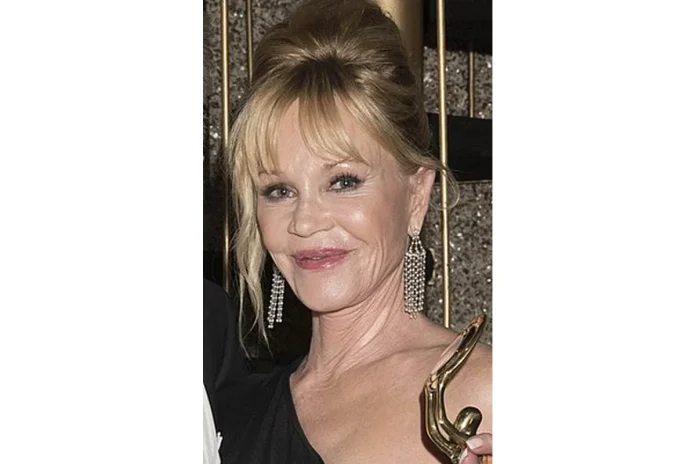
Melanie Griffith Bio
Melanie Richards Griffith (born August 9, 1957) is an American actress whose career has spanned film, television, and stage. Born in Manhattan to actress Tippi Hedren and former child actor Peter Griffith, she was raised mainly in Los Angeles and began acting as a teenager, eventually building a career that includes awards recognition from the Golden Globes, the National Society of Film Critics, and the Academy Awards. Over more than five decades in the entertainment industry, Griffith has alternated between dramatic and comedic roles in major Hollywood productions, independent films, and Broadway theater.
Griffith first drew widespread attention with her performance in the Brian De Palma thriller Body Double (1984), which earned her the National Society of Film Critics Award for Best Supporting Actress. Her mainstream breakthrough arrived with the Mike Nichols comedy Working Girl (1988), a film that brought her an Academy Award nomination for Best Actress and a Golden Globe Award for Best Actress in a Motion Picture – Musical or Comedy. She is the mother of three children, including actress Dakota Johnson, and has continued to appear on screen and on stage into the 2010s.
Early Life and Background
Melanie Richards Griffith was born on August 9, 1957, in Manhattan, New York City. Her mother, Tippi Hedren, was an actress who would later become famous for her work in Alfred Hitchcock’s The Birds and Marnie. Her father, Peter Griffith, was a former child stage actor who later worked as an advertising executive. Griffith’s parents separated when she was two years old, after which she relocated to Los Angeles with her mother. Through her mother, she also became half-sister to Tracy Griffith, an actress who is the daughter of Peter Griffith and his second wife, Nanita Greene.
During her childhood and adolescent years, Griffith divided her time between New York, where she stayed with her father, and Antelope Valley, California, where her mother established the Shambala animal preserve. As a young girl, she appeared in advertisements and briefly worked as a child model before abandoning that path, citing extreme shyness. She attended the Hollywood Professional School, where her academic advancement allowed her to skip a grade and graduate at age 16.
Growing up in a household shaped by her mother’s acting career gave Griffith an early awareness of film production and storytelling. Her parents’ separation, the move from New York to California, and her exposure to the entertainment world through her mother all contributed to her decision to pursue acting as a teenager.
Path to Acting
Griffith’s first onscreen appearances were as an extra in the films Smith! (1969) and The Harrad Experiment (1973). Her first major role came at age 17, when she was cast by director Arthur Penn in the neo-noir film Night Moves (1975), starring opposite Gene Hackman as a runaway teenager pursued by a private detective. The performance drew significant attention, including a profile in Newsweek that described her unusual blend of maturity and youthful presence. In 1975, she was also named Miss Golden Globe, a distinction recognizing children of Hollywood figures who assist at the Golden Globe Awards ceremony.
While on the set of The Harrad Experiment in 1973, fourteen-year-old Griffith met actor Don Johnson, then 22. The two began dating and married in January 1976, separating six months later in July 1976. Following her divorce from Johnson, Griffith continued to work steadily, taking supporting roles in films such as One on One (1977), the Israeli experimental film The Garden (1977), and Joyride (1977). She was also cast in Smile (1975), a satire of beauty pageants, and in The Drowning Pool (1975), a thriller directed by Stuart Rosenberg, co-starring Paul Newman and Joanne Woodward.
These early performances established Griffith as a working actress willing to take on varied and sometimes challenging material. By the early 1980s, she had accumulated enough experience to be cast in larger, more visible productions, even as personal struggles temporarily slowed her momentum.
Melanie Griffith Career
Early Career (1975-1984)
Griffith’s first major role in Night Moves (1975) introduced her to critics and audiences as a promising young dramatic actress. The film’s controversial content, including a nude scene, made headlines, and the role led to a string of supporting parts in 1975 productions such as Smile and The Drowning Pool. Her profile continued to grow through the late 1970s, with supporting work in One on One (1977), The Garden (1977), and Joyride (1977).
In 1981, Griffith appeared alongside her mother, Tippi Hedren, in Roar, a film directed by her then-stepfather Noel Marshall. The production, which featured a large number of live big cats, has been retrospectively described as one of the most dangerous film productions ever made. Griffith herself was mauled by a lion during filming and required facial reconstructive surgery. Also in 1981, she appeared in the made-for-television film She’s in the Army Now with Jamie Lee Curtis and Steven Bauer, and shortly afterward married Bauer. Her well-documented struggles with drug and alcohol addiction temporarily stalled her career in the early 1980s.
Breakthrough (1984-1988)
Griffith made a notable comeback at age 26 with her role in Brian De Palma’s Body Double (1984), in which she portrayed a pornographic film actor. Although the film was a commercial failure, her performance earned her the National Society of Film Critics Award for Best Supporting Actress. She followed this with a supporting role in Abel Ferrara’s thriller Fear City (1985), playing a stripper and prostitute being stalked in Times Square.
In 1986, Griffith had her first starring role opposite Jeff Daniels in Jonathan Demme’s comedy Something Wild, playing a free-spirited woman who befriends a straitlaced banker. The performance earned her a Golden Globe Award nomination for Best Actress in a Motion Picture – Musical or Comedy. Roger Ebert praised her acting, writing that she brought a sense of recklessness to the role. Griffith also appeared in the science-fiction film Cherry 2000 and the neo-noir Stormy Monday (1988), the latter co-starring Sean Bean, Tommy Lee Jones, and Sting.
Griffith achieved mainstream success when Mike Nichols cast her as spunky secretary Tess McGill in the box-office hit Working Girl (1988), co-starring Harrison Ford, Sigourney Weaver, Alec Baldwin, and Joan Cusack. She was nominated for the Academy Award for Best Actress for her performance and won the Golden Globe Award for Best Actress in a Motion Picture – Musical or Comedy. The film marked a professional shift that established her as an A-list actress.
Notable Works and Milestones
Among Griffith’s most recognized works are Body Double (1984), Something Wild (1986), and Working Girl (1988), the last of which remains her signature role. Her career-defining moment came with the Working Girl nomination and Golden Globe win, which positioned her among the leading actresses of late-1980s Hollywood. Subsequent performances in Pacific Heights (1990), Buffalo Girls (1995), and Lolita (1997) further demonstrated her range across genres, from thriller to period drama to dark comedy.
Melanie Griffith Award Nominations
Melanie Griffith has received several major award nominations across her career in film and television. In 1989, she was nominated for the Academy Award for Best Actress for her role in Working Girl, and in 1991 she received a BAFTA Award nomination for Best Actress in a Leading Role for Born on the Fourth of July. In 2000, she earned an Academy Award nomination for Best Supporting Actress for her performance in Paul Thomas Anderson’s Magnolia. On television, she received a Golden Globe nomination for Best Supporting Actress in a Series, Miniseries or Television Film for Buffalo Girls (1995) and an Emmy Award nomination for Outstanding Supporting Actress in a Limited Series or Movie for RKO 281 (1999).
Melanie Griffith Awards Won
Melanie Griffith has won major industry awards for both comedic and dramatic performances. In 1984, she won the National Society of Film Critics Award for Best Supporting Actress for her role in Body Double. In 1989, she won the Golden Globe Award for Best Actress in a Motion Picture – Musical or Comedy for her performance in Working Girl. Her award-winning performances have recognized her range across genres, from psychological thriller to romantic comedy.
| Award | Wins | Year |
|---|---|---|
| National Society of Film Critics Award – Best Supporting Actress (Body Double) | 1 | 1984 |
| Golden Globe Award – Best Actress in a Motion Picture – Musical or Comedy (Working Girl) | 1 | 1989 |
Melanie Griffith Family
Melanie Griffith is the daughter of actress Tippi Hedren and former child actor and advertising executive Peter Griffith. Her parents separated when she was two years old, and she was raised primarily by her mother in Los Angeles. Through her father’s second marriage to model and actress Nanita Greene, she has a half-sister, Tracy Griffith, who also became an actress, and a half-brother, Clay A. Griffith, a set designer. Griffith’s maternal ancestry includes Swedish, Norwegian, and German roots, while her paternal ancestry is English, Welsh, Scots-Irish, Native Irish, and Scottish.
Personal Life
Griffith has been married three times. She first married actor Don Johnson in January 1976; the marriage lasted six months. She married Johnson a second time on June 26, 1989, and they divorced in 1996. She then married Spanish actor Antonio Banderas on May 14, 1996, in London. Griffith and Banderas announced their intention to divorce in June 2014, and the divorce was finalized in December 2015. She has three children: a son, Alexander Griffith Bauer, born August 22, 1985, with actor Steven Bauer; a daughter, Dakota Johnson, born October 4, 1989, with Don Johnson; and a daughter, Stella del Carmen Banderas, born September 24, 1996, with Antonio Banderas. Dakota Johnson has followed her parents into acting. Griffith has spoken publicly about her recovery from drug and alcohol addiction, and in December 2009 and again in August 2018, she underwent surgery to remove skin cancer from her face.