
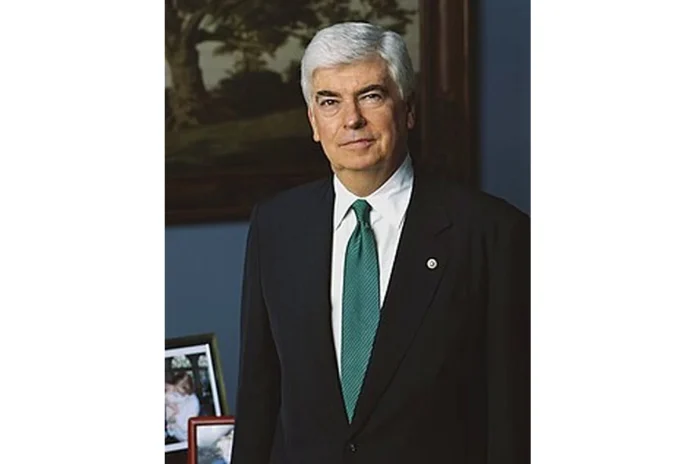
Chris Dodd Bio
Christopher John Dodd (born May 27, 1944) is an American lawyer, lobbyist, and Democratic politician who represented Connecticut in the United States Congress for more than three decades. He served in the U.S. House of Representatives from 1975 to 1981 and in the U.S. Senate from 1981 to 2011, becoming the longest-serving senator in Connecticut history. Dodd chaired the Senate Banking Committee and was a principal author of the Dodd–Frank Wall Street Reform and Consumer Protection Act following the 2008 financial crisis. After leaving the Senate, he led the Motion Picture Association of America and later returned to legal practice and political advisory work.
Early Life and Background
Christopher John Dodd was born on May 27, 1944, in Willimantic, Connecticut. He is the son of Thomas Joseph Dodd, a United States Senator from Connecticut who served from 1959 to 1971, and Grace Mary Dodd, née Murphy. All eight of his great-grandparents were born in Ireland, and he is the fifth of six children. His eldest brother, Thomas J. Dodd Jr., later became a U.S. ambassador to Uruguay and Costa Rica under President Bill Clinton and a Georgetown University professor.
Dodd attended Georgetown Preparatory School, a Jesuit boys’ school in Bethesda, Maryland. He went on to earn a bachelor’s degree in English literature from Providence College in 1966. From 1966 to 1968, he served as a Peace Corps volunteer in the small rural town of Moncion in the Dominican Republic, where he became fluent in Spanish. He then attended the University of Louisville School of Law, earning his Juris Doctor in 1972, while concurrently serving in the United States Army Reserve until 1975.
Path to US Politics
Growing up in a political household, Dodd was exposed to public service from an early age through his father’s Senate career. His two years in the Peace Corps sharpened his interest in social and economic issues, and his legal training at the University of Louisville prepared him for a career in public law. Joining the Army Reserve during law school further reflected his sense of civic duty.
After completing his education, Dodd returned to Connecticut and entered state-level Democratic politics. By 1974, he had won the Democratic nomination for Connecticut’s 2nd congressional district, joining the so-called Watergate class of 1974. His early grassroots work in Connecticut and his family’s political name set the stage for his rapid rise to the U.S. House of Representatives.
Chris Dodd Career
Early Career (1975–1981)
In 1974, Christopher John Dodd won election to the U.S. House of Representatives from Connecticut’s 2nd congressional district and was reelected in 1976 and 1978. He served in the House from January 4, 1975, to January 3, 1981. During his House tenure, he served on the United States House Select Committee on Assassinations and was widely viewed as part of a new generation of liberal Democrats.
In 1980, Dodd won election to the United States Senate. He would go on to win reelection in 1986, 1992, 1998, and 2004, becoming the first senator from Connecticut to serve five consecutive terms. His steady election victories established him as one of the most durable Democratic figures in the state.
Breakthrough (1981–2007)
During the 1994 midterm elections, Republicans won control of both houses of Congress, sending Dodd into the Senate minority. He ran for Senate Minority Leader but lost to South Dakota Senator Tom Daschle by a single vote. From 1995 to 1997, Dodd served as General Chairman of the Democratic National Committee, where he was the party’s public spokesman.
On the policy side, Dodd founded the first Senate Children’s Caucus and authored the Family and Medical Leave Act of 1993, which guarantees unpaid leave for employees dealing with illness, a sick family member, or the birth or adoption of a child. The National Head Start Association named him Senator of the Decade in 1990 for his work on children and family issues. He also briefly considered a 2004 presidential bid and was mentioned as a possible running mate for John Kerry.
Democratic Party Era (2007–2011)
In January 2007, Christopher John Dodd launched his candidacy for President of the United States on the Imus in the Morning show and made a formal announcement at the Old State House in Hartford. Despite opposition to the Iraq War, his campaign struggled in fundraising and polls, and he withdrew after the January 3, 2008, Iowa caucuses, where he placed seventh.
As Chairman of the Senate Banking Committee from 2007 to 2011, Dodd became the leading Senate voice on financial reform. In December 2009, he introduced a bill addressing fallout from the Great Recession that became the Dodd–Frank Wall Street Reform and Consumer Protection Act, signed into law in 2010. He also authored the Credit CARD Act of 2009, signed by President Barack Obama, which strengthened consumer protections on credit cards.
On January 2010, Dodd announced he would not seek reelection. He was succeeded by fellow Democrat Richard Blumenthal. In February 2011, he became chairman and chief lobbyist of the Motion Picture Association of America, serving until September 2017, when he was succeeded by Charles Rivkin.
Notable Events and Milestones
Among the defining moments of Dodd’s career were the passage of the Family and Medical Leave Act in 1993, his service as General Chairman of the Democratic National Committee from 1995 to 1997, and the enactment of the Dodd–Frank Wall Street Reform and Consumer Protection Act in 2010. His 2008 presidential campaign and his tenure as Senate Banking Committee chairman during the financial crisis cemented his standing as a major figure in modern American politics.
Chris Dodd Career Wins
Christopher John Dodd compiled one of the longest records of electoral success in Connecticut history, winning five consecutive Senate terms after three House victories. His legislative wins include the Family and Medical Leave Act, the Credit CARD Act of 2009, and the Dodd–Frank Act, each signed into law and still shaping American policy.
U.S. Senate Highlights
Dodd was elected to the U.S. Senate in 1980 and reelected in 1986, 1992, 1998, and 2004, making him the first senator from Connecticut to serve five consecutive terms. He chaired the Senate Banking Committee from 2007 to 2011. His final decision not to seek reelection in 2010 ended a 30-year career in Congress.
Other Wins & Achievements
Dodd received the Washington Office on Latin America’s Human Rights Award in 2008, The Media Institute’s Freedom of Speech Award in 2014, the Brass Ring Award from the United Friends of the Children in 2016, and the Presidential Citizens Medal from President Joe Biden in 2025. He was also named Senator of the Decade by the National Head Start Association in 1990.
| Position | Wins | Years |
|---|---|---|
| U.S. House of Representatives (CT-2) | 3 | 1974, 1976, 1978 |
| U.S. Senate (Connecticut) | 5 | 1980, 1986, 1992, 1998, 2004 |
Chris Dodd Family
Family Background and Political Lineage
Christopher John Dodd was raised in a prominent Irish-American political family. His father, Thomas Joseph Dodd, served as a United States Senator from Connecticut from 1959 to 1971, and his mother, Grace Mary Dodd, was a steady presence in family life. His eldest brother, Thomas J. Dodd Jr., became a U.S. ambassador to Uruguay and Costa Rica under President Bill Clinton, continuing the family’s tradition of public service.
Personal Life
In 1970, Dodd married Susan Mooney; the couple divorced in 1982. In 1999, he married Jackie Marie Clegg, a native of Orem, Utah, former aide to Senator Jake Garn, and former Export-Import Bank official. Dodd and Clegg have two daughters: Grace, born in September 2001, and Christina, born in May 2005. Dodd was raised Catholic and has spoken publicly about the influence of his faith on his policy work.