

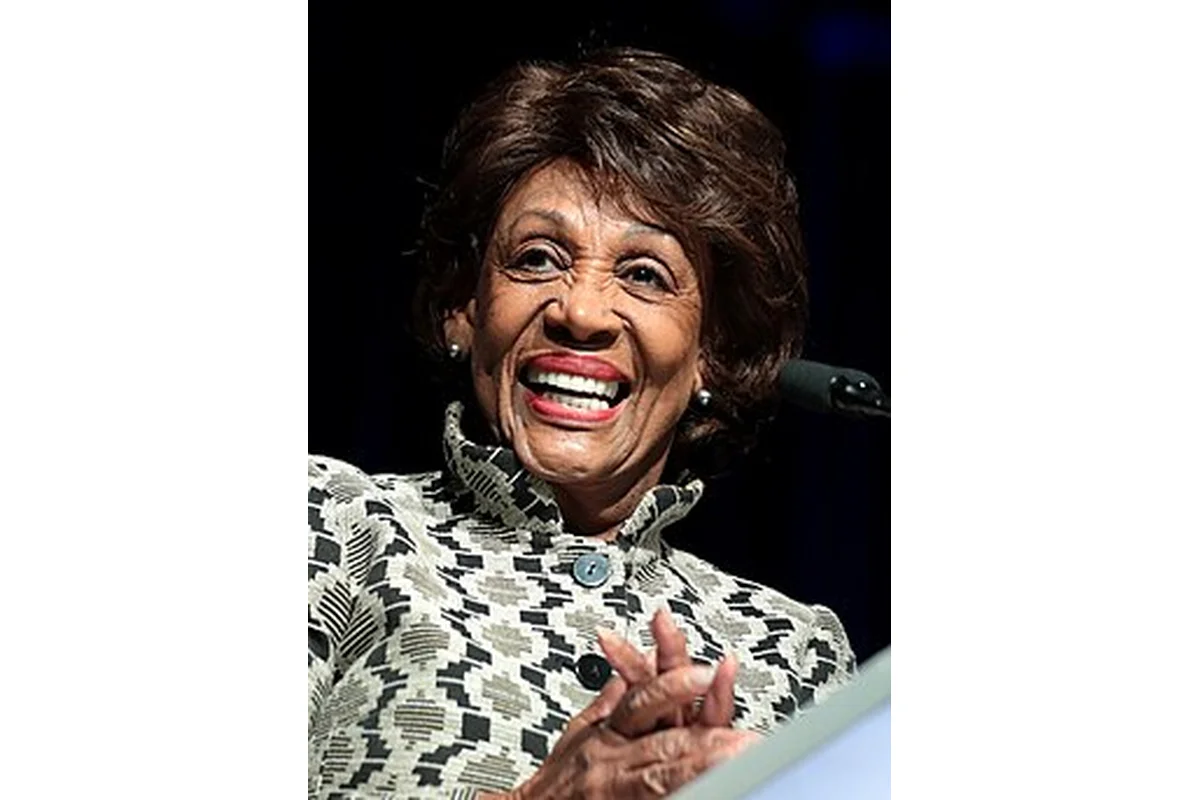
Maxine Waters Bio
Maxine Moore Waters (born August 15, 1938) is an American politician who has represented California’s 43rd congressional district in the United States House of Representatives since 1991. A long-serving member of the Democratic Party, she chaired the House Financial Services Committee from 2019 to 2023 and has served as its ranking member since 2023. Representing much of southern Los Angeles, she is widely known for her outspoken advocacy on housing, civil rights, financial oversight, and international human rights, and was named to Time magazine’s list of the 100 Most Influential People in 2018.
Before her tenure in Congress, Maxine Waters served seven terms in the California State Assembly, first winning election in 1976. She became one of the most senior members of the House, the most senior Black woman in Congress, and a leading voice within the Congressional Black Caucus, which she chaired from 1997 to 1999.
Early Life and Background
Maxine Waters was born in 1938 in St. Louis, Missouri, the daughter of Remus Carr and Velma Lee Moore. She was the fifth of thirteen children. After her father left the family when she was two years old, she was raised by her single mother, an experience that shaped her early awareness of economic hardship and racial inequality. She graduated from Vashon High School in St. Louis before moving with her family to Los Angeles in 1961.
After relocating to Los Angeles, she worked in a garment factory and as a telephone operator before being hired as an assistant teacher with the Head Start program in Watts in 1966. The position marked her first sustained engagement with public service in one of the city’s most underserved communities and helped redirect her career toward government and politics.
Maxine Waters later enrolled at Los Angeles State College, now known as California State University, Los Angeles, where she earned a bachelor’s degree in sociology in 1971. Her studies gave her an academic framework for the issues of poverty, race, and urban life that would become central to her political work.
Path to US Politics
Maxine Waters’s entry into politics began in 1973, when she was hired as chief deputy to Los Angeles City Councilman David S. Cunningham Jr. The role introduced her to the inner workings of municipal government and built the political network that would support her first run for office. In 1976, she won election to the California State Assembly, beginning a long career in elected public service.
As a state assemblywoman, she focused on divestment, working to pull state pension funds away from businesses operating in apartheid-era South Africa. She also helped pass legislation aligned with the Sullivan Principles, a corporate code of conduct promoting fair treatment of workers. Her colleagues elevated her to the position of Democratic Caucus Chair for the Assembly.
Her seven terms in Sacramento established her as a forceful voice on economic justice and racial equity. When veteran Congressman Augustus F. Hawkins announced his retirement in 1990, Maxine Waters launched a successful campaign for his seat, winning with more than 79 percent of the vote and beginning a congressional career that has continued for more than three decades.
Maxine Waters Career
Early Career (1976–1990)
Maxine Waters was elected to the California State Assembly in 1976 and quickly built a reputation as a determined legislator. Her early work centered on poverty, race, and corporate accountability, particularly the effort to force California to divest from companies doing business in apartheid South Africa. The campaign gave her a national profile among activists and set the tone for her future priorities in Congress.
She served seven terms in the Assembly, rising to Democratic Caucus Chair and gaining the political experience that would prove decisive when she decided to run for the United States House of Representatives. By the time veteran Democrat Augustus F. Hawkins retired, she had built a powerful local organization in south-central Los Angeles and a fundraising base capable of supporting a congressional bid.
Congressional Breakthrough (1991–2000)
Maxine Waters took office in 1991 after winning California’s 29th congressional district with more than 79 percent of the vote. She was repeatedly reelected, with her district renumbered as the 35th in 1992 and the 43rd in 2012, and she consistently earned at least 70 percent of the vote in subsequent campaigns. Her district has covered large parts of south-central Los Angeles, along with the Los Angeles coastal communities of Westchester and Playa del Rey and the cities of Torrance, Gardena, Hawthorne, Inglewood, and Lawndale.
She gained widespread national attention during the 1992 Los Angeles riots that followed the acquittal of officers in the Rodney King beating. Maxine Waters led a crowd in chanting “No justice, no peace” and helped deliver relief supplies in Watts, framing the unrest as a “rebellion” rooted in longstanding injustice. She later chaired the Congressional Black Caucus from 1997 to 1999, cementing her influence among African American lawmakers.
House Financial Services Era (2001–Present)
Throughout her tenure, Maxine Waters emerged as one of Congress’s most vocal critics of presidential power, voting against the Iraq War Resolution in 2002 and consistently calling for troop withdrawal. After Barney Frank’s retirement in 2012, she became the ranking member of the House Financial Services Committee. When Democrats regained the majority in 2019, she became chair, earning an “A” grade from the nonpartisan Lugar Center’s Congressional Oversight Hearing Index for her leadership of the panel.
In that role, she pressed Treasury Secretary Steven Mnuchin on financial oversight, introduced housing legislation such as the Home Forward Act of 2014 to expand affordable housing, and called on regulators to scrutinize Facebook’s proposed cryptocurrency. She stepped down as chair in 2023 and has since served as the committee’s ranking member. In 2017, she was one of 31 House Democrats who voted not to count Ohio’s electoral votes in the 2004 presidential election, and she objected to electoral votes from Wyoming after the 2016 contest.
Notable Events and Milestones
On July 29, 1994, Maxine Waters became the focus of a rare House disciplinary action when she repeatedly interrupted a speech by Representative Peter King during a debate tied to the Whitewater controversy. The presiding officer classed her behavior as “unruly and turbulent” and threatened to use the Mace of the House, the most recent instance of the mace being used for a disciplinary purpose as of 2017. In October 2018, pipe bombs were sent to two of her offices, intercepted by the FBI as part of a broader attack that targeted several Democratic leaders and CNN, leading to a 20-year prison sentence for the perpetrator in 2019.
Maxine Waters Career Wins
Maxine Waters has never lost a congressional election since her first victory in 1990, and she has consistently won more than 70 percent of the vote in her district, making her one of the most reliably successful politicians in California. Her electoral strength has allowed her to focus on policy rather than political survival.
Congressional Highlights
Her first major win came in 1990, when she captured more than 79 percent of the vote to succeed Augustus F. Hawkins in California’s 29th congressional district. She has been reelected continuously from that district, which was renumbered as the 35th in 1992 and the 43rd in 2012. In the 2008 Democratic presidential primary, she initially endorsed Senator Hillary Clinton before switching her support to Senator Barack Obama once his delegate lead became insurmountable.
Other Wins and Achievements
Maxine Waters was inducted into the National Women’s Hall of Fame and named one of Time magazine’s 100 Most Influential People in 2018, the same year she was honored at the Time 100 Gala. She is the most senior Black woman serving in Congress and the second-most senior member of the California congressional delegation after Nancy Pelosi.
| Position | Wins | Year |
|---|---|---|
| California State Assembly (first elected) | Elected | 1976 |
| U.S. House of Representatives (first elected) | Elected | 1990 |
| Congressional Black Caucus Chair | Served | 1997–1999 |
| House Financial Services Committee Chair | Served | 2019–2023 |
Maxine Waters Family
Family Background and Political Lineage
Maxine Waters was born into a large working-class family in St. Louis, Missouri, as one of thirteen children of Remus Carr and Velma Lee Moore. After her father left the family when she was two, her mother raised the children on her own, an experience that informed her lifelong focus on economic inequality and support for single mothers. She has drawn on that upbringing throughout her political career to advocate for low-income families in Los Angeles.
Personal Life
Maxine Waters married her first husband, Edward Waters, in 1956, and they divorced in 1972. The couple had two children, Karen Waters and Edward Waters. In 1977, she married Sid Williams, a former professional football player in the National Football League and a former United States ambassador to the Bahamas under the Clinton administration. The couple lives in the Windsor Square neighborhood of Los Angeles, and during the COVID-19 pandemic in May 2020, she confirmed that her sister, Velma Moody, had died of the virus at the age of 86.