

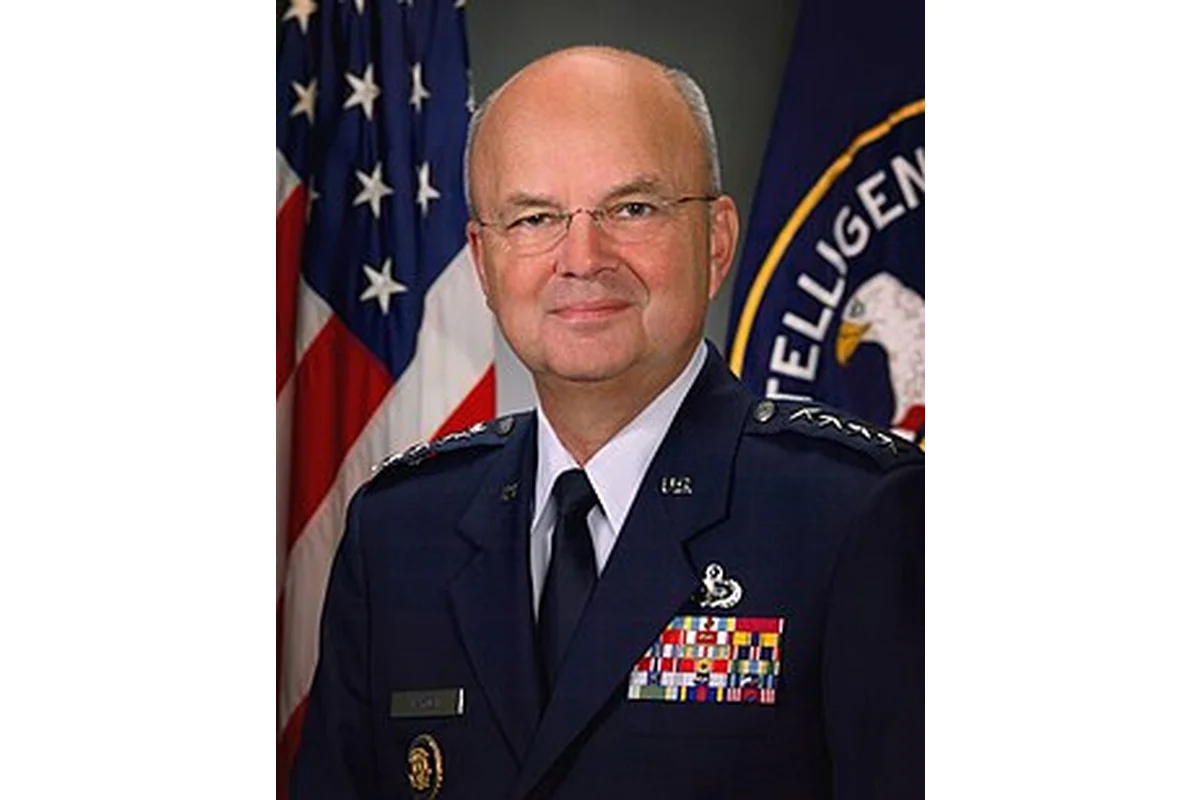
Michael Hayden Bio
Michael Vincent Hayden (born March 17, 1945) is a retired United States Air Force four-star general and former intelligence official. He served as Director of the National Security Agency (1999–2005), the first Principal Deputy Director of National Intelligence (2005–2006), and Director of the Central Intelligence Agency (2006–2009). After retiring from government service, he became a visiting professor, consultant, and public commentator on national security issues.
Early Life and Background
Michael Vincent Hayden was born on March 17, 1945, in Pittsburgh, Pennsylvania, to an Irish-American couple, Sadie (Murray) and Harry V. Hayden Jr. His father worked as a welder for a Pennsylvania manufacturing company. He has a sister, Debby, and a brother, Harry.
Hayden attended St. Peter’s Elementary School, where in seventh and eighth grade he played quarterback on the school football team and was coached by the late Dan Rooney, the son of the founder of the Pittsburgh Steelers. He graduated from North Catholic High School, and one of his first jobs was as an equipment manager for the Steelers. He went on to attend Duquesne University in Pittsburgh, where he earned a Bachelor of Arts in history in 1967 and was commissioned as a second lieutenant. He later attended graduate school at Duquesne, earning a master’s degree in modern American history.
Path to National Security Leadership
Hayden was commissioned through Duquesne University’s Air Force Reserve Officers’ Training Corps program and entered active military service in 1969. Over the following decades, he held a series of intelligence and staff positions in the United States Air Force, working at the U.S. Embassy in the People’s Republic of Bulgaria, serving in intelligence in Guam, and taking on senior staff roles at the Pentagon, U.S. European Command headquarters in Stuttgart, and the United Nations Command and U.S. Forces Korea in Yongsan Garrison.
He also served on the National Security Council in Washington, D.C., and directed the Joint Command and Control Warfare Center at Lackland Air Force Base. From 1996 to 1997, he commanded the Air Force Intelligence, Surveillance and Reconnaissance Agency, an organization staffed by 16,000 personnel charged with defending and exploiting the information domain.
Michael Hayden Career
Early Career (1969–1999)
Hayden’s early career centered on building expertise in signals intelligence, military staff work, and joint command operations. His postings across Europe, the Pacific, and the Pentagon gave him broad exposure to intelligence collection, alliance coordination, and information warfare. These assignments prepared him for senior leadership in the post-Cold War intelligence community.
By the late 1990s, Hayden had risen to the rank of lieutenant general and was widely respected as a thoughtful intelligence professional. His combination of operational experience and policy exposure positioned him as a leading candidate to lead the National Security Agency at a moment of rapid technological change.
National Security Agency Directorship (1999–2005)
In February 1999, President Bill Clinton nominated Hayden to be Director of the National Security Agency and Chief of the Central Security Service at Fort George G. Meade, Maryland. He served in that role from March 1999 to April 2005, leading a combat support agency of the Department of Defense with military and civilian personnel stationed worldwide.
Hayden arrived at the agency during a period of upheaval, and soon after he took office a major part of the NSA network system crashed and was down for several days. He worked to revitalize the agency by introducing outside contractors, encouraging older managers to retire, and overhauling management structures. He also championed the Trailblazer Project, a major effort to modernize the agency’s information technology capabilities.
After the September 11, 2001 attacks, Hayden oversaw a significant expansion of NSA activity, including controversial surveillance programs targeting communications between persons in the United States and foreign individuals with alleged ties to terrorist groups. The program became known as the NSA warrantless surveillance controversy and sparked lasting legal and political debate. In 2020, the U.S. 9th Circuit Court of Appeals ruled in United States v. Moalin that the NSA’s mass surveillance of Americans’ telephone records violated the Foreign Intelligence Surveillance Act and possibly the Fourth Amendment.
Principal Deputy Director of National Intelligence (2005–2006)
On April 21, 2005, the United States Senate confirmed Hayden as the first Principal Deputy Director of National Intelligence, a position created by the Intelligence Reform and Terrorism Prevention Act of 2004. He was awarded his fourth star, becoming the highest-ranking military intelligence officer in the armed forces. He served under the first Director of National Intelligence, John Negroponte, from May 2005 to May 2006.
Director of the Central Intelligence Agency (2006–2009)
On May 8, 2006, President George W. Bush nominated Hayden as Director of the Central Intelligence Agency following the resignation of Porter J. Goss. The Senate confirmed him on May 26, 2006, by a vote of 78–15. He retired from the Air Force in April 2008 after 41 years of service, while continuing to serve as CIA Director until February 12, 2009.
During his tenure, Hayden defended the NSA’s domestic telephone call database and the agency’s warrantless surveillance programs, stating that he had relied upon legal advice from the White House. He also pushed to allow the CIA to conduct drone strikes based on the behavior of ground vehicles, and he was a vocal defender of the CIA’s enhanced interrogation program. Critics accused him of misleading Congress during testimony about the program, and the 2014 Senate Intelligence Committee report on CIA torture cited an email indicating that Hayden had instructed that out-of-date information be used in briefing Congress.
Post-Government Career (2009–Present)
Following his departure from the CIA, Hayden joined the Chertoff Group, a security consultancy, where he worked as a principal for several years before leaving at the end of 2022. He serves on the board of directors of the Atlantic Council and co-founded the Michael V. Hayden Center for Intelligence, Policy, and International Security. He also works as a visiting professor at the George Mason University – Schar School of Policy and Government, co-chairs the Bipartisan Policy Center’s Electric Grid Cyber Security Initiative, and serves on the advisory board of NewsGuard.
Notable Events and Milestones
Hayden led three of the most powerful institutions in the U.S. intelligence community during one of the most turbulent periods in modern American history. His tenure coincided with the September 11 attacks, the Iraq and Afghanistan wars, the rise of drone warfare, and major debates over civil liberties and surveillance. In 2008, the city of Pittsburgh named a part of a street going past Heinz Field in his honor.
Michael Hayden Family
Family Background and Personal Life
Hayden is married to Jeanine Carrier. The couple has a daughter, Margaret, and two sons, Michael and Liam. Hayden was born into an Irish-American family in Pittsburgh, Pennsylvania, and he continues to be an avid fan of his hometown Pittsburgh Steelers, traveling with his wife to several games a year.
Health and Recognition
In November 2018, Hayden was hospitalized after suffering a stroke. He recovered, but the stroke left him with aphasia. Throughout his career he received numerous military decorations, including the Defense Distinguished Service Medal, the Defense Superior Service Medal, the Legion of Merit, the Bronze Star Medal, and the Meritorious Service Medal. In 2007, he received the Golden Plate Award of the American Academy of Achievement, and in 2011 he was inducted into the Air Force Reserve Officer Training Corps Distinguished Alumni at Maxwell Air Force Base.