
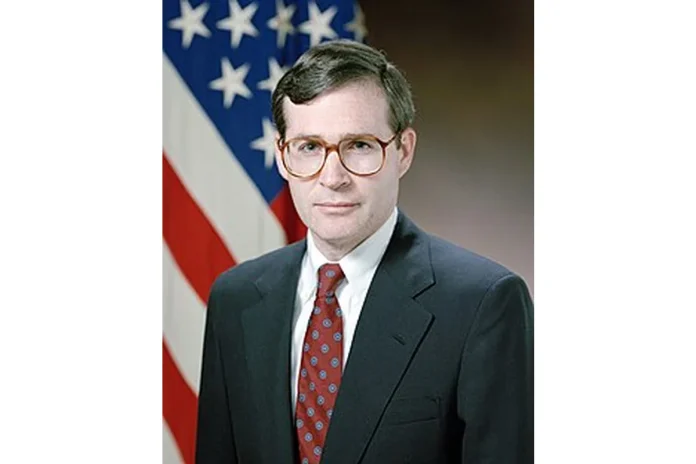
Stephen Hadley Bio
Stephen John Hadley (born February 13, 1947) is an American attorney and senior government official best known for serving as the 20th United States National Security Advisor from 2005 to 2009 under President George W. Bush. Over a career spanning more than five decades, Hadley has held senior positions in the United States Navy, the Pentagon, the National Security Council, and several Washington-based policy and consulting organizations.
A member of the Republican Party, Hadley has shaped American foreign and defense policy through roles that included Assistant Secretary of Defense for International Security Policy under President George H. W. Bush and Deputy National Security Advisor during George W. Bush’s first term. Since leaving government, he has remained a prominent voice on national security, strategy, and international affairs.
Early Life and Background
Stephen John Hadley was born on February 13, 1947, in Toledo, Ohio. He is the son of Suzanne Hadley (née Bentley), a homemaker, and Robert W. Hadley Jr., an electrical engineer. The family later moved to South Euclid, Ohio, in the Cleveland metropolitan area, where Hadley spent much of his childhood.
Hadley attended Charles F. Brush High School, where his interest in public service was sparked by reading the Allen Drury novel Advise and Consent. He became involved in student leadership and was elected student body president. He graduated as class valedictorian in 1965, an early indication of the academic discipline that would define his later career.
Following high school, Hadley earned a Bachelor of Arts degree in government from Cornell University in 1969. He then attended Yale Law School, where he received his Juris Doctor in 1972. At Yale, he served as Note and Comment Editor of the Yale Law Journal and was a classmate of Hillary Clinton. He was also a member of Phi Kappa Psi fraternity, the Cornell University Glee Club, and the Quill and Dagger society at Cornell.
Path to US Politics
Hadley’s path to government service began with military duty. After commissioning as an Ensign in the United States Navy through Yale Naval ROTC in 1972, he served as an officer from 1972 to 1975. His early assignments included working as an analyst for the Comptroller of the Department of Defense from 1972 to 1974, giving him firsthand exposure to federal budgeting and defense planning.
From 1974 to 1977, Hadley joined the National Security Council staff under President Gerald Ford. During this period, he also began work at the Washington, D.C., law firm of Shea & Gardner, laying the groundwork for a legal career focused on international business and regulatory matters. In 1986 and 1987, he served as counsel to the Special Review Board established by President Ronald Reagan to investigate the Iran-Contra affair, gaining experience in high-level government accountability.
Hadley’s national security career advanced significantly during the administration of President George H. W. Bush. From 1989 to 1993, he served as Assistant Secretary of Defense for International Security Policy, where his responsibilities included defense policy toward NATO and Western Europe, nuclear weapons, ballistic missile defense, arms control, and the use of space. He also represented Secretary of Defense Dick Cheney in negotiations led by Secretary of State James Baker that produced the START I and START II arms reduction treaties.
Stephen Hadley Career
Early Career (1972–2000)
After leaving the George H. W. Bush administration in 1993, Hadley spent the Clinton years in private legal and consulting practice. He returned to Shea & Gardner as an administrative partner, advising U.S. and foreign corporations on export controls, foreign investment in national security industries, and the national security responsibilities of U.S. information technology firms. He also served as a principal in The Scowcroft Group, an international consulting firm, representing American corporate clients operating overseas.
In addition, Hadley joined the Board of Managers of the Johns Hopkins Applied Physics Laboratory, strengthening his ties to the defense and technology research community. These roles kept him closely connected to Washington policy debates as he prepared for a return to senior government service.
George W. Bush Administration Breakthrough (2001–2009)
Hadley served as a senior foreign and defense policy adviser to Governor George W. Bush during the 2000 presidential campaign and participated in the Bush-Cheney Transition on the National Security Council. On January 22, 2001, he became Assistant to the President and Deputy National Security Advisor. In that role, he became a member of the White House Iraq Group in 2002.
In 2005, Hadley reached the pinnacle of his government career when he was appointed the 20th United States National Security Advisor, replacing Condoleezza Rice upon her confirmation as Secretary of State. As the principal White House foreign policy adviser to President Bush, he directed the National Security Council staff and managed the interagency national security policy process. In 2007, he led a public effort to build support for the proposed troop surge in Iraq, and he helped steer negotiations with North Korea through the Six-Party Talks aimed at denuclearizing the Korean Peninsula.
Post-Government Era (2009–Present)
After leaving office in 2009, Hadley became a senior adviser for international affairs at the United States Institute of Peace in Washington, D.C. On January 24, 2014, he was elected chairman of the organization’s Board of Directors. He has also co-founded Rice, Hadley, Gates & Manuel LLC, a strategic consulting firm, alongside Condoleezza Rice, Robert Gates, and Anja Manuel.
Hadley continues to serve on multiple influential boards. He is Executive Vice Chair of the Atlantic Council’s Board of Directors and a director at the defense contractor Raytheon. He is also a member of the Council on Foreign Relations, the Defense Policy Board, the Foreign Affairs Policy Board, the National Security Advisory Panel to the Director of Central Intelligence, and the Board of Trustees of Analytical Services. In January 2024, he traveled to Taipei with James Steinberg as part of a U.S. delegation in the aftermath of Taiwan’s 2024 presidential election.
Notable Events and Milestones
One defining moment of Hadley’s tenure came in 2003, when he accepted responsibility for allowing a disputed claim about Iraq’s pursuit of nuclear materials from Niger to appear in President Bush’s January 28, 2003, State of the Union Address. He offered his resignation to the President, who declined it. Hadley also played a central role in late-stage negotiations that produced the START I and START II strategic arms reduction treaties during the early 1990s, marking him as a key architect of post-Cold War nuclear policy.
Stephen Hadley Personal Life
Family Background
Hadley was born to Robert W. Hadley Jr., an electrical engineer, and Suzanne Hadley (née Bentley), a homemaker. His upbringing in Ohio and his early reading of Advise and Consent shaped his longstanding interest in public policy and government service.
Personal Life
Hadley lives in Washington, D.C., with his wife, Ann Hadley, a Justice Department lawyer. The couple has two daughters. He remains based in the nation’s capital, where he continues his work in foreign policy, consulting, and board service.