

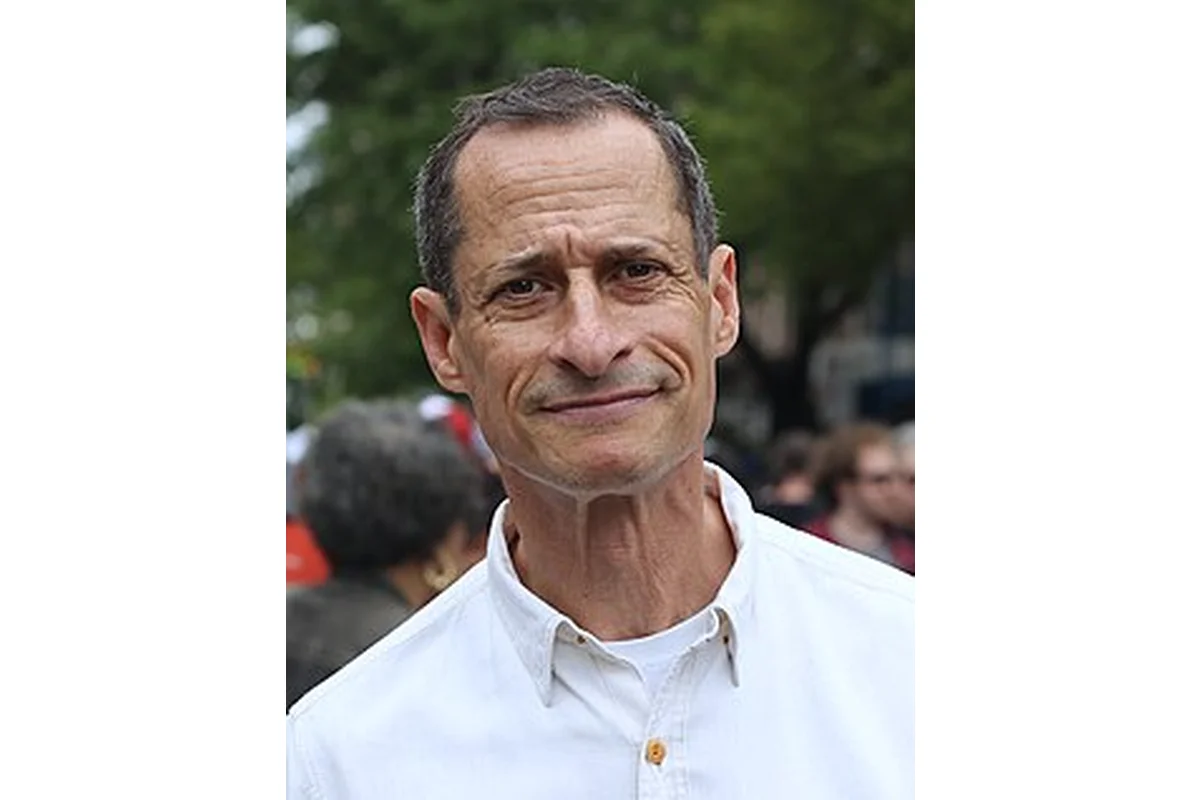
Anthony Weiner Bio
Anthony David Weiner (born 4 September 1964) is an American politician from New York. A member of the Democratic Party, he served on the New York City Council from 1992 to 1998 and represented New York’s 9th congressional district in the U.S. House of Representatives from 1999 until his resignation in 2011. Anthony Weiner began his political career on the staff of then-Representative Chuck Schumer and became the youngest city councilmember in New York City history at age 27.
After leaving Congress amid a public sexting scandal, Anthony Weiner mounted an unsuccessful bid for mayor of New York City in 2013. In 2017, he pleaded guilty to transferring obscene material to a minor, served time in federal prison, and is required to register as a sex offender. Following his release, he has worked in consulting, the private sector, and radio.
Early Life and Background
Anthony David Weiner was born in Brooklyn, New York, the middle son of Mort Weiner, a lawyer, and Frances Finkelstein, a public high school math teacher. The family lived for a time in the Park Slope neighborhood of Brooklyn, and Anthony attended elementary school at P.S. 39 The Henry Bristow School. He is Jewish and grew up in a household that placed value on public service and education.
Anthony Weiner took the Specialized High Schools Admissions Test and was admitted to Brooklyn Technical High School, from which he graduated in 1981. He then attended the State University of New York at Plattsburgh and spent his junior year as an exchange student at the College of William & Mary, where he became friends with future comic and political commentator Jon Stewart. At SUNY Plattsburgh, Anthony Weiner’s interests turned toward politics; he became active in student government and was named most effective student senator.
After earning a Bachelor of Arts degree in political science from SUNY Plattsburgh in 1985, Anthony Weiner joined the staff of then-United States Representative Charles Schumer. He worked in Schumer’s Washington, D.C., office for three years and then transferred to the district office in Brooklyn in 1988, when Schumer encouraged him to pursue local politics. That mentorship laid the groundwork for Anthony Weiner’s rapid rise in New York City government.
Path to US Politics
Anthony Weiner’s path to US politics began in earnest in 1991, when the New York City Council was expanded from 35 to 51 seats and he launched a long-shot campaign for the 48th district. He narrowly won the Democratic primary, besting Michael Garson by slightly more than 200 votes, and prevailed in the general election. In doing so, Anthony Weiner became the youngest city councilmember in New York City history at age 27.
During his time on the New York City Council from 1992 to 1998, Anthony Weiner focused on quality-of-life issues, started a program that put at-risk and troubled teens to work cleaning up graffiti, and backed development plans that helped revive the historic Sheepshead Bay area. In 1998, when his mentor Chuck Schumer opted to run for the U.S. Senate, Anthony Weiner ran for Congress from New York’s 9th congressional district. He narrowly won the Democratic primary and won by a wide margin in the general election, beginning a House career that would last until 2011.
Anthony Weiner Career
Early Career (1991–1998)
Anthony Weiner’s first notable political breakthrough came in 1991 when he won a seat on the New York City Council representing the 48th district. His campaign drew controversy in its final weeks after anonymous leaflets connected his opponent to the so-called “Jackson-Dinkins agenda,” but Anthony Weiner prevailed in both the primary and the general election. He took office at 27, the youngest city councilmember in New York City history.
During six years on the New York City Council, Anthony Weiner developed a reputation as an energetic legislator focused on constituent concerns. He launched teen anti-graffiti programs, supported Sheepshead Bay redevelopment, and built the local political network that would support his later campaigns. Those council years positioned him as a rising star in the New York Democratic Party and prepared him to run for the U.S. House of Representatives.
Breakthrough (1998–2010)
Anthony Weiner won election to the U.S. House of Representatives in 1998 from New York’s 9th congressional district and was sworn in for the 106th Congress in January 1999. He quickly became a vocal liberal voice on domestic policy, criticizing the 2009 Stupak-Pitts Amendment to the Affordable Care Act and advocating for a United States National Health Care Act that would have expanded Medicare to all Americans regardless of age. In 2008, Anthony Weiner founded the bipartisan Congressional Middle Class Caucus and sponsored legislation to increase O-visas for foreign fashion models to support New York City’s fashion industry.
In 2009, Anthony Weiner was the chief sponsor of the Prevent All Cigarette Trafficking Act, which made the selling of tobacco in violation of any state tax law a federal crime and effectively ended Internet tobacco smuggling through the United States Postal Service. He was a prominent critic of the 2009 arms deal with Saudi Arabia, a vocal opponent of the Tax Relief, Unemployment Insurance Reauthorization, and Job Creation Act of 2010, and a forceful advocate for first responders to the September 11 attacks. Anthony Weiner also sought the Democratic nomination for mayor of New York City in 2005, finishing second in the primary to Fernando Ferrer.
Anthony Weiner’s House tenure came to an abrupt end in 2011. On May 27, 2011, he sent a sexually explicit photograph of himself over Twitter to a follower. After several days of denial, Anthony Weiner admitted at a press conference that he had exchanged messages and photos of an explicit nature with about six women over three years. He resigned from Congress on June 21, 2011, and a special election held on September 13, 2011 returned the seat to Republican control when Bob Turner defeated David Weprin.
Post-Congressional Period (2011–Present)
After leaving Congress, Anthony Weiner created the consulting firm Woolf-Weiner Associates, advised clients including electronic medical records providers and biofuel firms, and worked with the international law firm Covington & Burling. He later served as a part-time consultant on the board of advisors of MWW Group, wrote columns on New York City politics, and appeared on NY1. In August 2021, Anthony Weiner stepped down as CEO of IceStone, a Brooklyn-based kitchen-countertop company, when it transitioned to a worker-owned cooperative. He currently co-hosts a weekly live show on WABC radio with Curtis Sliwa and records a weekly podcast.
In 2013, Anthony Weiner re-entered politics with a campaign for mayor of New York City. During the campaign, a second sexting scandal emerged when a woman posted a lewd photo that Anthony Weiner had sent her in 2012, after he had left Congress. He acknowledged sending sexual messages to at least three women that year and used the alias “Carlos Danger” in some of those exchanges. Anthony Weiner lost the 2013 Democratic mayoral primary with only 4.9 percent of the vote.
The political fallout deepened in 2016. In August, the New York Post reported that Anthony Weiner had sexted a picture of himself in bed with his young son, leading his wife Huma Abedin to announce their separation. In September 2016, claims surfaced that he had engaged in sexting with a 15-year-old girl from North Carolina. Devices owned by Anthony Weiner were seized, and emails pertinent to the Hillary Clinton email controversy were discovered on his laptop, prompting FBI Director James Comey to reopen the Clinton investigation days before the 2016 presidential election.
Notable Events and Milestones
Anthony Weiner’s most consequential moment came on September 25, 2017, when U.S. District Judge Denise Cote sentenced him to 21 months in federal prison after he pleaded guilty to a single charge of transferring obscene material to a minor. He reported to Federal Medical Center, Devens in Ayer, Massachusetts, on November 6, 2017, was released to a halfway house on February 17, 2019, and completed his supervised release on May 14, 2019. He is required to register as a sex offender.
Anthony Weiner Family
Family Background and Political Lineage
Anthony David Weiner was raised in a Brooklyn household shaped by public service. His father, Mort Weiner, was a lawyer, and his mother, Frances Finkelstein, was a public high school math teacher. His older brother Seth was killed by a hit-and-run driver in 2000 at the age of 39, and his younger brother Jason is a chef and co-owner of several New York restaurants. Politically, Anthony Weiner’s most important early mentor was Charles Schumer, who gave him his first staff job and later supported his move into New York City politics.
Personal Life
Anthony Weiner became engaged to Huma Abedin, a long-time personal aide to Hillary Clinton, in 2009, and they married in July 2010 with former President Bill Clinton officiating. In December 2011, the couple had a son. Abedin announced their separation in August 2016 and filed for divorce on May 19, 2017, the same day Anthony Weiner pleaded guilty in his federal case. The couple briefly withdrew their divorce filing in January 2018 before finalizing the divorce in early 2025. Anthony Weiner is a lifelong fan of the New York Mets and the New York Islanders.
Anthony Weiner Upcoming Projects
As of 2025, Anthony Weiner remains a co-host of a weekly live show on WABC radio with Curtis Sliwa and records a weekly podcast. In 2025, he announced a candidacy in the 2025 New York City Council election for District 2, running against New York State Assemblyman Harvey Epstein and three other Democrats. On July 1, 2025, Anthony Weiner lost the Democratic primary after being eliminated in the third round of ranked choice voting, finishing in fourth place with 10.3 percent of the vote.