

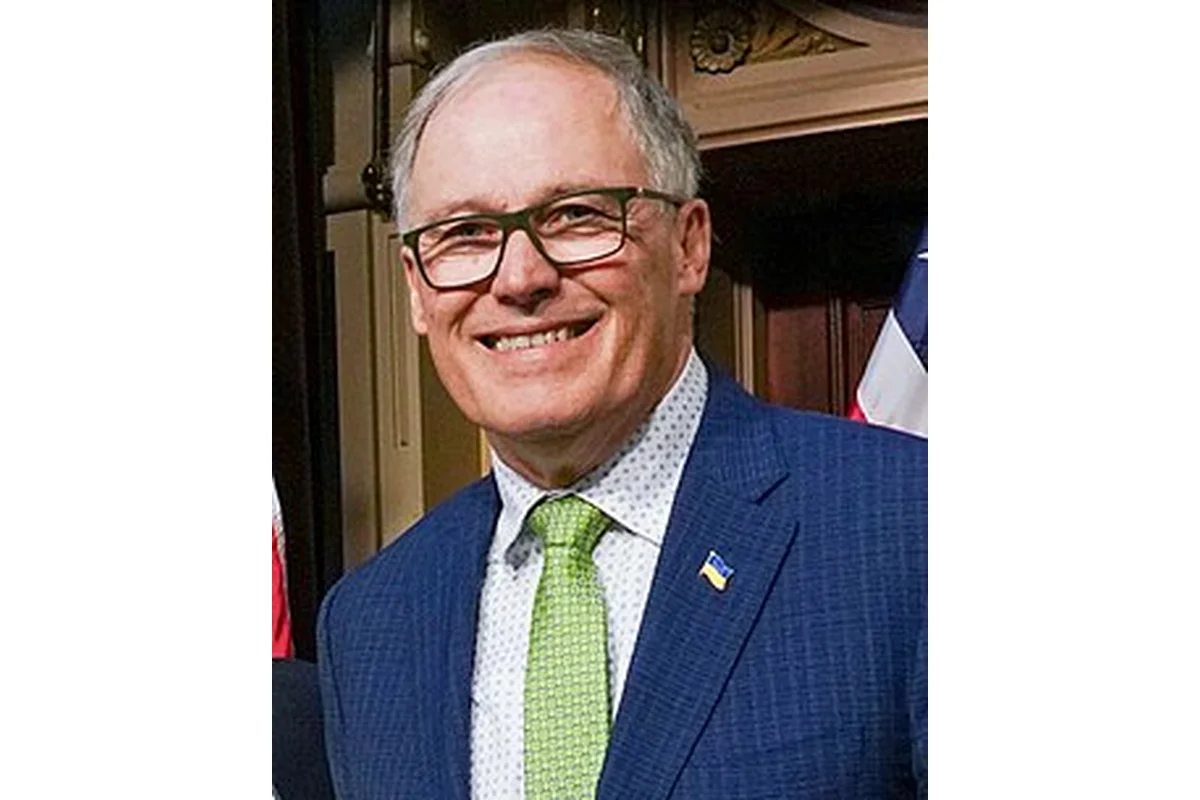
Jay Inslee Bio
Jay Robert Inslee, born February 9, 1951, is an American politician and attorney who served as the 23rd governor of Washington from 2013 to 2025. A member of the Democratic Party, Inslee built a long career in public service, representing Washington in the U.S. House of Representatives from 1993 to 1995 and again from 1999 to 2012, and serving in the Washington House of Representatives from 1989 to 1993.
Raised in Seattle and a fifth-generation Washingtonian, Inslee earned a Bachelor of Arts in economics from the University of Washington and a Juris Doctor from Willamette University College of Law. As governor, he emphasized climate change, education, criminal justice reform, and public-health policy, and he briefly sought the 2020 Democratic presidential nomination on a climate-centered platform.
Early Life and Background
Jay Robert Inslee was born on February 9, 1951, in Seattle, Washington, the oldest of three sons of Adele A. (née Brown), who died in 2007, and Frank E. Inslee, who lived from 1926 to 2014. Inslee is a fifth-generation Washingtonian and has described his family as being of English and Welsh descent.
Inslee attended Seattle’s Ingraham High School, where he was an honor-roll student and a star athlete. He played center on the basketball team and started at quarterback for the football team, graduating in 1969. His interest in environmental issues developed early; his parents led groups of high school students on trips cleaning Mount Rainier. He met his future wife, Trudi Tindall, at Ingraham during his sophomore year.
Inslee began college at Stanford University, where he initially intended to study medicine, but he left after a year when he was unable to secure a scholarship. He returned home, lived in his parents’ basement, and attended the University of Washington, earning a Bachelor of Arts with a major in economics in 1973. He then attended the Willamette University College of Law in Salem, Oregon, receiving a Juris Doctor in 1976.
Path to US Politics
After finishing law school, Inslee and his wife moved to Selah, a suburb of Yakima. He joined the law firm Peters, Schmalz, Leadon & Fowler, working as a city prosecutor, and practiced in Selah for ten years. His first sustained political activity came in 1985, when he advocated for the construction of a new high school; that experience encouraged him to pursue elected office.
In 1988, Inslee ran for the Washington House of Representatives after incumbent Republican Jim Lewis left the seat. Facing former Yakima mayor Lynn Carmichael, Inslee balanced his progressive views with the conservative leanings of Central Washington, emphasizing his rural upbringing and legal experience. He won the general election 52 percent to 48 percent and was reelected in 1990 with 62 percent of the vote.
During his time in the state legislature, Inslee pursued a bill to provide initial funding to build five branch campuses of the Washington State University system. Although the bill failed, his tenacity made an impression on House Speaker Joe King. Inslee also worked to prevent steroid usage among high school athletes and pushed for a bill requiring all drivers to carry auto insurance, building a reputation for energetic campaigning and retail politics.
Jay Inslee Career
Early Career (1988–1998)
In 1992, six-term incumbent Sid Morrison of Washington’s 4th congressional district chose not to run for reelection, and Inslee launched a campaign for the open seat. He defeated a favored state senator to win the Democratic primary by 1 percent and won the general election in an extremely close race. His tenure in the U.S. House of Representatives from 1993 to 1995 included work on the Yakima River Enhancement Act and efforts to open Japanese markets to American apples.
Inslee lost his 1994 reelection bid in the Republican Revolution to Doc Hastings, a result he attributed largely to his vote for the Federal Assault Weapons Ban. After his defeat, he briefly returned to private legal practice on Bainbridge Island. In 1996, he made his first run for governor of Washington, finishing fifth in the blanket primary with 9.75 percent of the vote. President Bill Clinton then appointed him regional director for the United States Department of Health and Human Services.
Congressional Comeback (1999–2012)
Inslee returned to the U.S. House of Representatives in 1999, this time representing Washington’s 1st congressional district, which included Seattle’s northern suburbs, Snohomish County, and Kitsap County. His 1998 campaign drew national attention when he became the first Democratic candidate to air television ads attacking the Republican congressional leadership over the Lewinsky scandal, and he won the seat with 49.8 percent of the vote.
Reelected six times, Inslee never faced another contest that close, winning three more times with over 60 percent of the vote. In Congress, he passed the long-stalled Yakima River Enhancement Act, helped fund and oversee the Hanford Nuclear Reservation, and served as a member of the centrist New Democrat Coalition. He also became one of Congress’s most prominent advocates for action on climate change, publishing Apollo’s Fire: Igniting America’s Clean Energy Economy and proposing an Apollo-like clean-energy program in December 2002.
In 2001, the National Parks Conservation Association honored Inslee with a Friend of the National Parks award for his support of legislation protecting the National Park System. He was also an outspoken critic of the George W. Bush administration’s 2003 invasion of Iraq and later introduced legislation in 2007 calling for an inquiry into the impeachment of United States Attorney General Alberto Gonzales, who eventually resigned.
Governor of Washington (2013–2025)
Inslee left Congress on March 20, 2012, to focus on his campaign for governor. He defeated Republican state attorney general Rob McKenna 52 percent to 48 percent, and was reelected in 2016 with 54 percent of the vote against former Port of Seattle Commissioner Bill Bryant. In his first term, he signed a $33.6 billion biennial budget that boosted education funding by $1 billion, declared a moratorium on executions in Washington in 2014, and was elected finance chair of the Democratic Governors Association.
Inslee’s second term included national attention for Washington v. Trump, a lawsuit he filed with Attorney General Bob Ferguson challenging the first Trump administration’s travel ban, which was temporarily blocked by the courts. He also launched Career Connect Washington, a $6.4 million apprenticeship initiative, served as chair of the Democratic Governors Association for the 2018 cycle, and signed legislation in December 2018 aimed at reducing the state’s carbon emissions over two decades. In 2020, he became the first Washington governor elected to a third term since Dan Evans in 1972, winning 57 percent of the vote.
During his third term, Inslee signed a 2021 bill restoring voting rights to convicted felons after they completed their sentences, signed a new capital gains tax into law in May 2021, and mandated COVID-19 vaccinations for state and health care workers in August 2021. He approved a 2023 bill banning assault weapons, signed legislation in March 2024 making Washington the first state to ban commercial octopus farming, and, after the resignation of Republican Secretary of State Kim Wyman, appointed state senator Steve Hobbs as her replacement. On May 1, 2023, Inslee announced that he would not run for a fourth term, leaving office in January 2025.
Notable Events and Milestones
Inslee’s most recognized political moment was the early 2017 legal challenge to the first Trump administration’s travel ban, which earned a temporary restraining order and was later revised by the federal government. His climate advocacy, including co-authoring Apollo’s Fire and championing a clean-fuel standard, defined his governorship and his brief 2020 Democratic presidential campaign, which he launched on March 1, 2019, before suspending it on August 21, 2019.
Jay Inslee Career Wins
Inslee compiled a long record of electoral victories across more than three decades in Washington politics, beginning with a state House win in 1988 and continuing through three successful gubernatorial campaigns. He is the first Washington governor to be elected to a third term since Dan Evans in 1972, and he secured the largest gubernatorial margin in the state since 2000 when he won his 2020 race by seventeen points.
Congressional Highlights
Inslee won his 1992 race for Washington’s 4th congressional district and reclaimed a House seat in 1998 in Washington’s 1st congressional district, going on to win reelection six times. In 2000, he defeated State Senate Minority Leader Dan McDonald with 54.6 percent of the vote, and in 2002 he defeated former state representative Joe Marine with 55.6 percent of the vote after redistricting made the seat more Democratic. He closed out his House tenure with a 15-point victory in 2010, winning 57.67 percent of the vote.
Other Wins and Achievements
Beyond his electoral wins, Inslee received the National Parks Conservation Association’s Friend of the National Parks award in 2001, helped pass the long-stalled Yakima River Enhancement Act, and was elected finance chair of the Democratic Governors Association in December 2013. He later served as chair of the Democratic Governors Association for the 2018 cycle, when Democrats gained seven net governorships nationwide.
Jay Inslee Family
Family Background and Political Lineage
Inslee is a fifth-generation Washingtonian, born the oldest of three sons to Frank E. Inslee (1926–2014) and Adele A. Inslee (née Brown), who died in 2007. He has described his family as being of English and Welsh descent, and his parents introduced him to environmental stewardship by leading groups of high school students on trips to clean Mount Rainier. That early exposure to the outdoors helped shape his later focus on climate policy as governor.
Personal Life
Inslee married Trudi Tindall on August 27, 1972, after meeting her at Seattle’s Ingraham High School during his sophomore year. The couple has three sons, Jack, Connor, and Joseph. Inslee has long been an avid basketball player and identified with a charity group called Hoopaholics; in October 2009, he played basketball at the White House in a game featuring members of Congress against members of the Obama administration.