
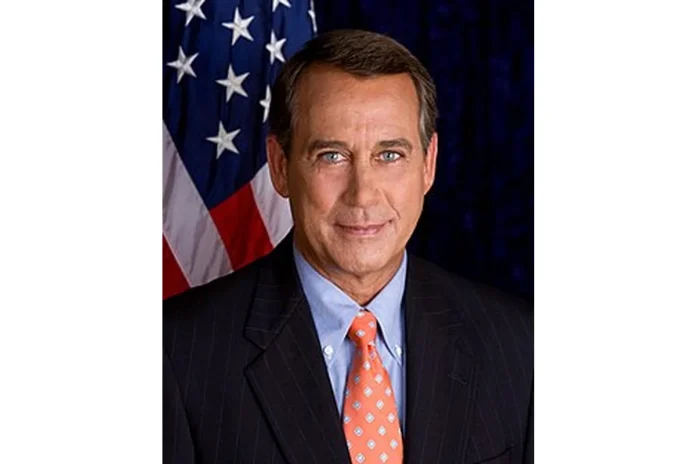
John Boehner Bio
John Andrew Boehner (born November 17, 1949) is a retired American politician and lobbyist who served as the 53rd Speaker of the United States House of Representatives from 2011 to 2015. A member of the Republican Party, he represented Ohio’s 8th congressional district for thirteen terms between 1991 and 2015 and previously held several senior House leadership posts, including majority leader and minority leader. After leaving Congress, Boehner joined the lobbying firm Squire Patton Boggs, served on corporate boards, and later became a prominent voice in the cannabis industry.
Known for his role in shaping the 1994 Contract with America and for chairing the House Education and the Workforce Committee, Boehner resigned from Congress in October 2015 amid intraparty pressure. He remains an influential figure in U.S. politics, recognized for his conservative voting record, his working relationship with Democrats on education reform, and his willingness to speak openly about the modern Republican Party.
Early Life and Background
John Andrew Boehner was born on November 17, 1949, in Reading, Ohio, the son of Mary Anne Hall Boehner (1926–1998) and Earl Henry Boehner (1925–1990). He was the second of twelve children in a family of German and Irish heritage. Boehner grew up in modest circumstances in Cincinnati, sharing a two-bedroom house and one bathroom with his eleven siblings. He began working at his family’s bar at the age of eight, a business founded by his grandfather Andy Boehner in 1938.
Boehner attended Moeller High School in Cincinnati, where he played linebacker on the football team under coach Gerry Faust, a future Notre Dame head coach. After graduating in 1968, during the height of U.S. involvement in the Vietnam War, Boehner enlisted in the United States Navy but was honorably discharged after eight weeks because of a back injury. He went on to earn a Bachelor of Arts in business administration from Xavier University in 1977, becoming the first member of his family to attend college. He took seven years to complete his degree while working multiple jobs to pay for his education.
Path to US Politics
After graduating from Xavier University in 1977, Boehner joined Nucite Sales, a small plastics-industry firm, where he rose to become president before leaving in 1990 to serve in Congress. He entered local politics in 1981, serving on the board of trustees for Union Township in Butler County, Ohio, a position he held until 1984. In 1984, he was elected to the Ohio House of Representatives, where he served until 1990, building a reputation as a pro-business conservative.
His break onto the national stage came in 1990, when he challenged incumbent Republican congressman Buz Lukens, who was facing intense scrutiny over a personal scandal. Despite being heavily outspent, Boehner won the Republican primary with 49 percent of the vote and went on to defeat Democrat Greg Jolivette in the general election. That same year, he resigned from his company to focus on his new role in the U.S. House of Representatives.
John Boehner Career
Early Career (1991–1994)
During his first term in Congress, Boehner joined the Gang of Seven, a group of House Republicans who drew national attention to the House banking scandal and later helped lead investigations of the Congressional Post Office. The group’s work contributed to the indictment of Congressman Dan Rostenkowski and reshaped public perceptions of congressional ethics.
Boehner quickly aligned himself with the rising reform wing of the Republican Party. Working alongside Minority Whip Newt Gingrich and other conservative lawmakers, he helped engineer the Contract with America, the 1994 policy agenda that propelled Republicans to their first House majority in four decades and set the tone for the party’s direction in the 1990s.
House Republican Leadership (1995–2010)
Following the 1994 election, Boehner was elected House Republican Conference Chairman, the fourth-ranking leadership position, serving from 1995 to 1999. During that period, he championed the Freedom to Farm Act, which revised direct payment programs for crops and eliminated federal milk price supports. He later lost his leadership post in 1998 amid a broader reorganization that brought Dennis Hastert to the speakership.
In 2001, Boehner became chairman of the House Education and the Workforce Committee, a position he held until 2006. Working with Senator Ted Kennedy, he co-authored the No Child Left Behind Act of 2001, signed into law by President George W. Bush in 2002, which he later called his proudest legislative achievement. He also led passage of the Pension Protection Act and a school-choice voucher program for low-income children in Washington, D.C.
After Representative Tom DeLay resigned as majority leader in 2005, Boehner won a competitive internal election to become House majority leader, defeating Representative Roy Blunt. When Republicans lost their House majority in 2006, Boehner was chosen as minority leader, a role he held until 2011, leading the Republican caucus in opposition to President Barack Obama’s domestic agenda.
Speaker of the House Era (2011–2015)
Republicans reclaimed the House majority in the 2010 midterm elections, and Boehner was elected Speaker of the House on January 5, 2011. His election made him the first Ohioan to hold the speakership since Nicholas Longworth in the 1920s. He was narrowly re-elected as Speaker in January 2013, receiving 220 votes.
As Speaker, Boehner led Republican efforts to repeal the Affordable Care Act, defund Planned Parenthood, and pursue spending cuts and tax reform. He frequently clashed with conservative insurgents, including members of the House Freedom Caucus and the Tea Party movement, who viewed his pragmatic approach as insufficiently aggressive. Despite his leadership, several high-profile legislative goals, including comprehensive tax and entitlement reform, remained out of reach during his tenure.
Notable Events and Milestones
One of the defining moments of Boehner’s speakership came on September 25, 2015, when he announced his resignation from Congress shortly after Pope Francis addressed a joint session of Congress, an event he called the high point of his legislative career. He stepped down amid pressure from conservative members and controversy over government funding, including a dispute over Planned Parenthood. In his final act as Speaker on October 29, 2015, Boehner presided over the election of Paul Ryan as his successor, and his resignation took effect on October 31, 2015.
John Boehner Career Wins
Over more than two decades in public service, Boehner earned a reputation as an effective vote-counter and party leader who helped shape major legislation on education, pensions, and taxes. While he did not pursue national elective office beyond the House, his career was marked by a series of congressional election victories and influential leadership roles.
Congressional Election Highlights
Boehner was first elected to the U.S. House of Representatives in 1990 and was subsequently re-elected twelve times, generally by comfortable margins. His early breakthrough came when he defeated scandal-plagued incumbent Buz Lukens in the Republican primary, a victory that launched his congressional career. After stepping down in 2015, he remained widely respected within his party as a senior statesman and institutional figure.
Other Achievements
In 2016, Boehner was awarded the Laetare Medal by the University of Notre Dame, one of the highest honors for American Catholics, sharing the recognition that year with Vice President Joe Biden. The award recognized his public service and his long record of support for Catholic education, including his work with Senator Ted Kennedy on school funding initiatives.
| Position | Wins | Year |
|---|---|---|
| U.S. Representative, Ohio’s 8th District | 13 | 1990–2014 |
| House Republican Conference Chairman | 1 | 1994 |
| House Majority Leader | 1 | 2005 |
| House Minority Leader | 1 | 2006 |
| Speaker of the House | 2 | 2011, 2013 |
John Boehner Family
Family Background and Political Lineage
Boehner was raised in a large, working-class family in southwestern Ohio. His father, Earl Henry Boehner, ran a family bar started by his grandfather Andy Boehner in 1938, and his mother, Mary Anne Hall Boehner, raised twelve children in a modest two-bedroom home. Boehner has often credited his upbringing for instilling the values of hard work, individual responsibility, and personal faith that defined his political career. He was the first member of his immediate family to earn a college degree.
Personal Life
Boehner married Deborah “Debbie” Gunlack in 1973, and the couple has two daughters, Lindsay and Tricia. The family has long resided in the Wetherington section of West Chester Township, Ohio. Boehner is known for his emotional public style and has been described by colleagues as someone who is unafraid to express his feelings. He is a practicing Catholic and has been a longtime advocate for Catholic education.