

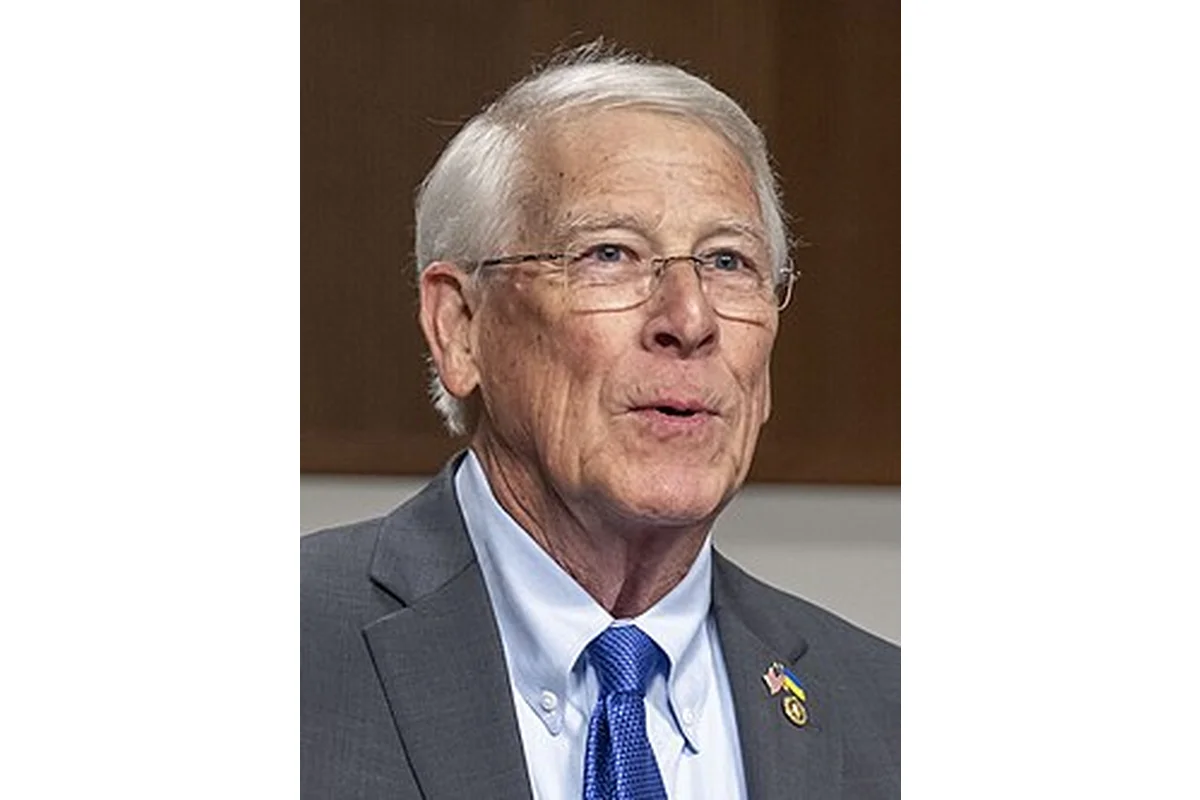
Roger Wicker Bio
Roger Frederick Wicker (born July 5, 1951) is an American politician, attorney, and former Air Force officer who has served as the senior United States senator from Mississippi since 2007. A Republican, he previously represented Mississippi in the State Senate from 1988 to 1995 and served as the U.S. representative for the state’s 1st congressional district from 1995 until his appointment to the Senate. He chairs the Senate Armed Services Committee and has been active on defense, foreign policy, and veterans’ issues.
Wicker lives in Tupelo, Mississippi, with his wife, Gayle Long Wicker, whom he married in 1975. The couple has three children and six grandchildren. He is a deacon and choir member at First Baptist Church Tupelo.
Early Life and Background
Roger Frederick Wicker was born on July 5, 1951, in Pontotoc, Mississippi, to Wordna Glen (née Threadgill) Wicker and Thomas Frederick “Fred” Wicker, a lawyer and onetime Mississippi state senator. Growing up in Pontotoc, Wicker was exposed to public service at a young age. At 16, he worked as a United States House of Representatives page for Representative Jamie L. Whitten of Mississippi’s 1st congressional district, an experience that introduced him to federal policymaking and the rhythms of Congress.
He graduated from Pontotoc High School in 1969 and went on to attend the University of Mississippi, where he was a member of the Sigma Nu fraternity and served as student body president. He was inducted into Omicron Delta Kappa for student leadership and academic merit. Wicker earned a Bachelor of Arts in journalism and political science in 1973 and a Juris Doctor in 1975 from the University of Mississippi School of Law.
Path to US Politics
After earning his law degree, Wicker was commissioned into the United States Air Force as a Judge Advocate, serving on active duty from 1976 to 1980. In 1980, he transitioned to the Air Force Reserve, where he continued serving until retiring in 2003 as a lieutenant colonel. That same year, he began his formal political career when he became counsel to U.S. Representative Trent Lott on the House Rules Committee, sharpening his understanding of legislative procedure.
In 1987, Wicker won a seat in the Mississippi State Senate, representing the 6th district, which included Tupelo. He served in the state Senate from 1988 to 1994, working on issues including a 1994 state Medicaid bill that authorized the Mississippi Attorney General to contract private attorneys on contingency. His time in the state legislature helped him build a reputation as a steady, conservative legislator and set the stage for his run for federal office.
Roger Wicker Career
Early Career (1987–1994)
Wicker’s early career in politics centered on his work in the Mississippi State Senate. Representing a Tupelo-area district from 1988 to 1994, he gained experience navigating state policy, including healthcare, legal contracting, and rural economic development. His legislative work positioned him as a rising figure within the Mississippi Republican Party.
In 1994, longtime Democratic Congressman Jamie Whitten announced he would not seek reelection after 53 years in office. Wicker entered the Republican primary and finished first in a crowded six-way race, advancing to a runoff he won convincingly. In the general election, he defeated Democrat Bill Wheeler with about 63 percent of the vote, becoming the first Republican to represent Mississippi’s 1st congressional district in over a century.
U.S. House of Representatives Breakthrough (1995–2007)
Assuming office in 1995 as part of the “Republican Revolution,” Wicker was elected president of the freshman class, which included 53 other new Republican representatives. He joined the House Appropriations Committee and served as deputy Republican whip, building relationships across the conference while advancing Mississippi’s economic and infrastructure interests.
Wicker worked on issues related to medical research, economic development, and veterans’ affairs, including service on the Military Construction and Veterans Affairs Subcommittee. He advocated for private-public partnerships to bring investment to rural areas. In his final year in the House, he topped the list in earmarks, drawing both recognition for delivering federal investment and criticism for a $6 million earmark tied to campaign contributors. He was reelected six times without serious difficulty, never receiving less than 65 percent of the vote.
U.S. Senate Era (2007–Present)
On December 31, 2007, Governor Haley Barbour appointed Wicker to fill the Senate seat vacated by Trent Lott, who had resigned earlier that month. Wicker was sworn in just before the announcement and won the subsequent 2008 special election against Democrat Ronnie Musgrove, the former governor, with about 55 percent of the vote. He won a full term in 2012, defeating Albert Gore Jr. with roughly 57 percent of the vote.
In 2014, Wicker was elected chair of the National Republican Senatorial Committee, a post he held from 2015 to 2017. He became Mississippi’s senior senator in 2018 when Thad Cochran resigned and was reelected later that year, defeating state legislator David Baria with 58.5 percent of the vote. In 2024, Wicker won another term, defeating Ty Pinkins with 62.8 percent of the vote. He chairs the Senate Armed Services Committee and also serves on the Commerce, Science, and Transportation Committee, the Environment and Public Works Committee, and the Rules Committee.
Notable Events and Milestones
Wicker was one of three politicians targeted in the April 2013 ricin letters bioterrorism attack; a letter addressed to him tested positive for the poison and was intercepted before reaching the Capitol. He played a leading role on foreign-policy matters, co-authoring the Hong Kong Human Rights and Democracy Act and supporting legislation targeting Russian human-rights violators. In 2020, he was nominated by President Barack Obama to serve as representative of the United States to the Sixty-fifth Session of the United Nations General Assembly.
Roger Wicker Career Wins
Roger Wicker has compiled a long record of electoral victories across federal and state offices in Mississippi. From his first U.S. House win in 1994 through his 2024 Senate reelection, he has consistently prevailed with comfortable margins, reflecting durable support in his home state.
U.S. House Highlights
Wicker won his first U.S. House race in 1994 with about 63 percent of the vote and was reelected six times, never dropping below 65 percent. In 2004, he ran essentially unopposed by a major-party challenger, defeating Reform Party nominee Barbara Dale Washer by a wide margin. His tenure in the House from 1995 to 2007 made him one of the longest-serving members of Mississippi’s federal delegation during that period.
U.S. Senate Highlights
Wicker won the 2008 special election with roughly 55 percent of the vote, his 2012 full-term race with about 57 percent, his 2018 reelection with 58.5 percent, and his 2024 reelection with 62.8 percent. He also previously won a 1987 race for the Mississippi State Senate, representing the 6th district from 1988 to 1994.
Roger Wicker Family
Family Background and Political Lineage
Roger Frederick Wicker was born into a family with deep ties to Mississippi’s legal and political life. His father, Thomas Frederick “Fred” Wicker, was a lawyer and served in the Mississippi State Senate, giving the younger Wicker early exposure to legislative work and public service. His mother, Wordna Glen (née Threadgill) Wicker, raised the family in Pontotoc, where Roger attended Pontotoc High School before going on to the University of Mississippi.
Personal Life
Wicker has been married to Gayle Long Wicker since 1975. The couple has three children and six grandchildren. The Wickers reside in Tupelo, Mississippi, where Roger is a deacon and a member of the choir at First Baptist Church Tupelo. He has also served on the Board of Advisors for the Global Panel Foundation, a nongovernmental organization working in crisis areas.