

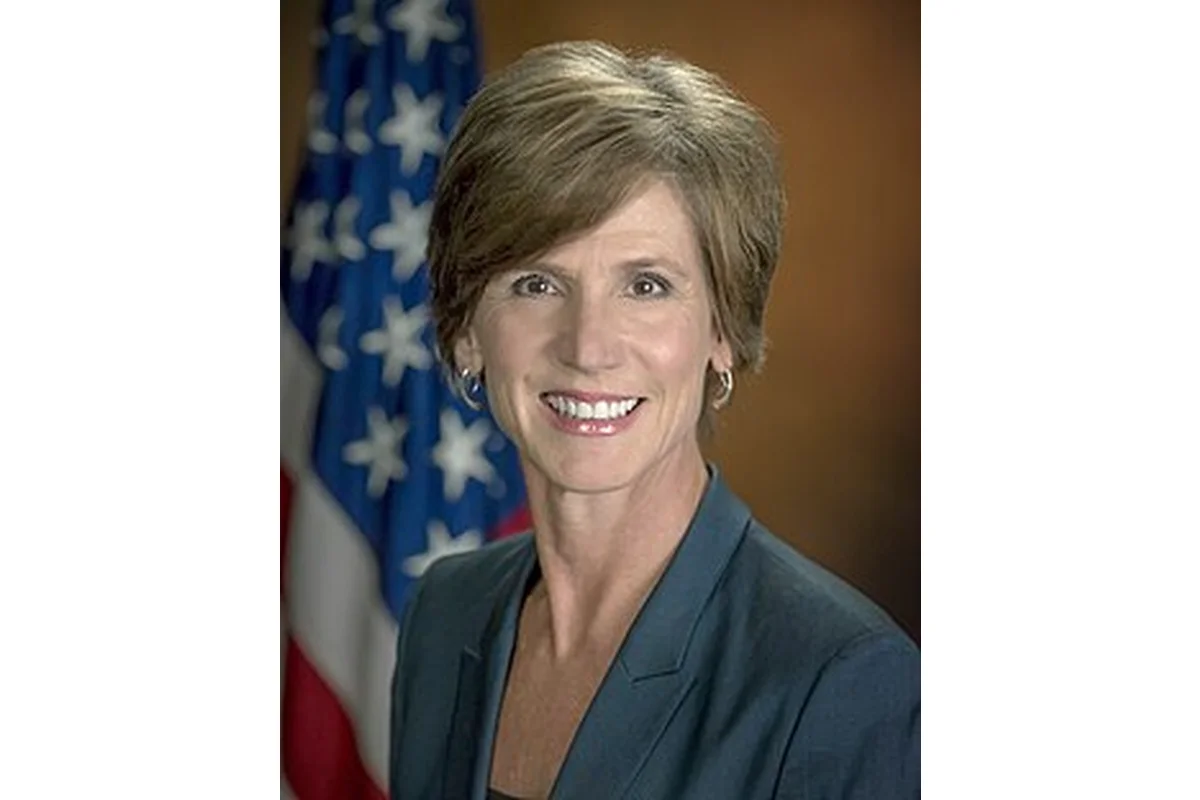
Sally Yates Bio
Sally Quillian Yates, born Sally Caroline Quillian on August 20, 1960, in Atlanta, Georgia, is an American lawyer and former senior United States Department of Justice official. She served as United States Attorney for the Northern District of Georgia from 2010 to 2015 and was later confirmed as United States Deputy Attorney General. Yates is best known for her brief tenure as acting United States Attorney General in January 2017, when she was dismissed by President Donald Trump after directing the Justice Department not to defend his travel ban executive order in court.
A career public servant who served under both Republican and Democratic administrations, Yates is a Democrat and has remained active in legal commentary, private practice, and teaching since leaving government. She has been honored for her commitment to the rule of law and her work on behalf of victims of abuse and corporate misconduct.
Early Life and Background
Sally Yates was raised in Atlanta, Georgia, in a family with deep roots in the law. Her father, John Kelley Quillian, served as a judge on the Georgia Court of Appeals from 1966 to 1984, and her paternal grandmother was one of the first women admitted to the Georgia Bar, though she worked as a legal secretary rather than as an attorney. Her mother, Xara “Mickey” DeBeaugrine Quillian, was an interior designer. Yates attended Dunwoody High School in suburban Atlanta, where she completed her secondary education before enrolling at the University of Georgia.
At the University of Georgia, Yates earned a Bachelor of Arts degree in journalism in 1982. She remained at the university’s School of Law, where she served as executive editor of the Georgia Law Review and graduated magna cum laude with a Juris Doctor degree in 1986. Her family’s legal heritage and her strong academic performance laid the foundation for a career in public service and the law.
Path to US Politics
Yates began her legal career in 1986 as an associate at the Atlanta law firm King & Spalding, where she specialized in commercial litigation for three years. In 1989, she transitioned to public service when she was hired as an Assistant United States Attorney for the Northern District of Georgia by Republican Bob Barr. This early appointment launched a long career inside the Department of Justice that spanned both major political parties and allowed Yates to develop a reputation as a skilled and nonpartisan prosecutor.
Over the following two decades, Yates rose through the ranks of the United States Attorney’s Office, prosecuting white-collar fraud and political corruption cases. In 1994, she was named Chief of the Fraud and Public Corruption Section, and she served as lead prosecutor in the case against Eric Rudolph, the bomber responsible for the 1996 Centennial Olympic Park attack and a series of related bombings. By 2002, she had become First Assistant United States Attorney, and she briefly served as Acting United States Attorney in 2004. President Barack Obama nominated her to lead the Northern District of Georgia office in 2009, and the Senate confirmed her on March 10, 2010, making her the first woman to hold that position.
Sally Yates Career
Early Career (1986–2009)
During her early years at the Department of Justice, Yates built a record as a tough and fair-minded federal prosecutor. She handled a wide range of cases, including high-profile terrorism and corruption matters, and earned the respect of colleagues across the political spectrum. Her leadership of the prosecution of Eric Rudolph, who was convicted for a series of bombings that killed two people and injured more than 120, remains one of the defining cases of her early tenure.
Her steady advancement through the ranks reflected her bipartisan appeal. She held senior positions in the United States Attorney’s Office for the Northern District of Georgia under both Republican and Democratic administrations, eventually serving as First Assistant United States Attorney and briefly as Acting United States Attorney. These experiences prepared her for the Senate confirmation process that would follow.
United States Attorney for the Northern District of Georgia (2010–2015)
President Barack Obama nominated Yates to serve as United States Attorney for the Northern District of Georgia, and the Senate confirmed her on March 10, 2010. She became the first woman to lead the office. During her five-year tenure, Attorney General Eric Holder appointed her to serve as Vice Chair of the Attorney General’s Advisory Committee, where she helped shape national prosecutorial policy.
Yates earned a reputation in Georgia and in Washington as a measured, well-regarded, and nonpolitical prosecutor. Her work on the committee positioned her for national prominence and helped pave the way for her elevation to the number two position at the Department of Justice.
Deputy Attorney General (2015–2017)
On May 13, 2015, the United States Senate voted 84 to 12 to confirm Yates as Deputy Attorney General, the second-highest-ranking official in the Justice Department. In her confirmation hearing, she told Senator Jeff Sessions that she would have an obligation to follow the law and the Constitution, and to provide independent legal advice to the president. As Deputy Attorney General, Yates oversaw the day-to-day operations of an agency of approximately 113,000 employees.
In 2015, she authored the so-called “Yates memo,” which prioritized the prosecution of individual corporate executives in corporate crime cases. During the final days of the Obama administration, she also oversaw the review of roughly 16,000 petitions for executive clemency and made recommendations to the President. Her tenure ended when President Donald Trump took office in January 2017.
Acting Attorney General and Dismissal (January 2017)
Following the inauguration of President Donald Trump on January 20, 2017, Yates served as acting United States Attorney General until the confirmation of Attorney General nominee Jeff Sessions. On January 27, 2017, President Trump signed Executive Order 13769, which restricted travel from several Muslim-majority countries. After reviewing the order, Yates concluded that it was not lawful, and she directed the Justice Department not to defend it in court.
Trump dismissed Yates on January 30, 2017, for what the White House described as insubordination, replacing her with Dana Boente, the United States Attorney for the Eastern District of Virginia. Yates’s actions drew widespread reactions, with some legal scholars praising her stand against what they viewed as an unconstitutional order and others arguing she should have resigned. The episode was widely compared to the Saturday Night Massacre during the Watergate scandal, though journalist Carl Bernstein rejected the parallel.
Post–Justice Department Work (2017–Present)
After leaving government, Yates returned to Atlanta as a partner at King & Spalding and became a lecturer at Georgetown University Law Center. She focused her practice on investigations and remained a prominent voice in legal and policy debates. In 2017, she testified before the Senate Judiciary Subcommittee on Crime and Terrorism alongside former Director of National Intelligence James Clapper regarding Russian interference in the 2016 United States election.
In October 2021, Yates was hired by the United States Soccer Federation to lead an independent investigation into abuse allegations within the National Women’s Soccer League. The final report, issued in October 2022, documented widespread abuse, sexual coercion, and systemic failures across the league. Yates was also a candidate for United States Attorney General in the Biden administration, though Merrick Garland was ultimately nominated for the post. In 2020, she served on the advisory council of the Biden-Harris Transition Team and delivered remarks at the Democratic National Convention.
Notable Events and Milestones
Yates’s most defining moment came in January 2017, when she refused to defend Executive Order 13769 and was dismissed as acting Attorney General. Her stand drew national attention and helped spark a broader debate about the independence of the Justice Department. She was also the lead prosecutor in the Eric Rudolph bombing case and authored the influential “Yates memo” on corporate criminal prosecution.
Sally Yates Honors and Recognition
Yates has received several honors for her public service and commitment to justice. Her awards reflect a career dedicated to legal integrity, public interest work, and advocacy for victims of abuse.
Awards and Honors
In January 2016, Yates received the Emory Public Interest Committee Inspiration Award from Emory University School of Law. Following her dismissal as acting Attorney General, Representative Jackie Speier nominated her for the John F. Kennedy Profile in Courage Award, and Georgia State Senator Elena Parent introduced a resolution commending her. In April 2017, Yates received the Mary Church Terrell Freedom and Justice Award during the Detroit NAACP’s 62nd Annual Fight for Freedom Fund Dinner.
Other Recognition
Yates has been recognized as a leading voice on the rule of law, corporate accountability, and government ethics. Her 2017 Senate testimony on Russian interference in the 2016 election and her leadership of the 2022 National Women’s Soccer League investigation brought her continued public attention.
Sally Yates Family
Family Background and Legal Lineage
Yates comes from a family with a long history in the Georgia legal community. Her father, John Kelley Quillian, was a judge on the Georgia Court of Appeals, and her paternal grandmother was one of the first women admitted to the Georgia Bar, though she worked as a legal secretary. This heritage influenced Yates’s decision to pursue a career in law and public service.
Personal Life
Yates is married to J. Comer Yates, an executive director of the Atlanta Speech School, who received an honorary degree from Oglethorpe University in 2017. He ran unsuccessfully for Congress as a Democrat in 1994 and 1996. The couple has two children, a daughter named Kelley Malone and a son named James “Quill” Quillian. Yates has also been open about her father’s struggle with depression and his death in 1986, advocating publicly for suicide prevention awareness.