
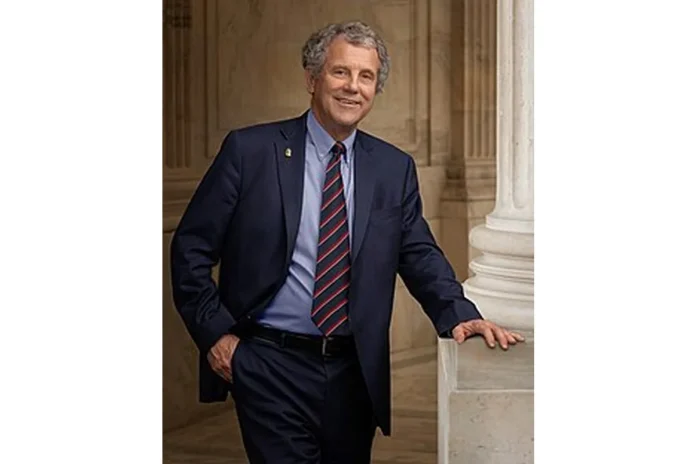
Sherrod Brown Bio
Sherrod Campbell Brown, born November 9, 1952, in Mansfield, Ohio, is an American politician and educator. A member of the Democratic Party, he served as a United States senator from Ohio from 2007 to 2025, representing one of the most recognizable working-class voices in the national party. He is widely regarded as a left-leaning populist who has spent more than four decades in elected office at the state and federal levels.
Before his time in the Senate, Brown represented Ohio’s 13th congressional district in the U.S. House of Representatives from 1993 to 2007 and served as the 47th secretary of state of Ohio from 1983 to 1991. He began his political career in 1975 as a state representative in Columbus. A graduate of Yale University and Ohio State University, Brown is also known for his long advocacy on trade, labor, and banking issues.
Early Life and Background
Sherrod Campbell Brown was born on November 9, 1952, in Mansfield, Ohio, to Emily Campbell and Charles Gailey Brown, a physician. He is one of three brothers and has Scottish, Irish, German, and English ancestry. He was named after his maternal grandfather. Brown’s brother Charlie later served as attorney general of West Virginia from 1985 to 1989, while another brother, Robert, was an attorney and graduate of Harvard Law School.
Brown attended Mansfield Senior High School and graduated in 1970. In 1967, he became an Eagle Scout, an honor whose badge was presented to him by famed astronaut and U.S. senator John Glenn. That same year of statewide recognition helped shape his early interest in civic life and Democratic politics. He went on to earn a Bachelor of Arts degree in Russian studies from Yale University in 1974, where he lived in Davenport College and campaigned for George McGovern during the 1972 presidential election.
After Yale, Brown returned to Ohio and earned a Master of Arts in education in 1979 and a Master of Public Administration in 1981, both from Ohio State University in Columbus. From 1979 to 1981, he taught at Ohio State University’s Mansfield branch campus, balancing classroom work with his growing interest in public service.
Path to US Politics
Brown’s path to a political career began during his senior year at Yale, when a local Democratic leader recruited him to run for the Ohio state house. In 1974, at the age of 22, he won a seat in the Ohio House of Representatives, becoming the youngest person ever elected to that body at the time. He served as a state representative from 1974 to 1982, building a reputation as a young, energetic voice for working-class Ohioans.
In 1982, Brown ran for Ohio secretary of state to succeed Anthony J. Celebrezze Jr. He won a competitive four-way Democratic primary that included Dennis Kucinich, then defeated Republican Virgil Brown in the general election. As secretary of state, Brown focused on expanding voter registration outreach and making the ballot more accessible to ordinary citizens. He was reelected in 1986, defeating Vincent C. Campanella, but lost his 1990 reelection bid in a heated race against Republican Bob Taft, who would later become governor of Ohio.
After his time as secretary of state, Brown shifted his focus to federal office. In 1992, he moved from Mansfield to Lorain, Ohio, and won the Democratic primary for the open seat in Ohio’s 13th congressional district after eight-term incumbent Don Pease announced his retirement. The Democratic-leaning district gave him an easy general-election victory over Republican Margaret R. Mueller, launching a 14-year career in the U.S. House of Representatives.
Sherrod Brown Career
Early Career (1974–1991)
Brown’s early political career began in the Ohio House of Representatives, where he served from 1974 to 1982 and quickly established himself as a forceful advocate for working families. His early legislative work focused on consumer protection, education funding, and support for organized labor. By the time he ran for statewide office, he had earned a reputation as one of the most independent-minded Democrats in the state legislature.
As Ohio’s 47th secretary of state from 1983 to 1991, Brown modernized the office and prioritized voter registration drives, especially in underserved communities. He used the position to push back against efforts to restrict ballot access and to promote civic education in Ohio’s schools. His tenure ended with a narrow 1990 loss to Bob Taft, a defeat that ultimately pushed him toward a future run for federal office.
U.S. House of Representatives Era (1993–2007)
Brown represented Ohio’s 13th congressional district in the U.S. House of Representatives from 1993 to 2007, winning easy reelection six times in a Democratic-leaning district. During his early years in Congress, the Democrats lost their long-held House majority in the 1994 elections, and Brown spent the rest of his House tenure in the minority. Even so, he built a national profile as a sharp critic of free trade and a champion of manufacturing workers.
As ranking member of the Energy and Commerce Health Subcommittee, Brown successfully pushed for increased federal funding to fight tuberculosis. He also served on the Subcommittee on Telecommunications and the Internet, the Subcommittee on Commerce, Trade and Consumer Protection, and the House International Relations Committee’s Subcommittee on Asia and the Pacific. In 2005, he led the Democratic effort to block the Central American Free Trade Agreement, serving as whip on the issue and helping delay a final House vote on CAFTA until just after midnight on July 28, 2005, when it passed by a single vote. He was also one of the few representatives to vote against the Defense of Marriage Act in 1996.
U.S. Senate Era (2007–2025)
In August 2005, Brown announced he would not run for the U.S. Senate seat held by two-term Republican incumbent Mike DeWine, but reversed his decision in October of that year. He easily won the May 2006 Democratic primary with 78 percent of the vote, and on November 7, 2006, he defeated DeWine 56.2 percent to 43.8 percent. Brown’s victory made him a leading Senate voice on economic populism, and he quickly rose to chair the Senate Committee on Banking, Housing, and Urban Affairs.
Brown won reelection in 2012 against Republican Josh Mandel, holding his seat with 50.7 percent of the vote despite facing more outside-group spending than any other reelection candidate that year besides President Barack Obama. In 2018, he won a third term by defeating Republican U.S. representative Jim Renacci 53.4 percent to 46.6 percent. In 2024, he ran for a fourth term but was defeated by Republican businessman Bernie Moreno, earning 46.5 percent of the vote to Moreno’s 50.1 percent. His 2024 loss ended an 18-year Senate career, and his departure marked the first time in years that Ohio was represented in the U.S. Senate only by Republicans.
Notable Events and Milestones
Brown’s career has been defined by his willingness to break with party leadership on trade and labor issues. In 2016, he called for tariffs on Chinese imports and praised Hillary Clinton’s plan to triple enforcement budgets at the U.S. Department of Commerce. He opposed NAFTA, supported President Donald Trump’s 2018 decision to impose tariffs on washing machine imports, and in 2019 voted for his first trade agreement in Congress, the United States-Mexico-Canada Agreement, citing its pro-worker provisions. He also voted to impeach Trump in early 2020 and later called for President Joe Biden to withdraw from the 2024 presidential race.
Sherrod Brown Career Wins
Across more than four decades in elected office, Sherrod Brown has compiled a long record of electoral victories at the state and federal levels, with losses confined to his 1990 secretary of state reelection bid and his 2024 U.S. Senate race. He was a six-time winner in Ohio’s 13th congressional district and a three-time winner of statewide U.S. Senate races in Ohio.
Senate Race Highlights
Brown first won his U.S. Senate seat in 2006 by defeating two-term Republican incumbent Mike DeWine 56.2 percent to 43.8 percent. He followed that victory with a 2012 reelection win over Ohio state treasurer Josh Mandel, taking 50.7 percent of the vote to Mandel’s 44.7 percent. His third Senate victory came in 2018, when he defeated Republican U.S. representative Jim Renacci 53.4 percent to 46.6 percent. His 2024 campaign ended in a 50.1 percent to 46.5 percent loss to Republican businessman Bernie Moreno.
Other Wins & Achievements
Beyond the U.S. Senate, Brown won a seat in the Ohio House of Representatives in 1974, was twice elected Ohio secretary of state in 1982 and 1986, and won six consecutive U.S. House races in Ohio’s 13th congressional district between 1992 and 2006. He also received honorary degrees from Capital University in 2007 and from Otterbein University in 2014.
Sherrod Brown Family
Family Background and Political Lineage
Brown was born to Emily Campbell and Charles Gailey Brown, a physician, and grew up as one of three brothers in Mansfield, Ohio. His brother Charlie served as attorney general of West Virginia from 1985 to 1989, while his brother Robert was a Harvard Law School-trained attorney. The family ties to public service helped shape Brown’s early interest in politics and his lifelong focus on working-class issues.
Personal Life
Brown was married to Larke Recchie from 1979 to 1987, and they had two children together. He married Pulitzer Prize-winning columnist Connie Schultz in 2004, and the couple has two stepchildren. His daughter Elizabeth Brown is a former president pro tempore of the Columbus City Council and served on the council for seven years. Brown has five grandchildren, is Lutheran, and was awarded an honorary doctorate from Capital University in 2007 and an honorary doctor of public service from Otterbein University in 2014.