

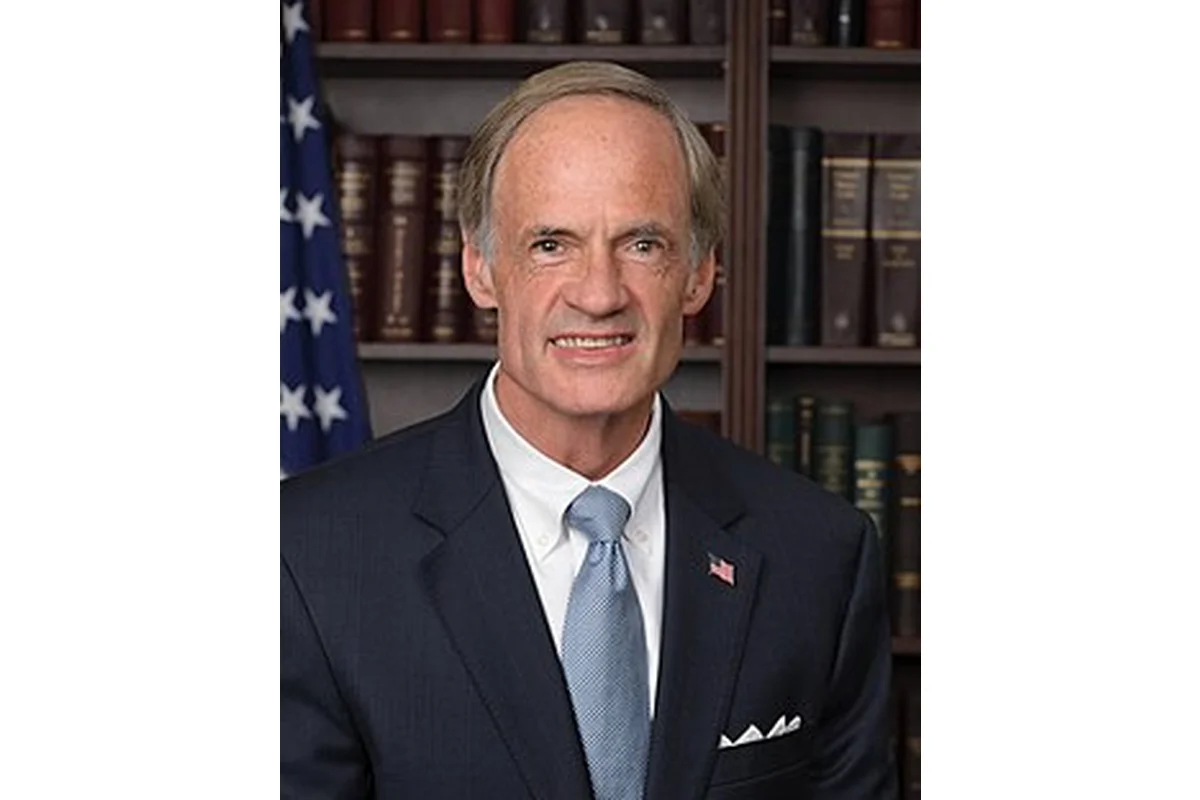
Tom Carper Bio
Thomas Richard Carper, born on January 23, 1947, is an American politician and former naval officer who built one of the longest careers in Delaware’s modern political history. A member of the Democratic Party, he is best known for serving as a United States senator from Delaware from 2001 to 2025, following five terms in the U.S. House of Representatives and two terms as the 71st governor of Delaware. Earlier in his career, he served as Delaware State Treasurer from 1977 to 1983. A Vietnam War veteran, Carper remained connected to military service long after leaving active duty, retiring from the U.S. Naval Reserve as a captain in 1991.
Throughout his decades in public office, Carper became known for a pragmatic, moderate approach shaped by his executive experience and military background. He championed bipartisan cooperation on environmental, infrastructure, and fiscal policy, and was frequently cited as one of the most effective deal-makers in the Senate. He also holds the distinction of being the last Vietnam War veteran to serve in the United States Senate.
Early Life and Background
Thomas Richard Carper was born in Beckley, West Virginia, to Wallace Richard Carper and Mary Jean Patton Carper. He spent part of his childhood in Danville, Virginia, before his family settled in Columbus, Ohio, where he graduated from Whetstone High School. Growing up across multiple states gave Carper an early appreciation for regional differences in American life and politics, a perspective that would later inform his consensus-driven style in office.
Carper went on to attend Ohio State University on a Naval Reserve Officers Training Corps (NROTC) scholarship, earning a Bachelor of Arts degree in economics in 1968. While there, he joined the Beta Phi Chapter of the Delta Tau Delta fraternity and volunteered on the 1968 presidential campaign of U.S. Senator Eugene McCarthy of Minnesota, an experience that deepened his interest in public service. Following his graduation, he was commissioned as a naval officer and entered active service.
After leaving active duty in the Navy, Carper pursued graduate studies at the University of Delaware, completing a Master of Business Administration degree in 1975. He then joined the State of Delaware’s economic development office, applying his business training and military discipline to state-level policy work and laying the groundwork for his first run for statewide office.
Path to US Politics
Carper’s entry into politics began at the state level in 1976, when he took out a $5,000 personal loan to run for Treasurer of Delaware. He defeated the favored Republican candidate, Theodore Jones, and went on to serve three terms as state treasurer, a tenure that lasted from January 18, 1977, to January 3, 1983. During this period, he oversaw the creation of Delaware’s first cash management system, earning a reputation for financial competence that would carry him into higher office.
His path to federal office opened in 1982, when U.S. Senator Joe Biden and other leading Delaware Democrats encouraged him to run for the state’s only seat in the U.S. House of Representatives. Carper won a hard-fought race against incumbent Republican Thomas B. Evans Jr., surviving a late-campaign controversy to claim the seat. His success in the House positioned him for a career that would soon include a governorship and a Senate seat.
Tom Carper Career
Early Career (1968–1983)
Carper began his professional career in 1968 as a Naval Flight Officer in the U.S. Navy, serving on active duty until 1973. He flew the P-3 Orion as a tactical coordinator and mission commander, completing three tours of duty in Southeast Asia during the Vietnam War. He then transferred to the U.S. Naval Reserve, where he continued to serve as a P-3 aircraft mission commander with VP-66 at Naval Air Station Willow Grove in Pennsylvania, ultimately retiring with the rank of Captain (O-6) in 1991.
While still in college, Carper had joined the 1968 presidential campaign of U.S. Senator Eugene McCarthy, an early signal of his interest in politics. After graduate school, he worked briefly as the campaign treasurer for University of Delaware professor James R. Soles during Soles’ unsuccessful 1974 bid for the U.S. House of Representatives. Carper’s election as Delaware State Treasurer in 1976 marked the true start of his political career and gave him a platform to demonstrate his managerial skills.
U.S. House of Representatives Breakthrough (1983–1993)
Carper represented Delaware in the U.S. House of Representatives for five terms, beginning with his 1982 victory over Thomas B. Evans Jr. and ending in 1993. In the House, he served on the U.S. House Committee on Banking, Finance and Urban Affairs and the U.S. House Committee on Merchant Marine and Fisheries, and he chaired the House Subcommittee on Economic Stabilization. In these roles, he worked to allow banks into the securities business and to discourage the dumping of sludge into the ocean.
He won his second term in 1984 by defeating Elise R. W. du Pont, wife of retiring Governor Pete du Pont, and then cruised to easy wins against Thomas S. Neuberger in 1986, James P. Krapf in 1988, and Ralph O. Williams in 1990. Behind the scenes, he also worked to reform Delaware’s Democratic Party organization, recruiting chemist Joseph E. Reardon to replace the long-disputed party boss Eugene T. Reed as head of the New Castle County Democratic Party.
Governorship Era (1993–2001)
In 1992, term-limited Republican Governor Michael Castle and Carper executed what became known as “the Swap,” with Castle running for Delaware’s U.S. House seat and Carper running for governor. Both were easily elected, and Carper went on to serve two terms as the 71st governor of Delaware. He positioned himself as a moderate, business-oriented New Democrat, focusing on economic development, business recruitment, and tax reform.
As governor, Carper helped prevent the closure of the General Motors automobile operation near Newport, Delaware, and convinced pharmaceutical company AstraZeneca to build its new U.S. headquarters in the state. He led efforts to cut income tax rates, eliminate the marriage penalty and estate tax, and reduce the gross receipts tax for many small businesses. Under his leadership, Delaware’s credit rating improved from among the worst in the nation to AAA. He also retained predecessor Castle’s standards-based education programs, fully funded Head Start, and established a prescription-drug benefit for seniors. By the end of his final term, Delaware held the highest per-capita ratio of youth mentors in the country.
U.S. Senate Era (2001–2025)
Carper was elected to the U.S. Senate in 2000, defeating Republican incumbent William Roth 56% to 44%, and went on to win three landslide reelections in 2006 (67% to 27%), 2012 (66% to 34%), and 2018 (60.0% to 37.8%). Over his Senate career, he served as one of four deputy Democratic whips, chaired the Senate Environment and Public Works Committee, and sat on the Homeland Security and Governmental Affairs Committee and the Finance Committee. He was the senior senator in Delaware’s congressional delegation and the dean of the delegation.
During his tenure, Carper worked on a wide range of issues, including environmental protection, fiscal policy, gun control, housing, and national security. He co-wrote the Protecting Cyberspace as a National Asset Act of 2010 with Senators Joe Lieberman and Susan Collins, and he supported the 2019 Background Check Expansion Act. He was a frequent voice for bipartisan compromise and was often described as one of the Senate’s most effective deal-makers. On May 22, 2023, he announced that he would not seek reelection in 2024, and he formally retired from the United States Senate on January 3, 2025.
Notable Events and Milestones
One of the defining milestones of Carper’s career was his 2000 Senate victory over five-term Republican incumbent William Roth, a race that launched his long tenure in the upper chamber. He went on to become the last Vietnam War veteran to serve in the U.S. Senate, a distinction that marked the end of an era in American political life. In 2024, Newark Train Station was renamed in his honor, recognizing his decades of commuting by Amtrak from Wilmington, Delaware, to Washington, D.C.
Tom Carper Career Wins
Thomas Richard Carper compiled one of the most consistent winning records in Delaware political history, capturing statewide and federal seats repeatedly over more than four decades. He won three terms as state treasurer, five terms in the U.S. House of Representatives, two terms as governor, and four terms in the U.S. Senate, with his Senate reelection margins often exceeding 60% of the vote.
U.S. Senate Highlights
Carper first won his U.S. Senate seat in 2000 by defeating longtime Republican incumbent William Roth, a victory widely seen as a generational change in Delaware politics. He was then reelected in landslides in 2006, 2012, and 2018, each time establishing himself as one of the most popular politicians in the state. His 2012 primary, in which he captured 88% of the vote, and his 2018 primary, in which he defeated challenger Kerri Evelyn Harris with roughly 65% of the vote, reflected his enduring strength within the Democratic Party.
Other Wins & Achievements
Beyond his federal service, Carper won three consecutive terms as Delaware State Treasurer beginning in 1977, the governorship in 1992, and five terms in the U.S. House of Representatives starting in 1982. He also helped guide Delaware’s credit rating to AAA during his governorship and championed the creation of mentoring programs that gave the state the highest per-capita ratio of youth mentors in the country.
Tom Carper Family
Family Background and Political Lineage
Thomas Richard Carper was raised by his father, Wallace Richard Carper, and his mother, Mary Jean Patton Carper. The family moved from his birthplace of Beckley, West Virginia, to Danville, Virginia, and eventually to Columbus, Ohio, where he finished high school. His father-in-political-life, U.S. Senator Joe Biden, was among the early figures who encouraged him to seek federal office in 1982.
Personal Life
Carper has been married twice. His first marriage, to Diane Beverly Isaacs, a former Miss Delaware, lasted from 1978 to 1983 and ended in divorce. In 1985, he married Martha Ann Stacy, with whom he has two children. The family are members of Westminster Presbyterian Church in Wilmington, Delaware. Unlike most senators, Carper commuted more than 100 miles by Amtrak train from his home in Wilmington to the United States Capitol for many years, an arrangement he credited with helping his family maintain a normal life despite his high-profile career.