Dustin Hoffman Bio
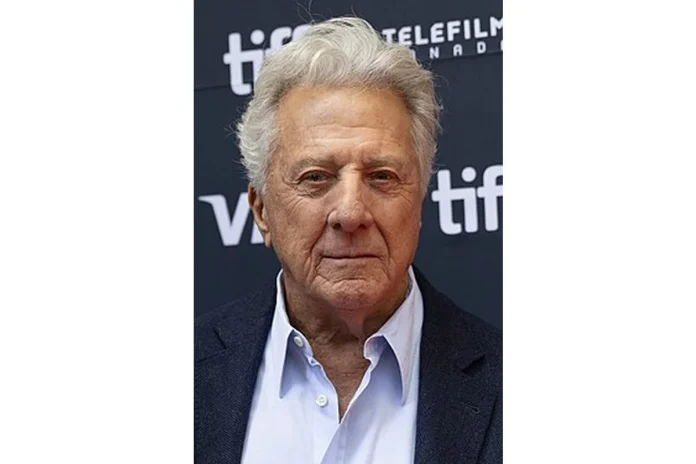
Dustin Lee Hoffman (born August 8, 1937) is an American actor and filmmaker whose career has spanned more than six decades. He is widely regarded as one of the key leading men of the New Hollywood movement, known for his versatile portrayals of antiheroes and emotionally vulnerable characters. Among his numerous accolades are two Academy Awards, four BAFTA Awards, five Golden Globe Awards, two Primetime Emmy Awards, and a Tony Award nomination. He has also been honored with the Cecil B. DeMille Award in 1997, the AFI Life Achievement Award in 1999, the Kennedy Center Honors in 2012, and an Honorary César in 2009.
Beyond acting, Hoffman made his directorial debut with Quartet in 2012 and continues to appear in major film productions. His influence on screen acting remains significant, and he is often mentioned alongside peers such as Jack Nicholson, Robert Redford, Warren Beatty, and Woody Allen as a defining figure of his era.
Early Life and Background
Dustin Lee Hoffman was born on August 8, 1937, in Los Angeles, California, the younger of two sons of Harry Hoffman, a former set decorator at Columbia Pictures who later became a furniture salesman, and Lillian Gold Hoffman. He was named after silent screen and stage actor Dustin Farnum. Hoffman is Jewish, from an Ashkenazi family with roots in the Russian Empire and Romania, and his upbringing was largely nonreligious.
Hoffman has an older brother named Ronald, who went on to become a lawyer and economist. As a young man, Hoffman dreamed of becoming a classical pianist and studied music for many years. He later enrolled at Santa Monica College intending to study medicine, but an acting class changed his course entirely. He has said that he caught the acting bug almost immediately, and he soon left college to train at the Pasadena Playhouse, where his aunt famously warned him that he could not be an actor because he was not good-looking enough.
Path to Acting
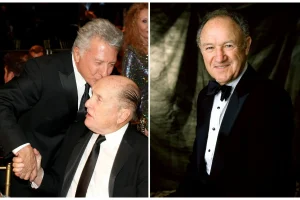
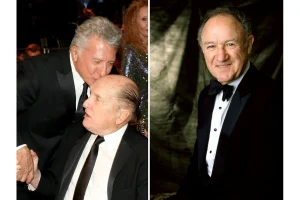
After two years at the Pasadena Playhouse, where he appeared alongside future Academy Award winner Gene Hackman, Hoffman followed Hackman to New York City. He shared a home with Hackman and Robert Duvall, and the three young men spent the 1960s auditioning, doing odd jobs, and occasionally teaching to make ends meet. Hoffman’s appearance and small frame initially made casting directors hesitant, but he remained committed to his craft.
He studied at the Actors Studio and embraced the method approach to acting. In 1960 he landed his first off-Broadway role, and in 1961 he made his Broadway debut in A Cook for Mr. General. Throughout the early and mid-1960s he performed in plays, summer stock, and off-Broadway productions, including Eh? at the Circle in the Square Theatre in 1966, which earned him a Drama Desk Award. He also picked up small television roles and commercials, and in 1967 he made his film debut in the comedy The Tiger Makes Out alongside Eli Wallach.
Dustin Hoffman Career
Early Career (1960–1966)
Hoffman’s earliest professional years were spent on the New York stage, where he built his reputation through a series of off-Broadway and Broadway appearances. His turn in Eh? in 1966 was particularly well received and established him as a serious dramatic talent. The Drama Desk Award he won for that role signaled that he was ready for a larger audience.
His first film appearance, The Tiger Makes Out in 1967, came after a long apprenticeship of theatre, television bit parts, and commercials. Between major projects he also directed community theatre in North Dakota and worked as an assistant director, experiences that helped him understand the craft from multiple angles.
Breakthrough (1967–1969)
Hoffman’s career changed overnight when director Mike Nichols cast him as Benjamin Braddock in The Graduate (1967), despite earlier rejecting him for a musical role. The film became a huge box office success, and Hoffman’s performance earned him his first Academy Award nomination for Best Actor. Critics called him a symbol of youth, and Time magazine noted that he represented a new breed of actors.
Just two years later, Hoffman proved his range with Midnight Cowboy (1969), in which he played the small-time con man Ratso Rizzo opposite Jon Voight’s Joe Buck. The film won the Academy Award for Best Picture, earned Hoffman his second Oscar nomination, and was later selected for preservation in the United States National Film Registry. In the same period he also won a BAFTA Award for his work in John and Mary (1969) with Mia Farrow.
Notable Works and Milestones
Through the 1970s Hoffman cemented his stardom with a remarkable run of films, including Little Big Man (1970), Straw Dogs (1971), Papillon (1973), and Lenny (1974), the last of which brought him another Best Actor nomination. He starred opposite Robert Redford in All the President’s Men (1976) and opposite Laurence Olivier in Marathon Man (1976). His portrayal of a divorcing father in Kramer vs. Kramer (1979) won him his first Academy Award for Best Actor, and his work as an autistic savant in Rain Man (1988) earned him a second. He received additional Best Actor nominations for Tootsie (1982) and Wag the Dog (1997), and supporting or ensemble acclaim for films such as Hook (1991), Outbreak (1995), and the Meet the Fockers series.
Dustin Hoffman Award Nominations
Across his career, Hoffman has collected a long list of major nominations, including seven Academy Award nominations for The Graduate, Midnight Cowboy, Lenny, All the President’s Men, Kramer vs. Kramer, Tootsie, Rain Man, and Wag the Dog, as well as Golden Globe, BAFTA, Tony, and Emmy nominations for his work in film, television, and on stage. His 1989 performance as Shylock in The Merchant of Venice earned him a Tony Award for Best Actor in a Play nomination, and his Death of a Salesman television film brought further Emmy and Golden Globe recognition.
Dustin Hoffman Awards Won
Hoffman has won two Academy Awards for Best Actor, for Kramer vs. Kramer (1979) and Rain Man (1988); four BAFTA Awards, including his early win for John and Mary; five Golden Globe Awards; two Primetime Emmy Awards, including one for Death of a Salesman; and three Drama Desk Awards for Eh?, Jimmy Shine, and Death of a Salesman. He also received the Cecil B. DeMille Award in 1997, the AFI Life Achievement Award in 1999, the Kennedy Center Honors in 2012, and an Honorary César in 2009.
Dustin Hoffman Family
Hoffman was born to Harry Hoffman and Lillian Gold Hoffman, and he grew up alongside his older brother Ronald. He adopted his first wife Anne Byrne’s daughter Karina after their 1969 marriage, and he and Byrne also had a daughter named Jenna. With his second wife, Lisa Gottsegen, whom he married in 1980, he has four children: Jacob Edward, Rebecca Lillian, Maxwell Geoffrey, and Alexandra Lydia, often called Ali.
Personal Life
Hoffman married Anne Byrne in May 1969, and the couple divorced in 1980. He married Lisa Gottsegen on October 12, 1980, and they have remained together since. Hoffman has spoken openly about how playing a father in Kramer vs. Kramer helped him grow closer to his own role as a dad. He has also discussed returning to a more observant Jewish life as his children from his second marriage celebrated bar and bat mitzvahs. In 2013, he was successfully treated for cancer.
Upcoming Projects
Hoffman is attached to Peter Greenaway’s Tower Stories, which has begun filming in Lucca, Italy, and he appeared in Francis Ford Coppola’s Megalopolis, which premiered at the 2024 Cannes Film Festival. His most recent performance was in the film Tuner in 2025.