

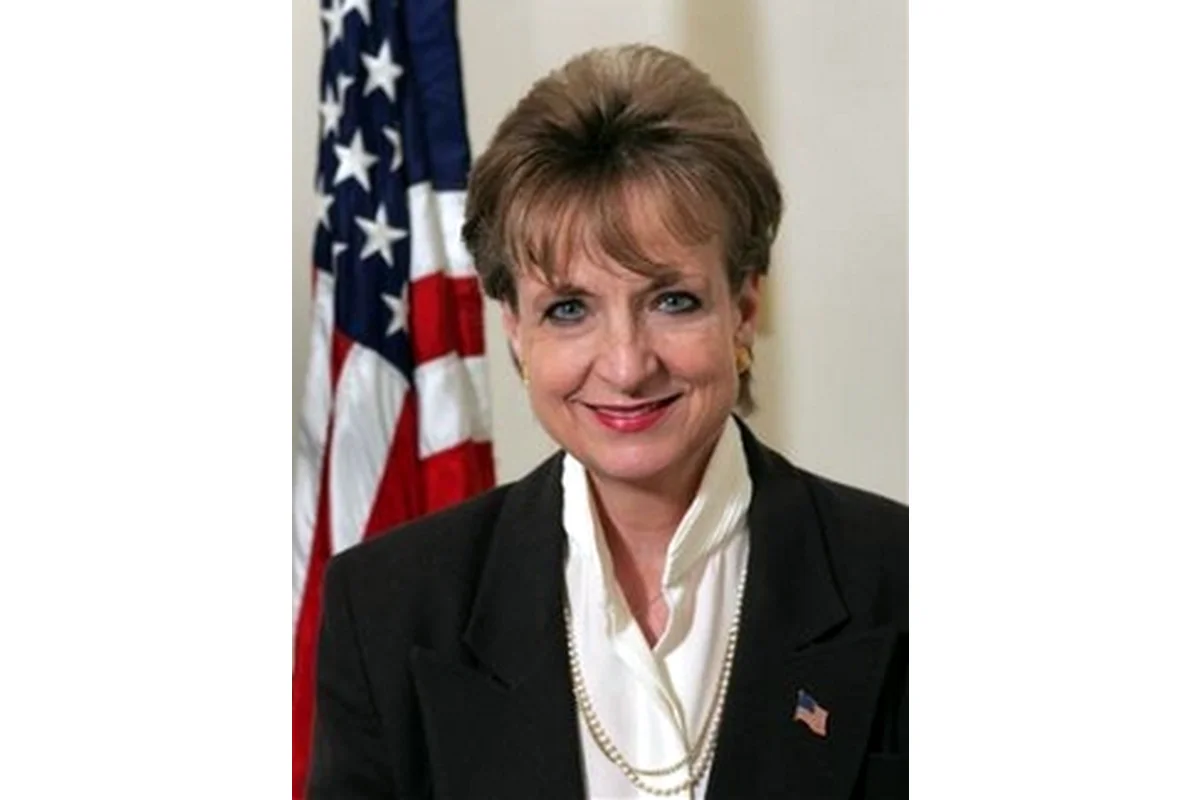
Harriet Miers Bio
Harriet Ellan Miers (born August 10, 1945) is an American lawyer and Republican politician who served as White House counsel to President George W. Bush from 2005 to 2007. A longtime confidante of Bush, she previously served in the White House as staff secretary and as Deputy Chief of Staff for Policy. In 2005, Bush nominated her to the Supreme Court of the United States to replace Justice Sandra Day O’Connor, but she asked that her nomination be withdrawn after weeks of bipartisan criticism.
Before her government service, Miers built a prominent legal career in Dallas, becoming the first woman to head both the Dallas Bar Association and the State Bar of Texas. She later returned to private practice at the firm now known as Locke Lord, where she continues to work in litigation and public policy.
Early Life and Background
Harriet Ellan Miers was born in Dallas, Texas, and spent most of her early life in the city. She is the fourth of the five children of real estate investor Harris Wood Miers Sr. and his wife, Erma (Sally) Grace Richardson. Miers graduated from Hillcrest High School in Dallas in 1963 and has described herself as a Texan through and through.
She entered Southern Methodist University intending to become a teacher. The economic situation of her family was so difficult that she almost dropped out during her freshman year, but she found part-time work that allowed her to remain in school. Her father later suffered a debilitating stroke, and when a lawyer helped organize her family’s finances, Miers was inspired to pursue a legal career.
In 1967, Miers earned a bachelor’s degree in mathematics from Southern Methodist University. She continued at the same university’s Dedman School of Law, graduating with a Juris Doctor degree in 1970.
Path to US Politics
After law school, Miers clerked for the Chief Judge of the U.S. District Court for the Northern District of Texas, Joe E. Estes, from 1970 to 1972. She then joined a Dallas law firm, where she rose to become the first female president of the Dallas Bar Association in 1985 and the first woman to head the State Bar of Texas in 1992. Her work with bar associations and her growing profile in Texas legal circles paved the way for her entry into electoral politics.
Miers formally registered with the Republican Party in 1989, the same year she won a two-year term as an at-large member of the Dallas City Council. Earlier, during the 1980s, she had contributed to Democratic candidates, including the presidential campaign of Al Gore in 1988. Her association with George W. Bush began in January 1989, when mutual friend Nathan Hecht introduced the two at an Austin political dinner.
Harriet Miers Career
Early Career (1970–1994)
From 1972 until 2001, Miers worked for the Dallas law firm of Locke, Liddell & Sapp and its predecessor firms. She was the first female lawyer hired by the firm and eventually became its president. As a commercial litigator, she represented clients including Microsoft and the Walt Disney Company.
She served as the first female president of the Dallas Bar Association in 1985 and as the first woman to head the State Bar of Texas in 1992. From 1989 to 1998, she led the board of editors of the American Bar Association Journal, and from 2000 to 2001 she chaired the ABA’s Commission on Multi-Jurisdictional Practice. In 1989, she was elected to the Dallas City Council as an at-large member but did not seek reelection in 1991 after the council was restructured.
Breakthrough (1994–2004)
In 1994, Miers served as general counsel for George W. Bush’s gubernatorial transition team in Texas. The following year, Governor Bush appointed her to chair the Texas Lottery Commission, a position she held until early 2000. Her tenure included reforms following a corruption scandal, though it was also marked by controversy over the firing of an executive director who had launched an investigation into the lottery’s primary contractor.
Miers subsequently became Bush’s personal lawyer and worked on his 2000 presidential campaign. In January 2001, she followed Bush to Washington, D.C., serving as Assistant to the President and Staff Secretary. In 2003, she was promoted to Deputy Chief of Staff for Policy, a role she held until 2005.
Republican Era (2005–2007)
In November 2004, Bush named Miers to succeed Alberto Gonzales as White House Counsel, the chief legal adviser to the President. She took on the role in 2005 and served as one of Bush’s closest personal advisers during a period that included the War on Terror, the Abu Ghraib investigation, and Hurricane Katrina.
On October 3, 2005, Bush nominated Miers to serve as an associate justice of the Supreme Court of the United States, replacing Justice Sandra Day O’Connor. Her nomination drew criticism from both parties over her lack of judicial experience, the absence of a clear constitutional record, and her close personal ties to the President. After a difficult round of private meetings with senators, Miers asked Bush to withdraw her nomination on October 27, 2005, citing concerns that confirmation proceedings would burden the White House. Bush then nominated Samuel Alito, who was confirmed in January 2006.
Miers remained as White House Counsel until announcing her resignation on January 4, 2007, following sustained pressure from new Chief of Staff Joshua B. Bolten. She left the White House on January 31, 2007. In April 2007, she returned to private practice at her former firm, then known as Locke Lord, joining its litigation and public policy group.
Notable Events and Milestones
Miers was the first Supreme Court nominee to withdraw under duress since Douglas H. Ginsburg in 1987. She was also cited for contempt of Congress by the U.S. House of Representatives in 2008 after refusing to testify under oath about the dismissal of several U.S. attorneys, an episode in which she had been implicated through internal administration documents. In March 2009, she agreed to testify under oath before Congress regarding the matter.
Harriet Miers Career Wins
Harriet Miers is best known for her barrier-breaking leadership in the legal profession and her senior roles in the George W. Bush administration. Her most visible achievements came in Texas law and at the federal executive level, including her role as a legal counsel to the President and her historic Supreme Court nomination.
Bar Association and Government Highlights
In 1985, Miers became the first female president of the Dallas Bar Association, and in 1992 she became the first woman to head the State Bar of Texas. She also chaired the Texas Lottery Commission from 1995 to 2000 and led the ABA’s Commission on Multi-Jurisdictional Practice from 2000 to 2001. Her appointment as White House Counsel in 2005 marked the pinnacle of her government career, and her nomination to the Supreme Court remains a defining moment in her public life.
Other Achievements
Miers contributed to Republican political campaigns beginning in 1994 and supported Texas Governor George W. Bush in his transition, governorship, and presidential campaign. Her close relationship with Bush, her leadership of the State Bar of Texas, and her role in shaping White House legal policy defined her contributions to American public life.
Harriet Miers Family
Family Background and Lineage
Miers is the fourth of five children born to real estate investor Harris Wood Miers Sr. and his wife, the former Erma (Sally) Grace Richardson. Her family experienced significant financial hardship during her college years, a circumstance that shaped her path toward a legal career. She has described herself as a Texan through and through, and her family ties to Dallas remain central to her identity.
Personal Life
Miers is a close friend of former Secretary of State Condoleezza Rice and former Secretary of Agriculture Ann Veneman. She has also maintained a long association with Texas Supreme Court Justice Nathan Hecht, who introduced her to George W. Bush in 1989. After making partner at her law firm in 1979, Miers became an evangelical Christian following extended discussions with Hecht. Public records do not list a spouse or children.