

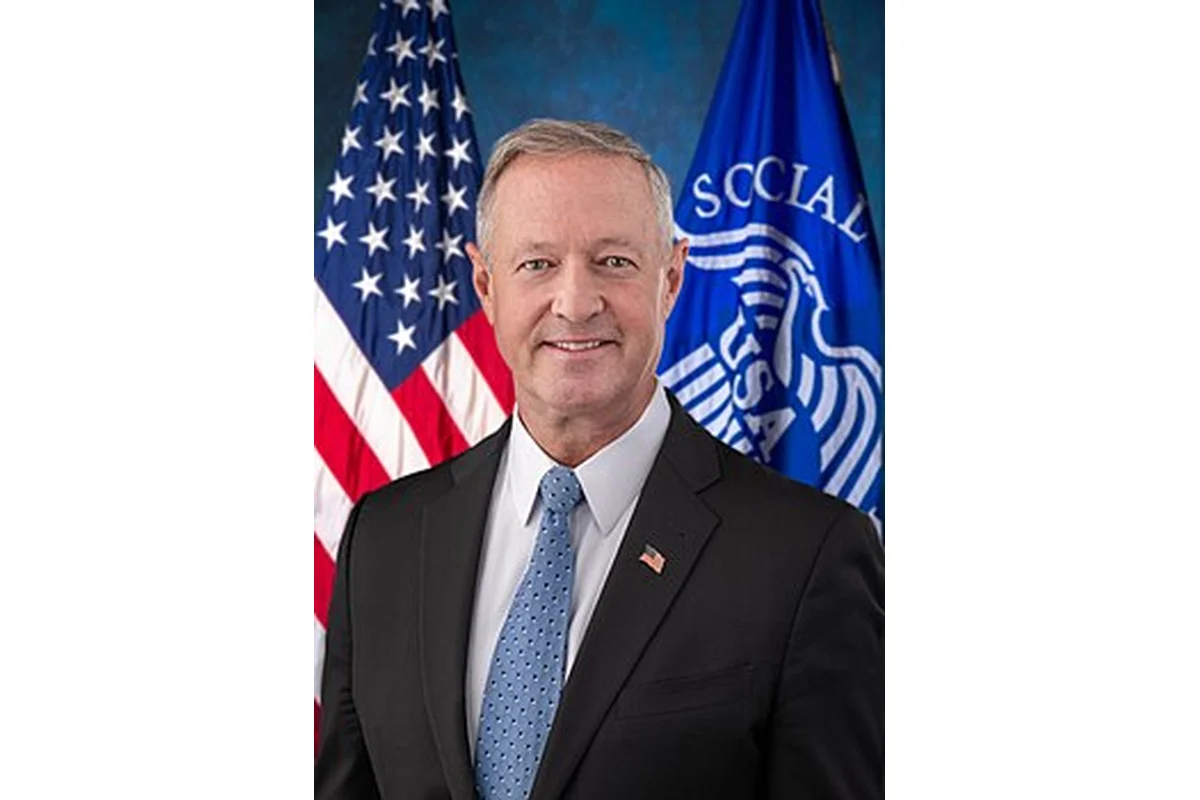
Martin O’Malley Bio
Martin Joseph O’Malley is an American politician, lawyer, author and musician who has spent more than three decades in public life. A member of the Democratic Party, he served as mayor of Baltimore, governor of Maryland, and later as commissioner of the Social Security Administration. He also briefly campaigned for the 2016 Democratic presidential nomination and has continued to play a leading role in national party affairs.
Born in Washington, D.C. in 1963, O’Malley built his political career in Maryland, where he became known for data-driven management in city and state government. Beyond politics, he leads the Celtic rock band O’Malley’s March and has written books on the use of technology in government. In November 2024, he launched an unsuccessful campaign for chair of the Democratic National Committee.
Martin O’Malley
Early Life and Background
Martin Joseph O’Malley was born on January 18, 1963, in Washington, D.C. He is the son of Thomas Martin O’Malley, a former U.S. Army Air Force bombardier in the Pacific theater of World War II who later became a Montgomery County-based criminal defense lawyer and assistant U.S. Attorney, and Barbara Suelzer. His father witnessed the mushroom cloud over Hiroshima during a routine mission, an experience he often shared with his son.
O’Malley’s paternal ancestors came from An Mám in County Galway, Ireland, while his mother’s ancestry includes Irish, German, Dutch and Scottish roots. He grew up in a Catholic household in the Washington, D.C. area and attended Our Lady of Lourdes School in Bethesda, Maryland, before enrolling at Gonzaga College High School. He later described himself as a practicing Catholic who prays daily and attends church every Sunday.
He earned a Bachelor of Arts degree from the Catholic University of America in 1985 and went on to receive his Juris Doctor from the University of Maryland School of Law in 1988, the same year he was admitted to the Maryland bar.
Path to US Politics
O’Malley’s first taste of national politics came in December 1982, when he joined Gary Hart’s presidential campaign for the 1984 election while still in college. He traveled to Iowa to phone-bank, organize volunteers and play guitar at small fundraisers. In 1986, while in law school, U.S. Congresswoman Barbara Mikulski named him state field director for her successful U.S. Senate campaign. He then served as a legislative fellow in her Senate office from 1987 to 1988, before becoming an assistant state’s attorney for Baltimore.
In 1990, he ran for the Maryland State Senate in the 43rd district and lost the Democratic primary by just 44 votes, a near-miss that put him on the political map. Two years later, he coordinated Senator Bob Kerrey’s 1992 presidential campaign in Maryland. These early experiences in field organizing, policy work and electoral politics set the stage for his entry into the Baltimore City Council in 1991.
Martin O’Malley Career
Early Career (1991–1999)
O’Malley was elected to the Baltimore City Council in 1991 to represent the 3rd Councilmanic District and was re-elected in 1995. On the council, he chaired the Legislative Investigations Committee and the Taxation and Finance Committee, building a reputation as a reform-oriented voice in city government. His work on fiscal and oversight issues helped him develop the data-driven style that would later define his mayoral administration.
During this period, he also continued his work in Democratic politics at the state and national level. By his second term, local observers described him as a charismatic rising star likely to seek higher office, a prediction that came true when he launched a successful campaign for mayor of Baltimore in 1999.
Mayor of Baltimore Breakthrough (1999–2007)
O’Malley announced his candidacy for mayor of Baltimore in 1999 after incumbent Kurt Schmoke decided not to seek re-election. As the only white candidate in a city with a predominantly African-American electorate and two recent black mayors, his entry was considered surprising, but he won the Democratic primary with 53 percent of the vote and the general election with 90 percent. He won a second term in 2004 with 87 percent of the vote, though term-limit conflicts left him with a three-year term rather than the usual four.
In his first year, he introduced CitiStat, a statistics-based accountability system modeled after New York City’s Compstat. The system logged every call for service into a database for analysis, helping the city identify and address problem areas quickly. According to The Washington Post, CitiStat saved an estimated $350 million and produced the city’s first budget surplus in years. In 2004, CitiStat won Harvard University’s Innovations in American Government award, and in 2002, Esquire named him the Best Young Mayor in the country. Time magazine later included him among America’s Top 5 Big City Mayors in 2005.
His tenure as mayor also drew criticism, particularly over accusations that his zero-tolerance policing strategy targeted African-American communities. While running for governor in 2006, he claimed violent crime had fallen 37 percent on his watch, a statistic that became the subject of political controversy, though The Washington Post found no evidence of systemic manipulation of crime data.
Governor of Maryland Era (2007–2015)
In 2006, O’Malley defeated incumbent Republican Governor Bob Ehrlich 53 percent to 46 percent, after his main Democratic primary opponent, Montgomery County Executive Doug Duncan, withdrew for health reasons. He won re-election in 2010 against Ehrlich in a 56 percent to 42 percent landslide. As governor, he expanded CitiStat into Maryland StateStat, which by 2014 engaged more than 20 agencies in monthly data reviews and led to programs like BayStat, StudentStat, VetStat and ReEntryStat. The U.S. Environmental Protection Agency later based its ChesapeakeStat program on Maryland’s BayStat.
O’Malley signed several high-profile bills during his two terms. In 2007, he became the first governor to sign legislation entering his state into the National Popular Vote Interstate Compact. In 2011, he signed a law making children of undocumented immigrants eligible for in-state college tuition under certain conditions, and in 2012 he signed a bill legalizing same-sex marriage in Maryland. Both measures were upheld by voters in the 2012 general election. He also signed a 2013 bill repealing the death penalty in Maryland, commuted the sentences of four death-row inmates to life without parole, banned shark finning, signed a new gun control law and approved tightly regulated hydraulic fracturing in western Maryland.
He served as chair of the Democratic Governors Association from 2011 to 2013 and was widely viewed as laying the groundwork for a future presidential run. In 2015, he announced his candidacy for the 2016 Democratic presidential nomination, but suspended his campaign on February 1, 2016, after a weak showing in the Iowa caucuses. He endorsed Hillary Clinton in June 2016. After leaving office, he served as a visiting professor at Johns Hopkins University’s Carey Business School, taught at Georgetown University and Boston College Law School, and wrote two books on the use of technology in government.
Social Security Administration and DNC Bid (2023–2024)
In July 2023, President Joe Biden nominated O’Malley to serve as commissioner of the Social Security Administration. The United States Senate confirmed him on December 18, 2023, by a 50–11 vote, and he took office as the 17th commissioner, serving into 2024. He pursued modernization and customer-service reforms during his tenure.
In November 2024, O’Malley announced a campaign for chair of the Democratic National Committee to succeed Jaime Harrison. At the 2025 DNC election, he placed third with the votes of 44 delegates, finishing behind Ken Martin, who won the position, and another challenger.
Martin O’Malley Family
Family Background and Personal Life
O’Malley met his wife, Catherine Katie Curran, in 1986 while both were in law school. She is the daughter of J. Joseph Curran Jr., a longtime Maryland attorney general. The couple married in 1990 and have four children: Grace, Tara, William and Jack. Curran’s uncle, Robert W. Curran, served alongside O’Malley on the Baltimore City Council.
He is a member of the Maryland Society of the Sons of the American Revolution and the General Society of the War of 1812. In 2008, the University of Galway awarded him an honorary degree in recognition of his Irish heritage and public service. He continues to perform Irish and folk rock music as the lead singer of the Baltimore-based band O’Malley’s March, which he founded in 1988.