

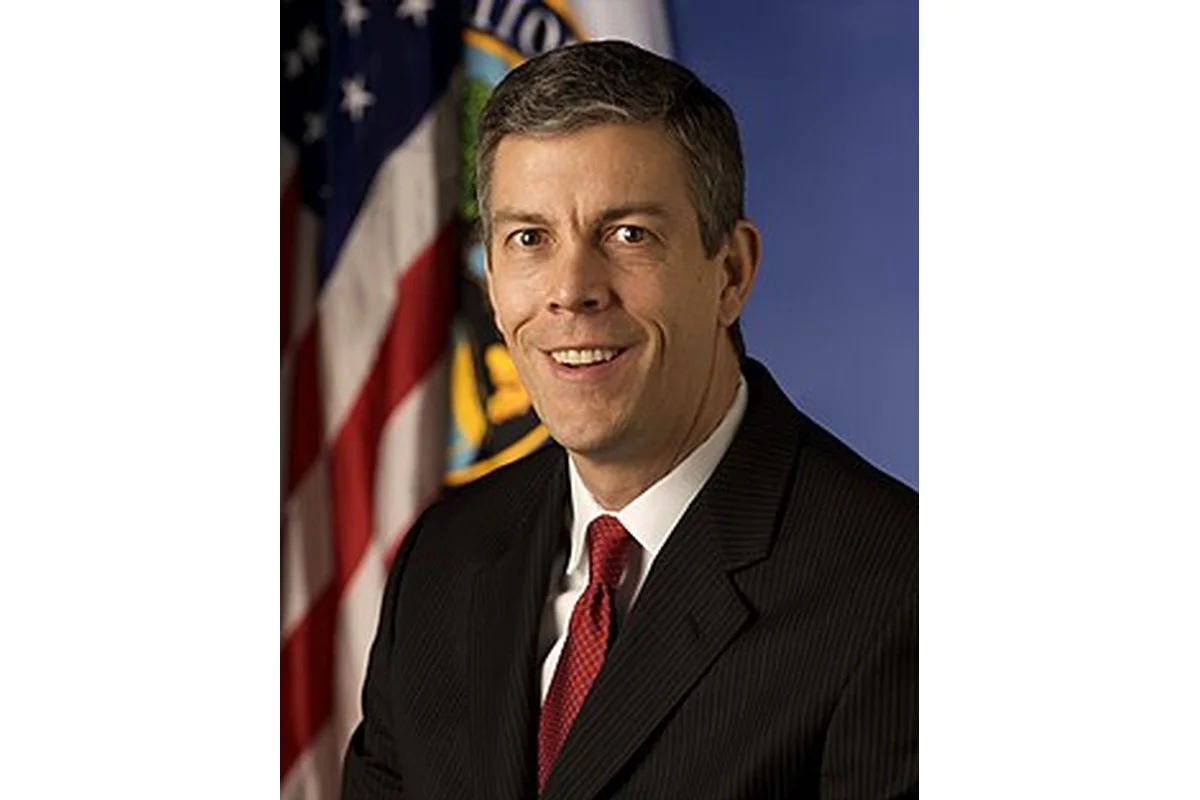
Arne Duncan Bio
Arne Starkey Duncan, born on November 6, 1964, in Chicago, Illinois, is an American educator and politician who served as the 9th United States Secretary of Education from 2009 to 2016 under President Barack Obama. Before his time in the federal cabinet, he was the Chief Executive Officer of Chicago Public Schools from 2001 to 2009, earning a reputation as a reformer focused on accountability, school choice, and higher academic standards. In addition to his education work, Duncan was a professional basketball player in the United States and Australia, and he has continued to play in celebrity and amateur competitions throughout his public career. He is a member of the Democratic Party and has remained active in civic and anti-violence efforts in Chicago since leaving Washington.
Early Life and Background
Arne Starkey Duncan was born in the Hyde Park neighborhood of Chicago to Starkey Duncan and Susan Duncan. His father was a professor of psychology at the University of Chicago, and his mother founded a tutoring center that operated out of a church basement in the Kenwood–Oakland area of the city’s South Side. As a child, Duncan helped his mother with tutoring and frequently played basketball with the students who came through the program. The center was firebombed when Duncan was six, after the church’s pastor refused to let it be used to store weapons, an experience that shaped his early awareness of urban violence.
Duncan grew up playing basketball in heavily crime-ridden neighborhoods of Chicago, often alongside members of street gangs. He has said the experience taught him about trust and survival, noting that older players looked out for him in dangerous situations. He attended the University of Chicago Laboratory Schools for his secondary education, and he went on to study sociology at Harvard College, where he stood six feet five inches tall and joined the basketball team in his sophomore year. He was named co-captain in his senior year and earned first-team Academic All-American honors. For his senior thesis, he wrote about the values, aspirations, and opportunities of the urban underclass, drawing on research he conducted while working for his mother’s tutoring program.
Path to Education Leadership
After graduating from Harvard, Duncan played professional basketball in the United States and Australia, suiting up for the Rhode Island Gulls and the Eastside Spectres, where he spent four seasons and earned the nickname “the Cobra.” He also tried out for the Boston Celtics during this period. While in Australia, he met his future wife, Karen Leanne, and he tutored wards of the state. The couple later had two children together.
Duncan returned to Chicago in 1992 and became director of the South Side’s Ariel Education Initiative, working alongside his sister at a program funded by financier John Rogers. The two eventually founded a charter school out of the initiative. In 1998, Duncan was named Deputy Chief of Staff of the Chicago Public Schools district, working under Paul Vallas and managing the city’s magnet school program. His close friendship with state senator Barack Obama, cemented through pick-up basketball games with a social circle that included John Rogers and Craig Robinson, would later prove pivotal to his national career.
Arne Duncan Career
Early Career (2001–2008)
Mayor Richard M. Daley appointed Duncan as Chief Executive Officer of Chicago Public Schools in 2001. As CEO, he pushed policies aimed at improving teacher quality and reforming underperforming schools, and he helped select which new campuses would open as part of Daley’s Renaissance 2010 initiative. In his early years, his approach to failing schools centered on closure; that changed in 2006, when he began ordering that staff be replaced while the school remained open. Supporters pointed to higher math and reading proficiency in Chicago elementary schools and rising graduation and scholarship rates among high school students during his tenure.
Duncan was also a frequent presence on the basketball court during this period, using the game to build relationships with local politicians. He played his first Hoop It Up three-on-three competition in 2003, and over the years that followed he won nine of eleven championships. He also attracted national attention for unconventional programs, including payments of up to $4,000 per year for high-achieving students and a controversial proposal to open a high school supporting gay students called Pride Campus. When President-elect Barack Obama announced his nomination of Duncan as Secretary of Education on December 16, 2008, the choice drew wide approval from groups as varied as the Democrats for Education Reform, the National Parent Teacher Association, teachers’ union leader Randi Weingarten, and former Republican Secretary of Education Margaret Spellings. The Senate confirmed him unanimously on January 20, 2009.
Breakthrough (2009–2012)
As Secretary of Education, Duncan moved quickly to expand the use of standardized tests, charter schools, and national learning standards. He implemented the Race to the Top program, which offered states additional education funding in exchange for reforms tied to national standards, the removal of caps on charter schools, and the use of student performance in teacher evaluations. The program was authorized as part of stimulus spending during the Great Recession, and Common Core was adopted by 46 states in 2010. By 2011, Race to the Top had been amended to allow states to seek waivers from the requirements of the No Child Left Behind Act, with 42 states plus Washington, D.C., and Puerto Rico ultimately accepting the waiver.
Duncan also pushed for higher-education reform, overseeing the creation of the College Scorecard to compare post-secondary institutions by graduation and employment outcomes. He expanded student financial aid through larger Pell Grants and the American Opportunity Tax Credit, and he created a federal student loan program that capped payments at 10 percent of income and allowed forgiveness for most loans after 20 years. He faced pushback, however, for his unsuccessful attempt to create a federal ratings system for colleges and for his 2011 effort to regulate for-profit colleges, which was struck down in court. He also drew bipartisan criticism for a 2010 challenge to the National Collegiate Athletic Association over the graduation rates of college athletes.
Democratic Era (2012–2015)
By his second term, Duncan’s policies had grown increasingly divisive. Teachers’ unions objected to the use of standardized test scores to evaluate teacher performance, and members of the Republican Party accused him of federal overreach. The National Education Association passed a resolution in 2014 demanding his resignation, and the American Federation of Teachers called on him to follow an improvement plan similar to those prescribed to failing teachers. In November 2013, Duncan drew further criticism and apologized after telling state superintendents that Common Core was opposed by “white suburban moms.” In the final month of his tenure, Congress passed the Every Student Succeeds Act, which restricted the Department of Education’s ability to set national policies for schools.
Duncan also championed progressive positions on gun control, immigration, criminal justice, and same-sex marriage, and he participated in a Black Lives Matter march while in office. He was one of only two members of President Obama’s original cabinet, alongside Secretary of Agriculture Tom Vilsack, still serving in late 2015. Rumors of his resignation began that summer after his family returned to Chicago, and on October 2, 2015, he announced he would step down in December. John King Jr. was named as his successor.
Notable Events and Milestones
One of the most memorable moments of Duncan’s time in office came on the basketball court. He participated in the 2012, 2013, and 2014 NBA All-Star Celebrity Games, scoring 17, 11, and 20 points, respectively, and a viral video of a pass he made in 2014 spread widely. Kevin Hart, the fan-voted MVP that year, declined the award and instead gave it to Duncan. In 2014, he also won the USA Basketball three-on-three championship with Team Ariel, though he was unable to attend the FIBA 3×3 World Tour in Russia. He returned to the NBA All-Star Celebrity Game in 2020 as a late entrant.
Arne Duncan Later Career
Post-Cabinet Work (2016–Present)
After leaving Washington, Duncan began working with the Emerson Collective in 2016, both with its XQ Institute and with a new office in Chicago. He founded gun control initiatives including Chicago CRED and the Scaling Community Violence Intervention for a Safer Chicago program, and following a 2018 school shooting in Texas, he proposed that parents engage in a national boycott of schools until gun control laws were passed. He released a book in 2018 titled How Schools Work: An Inside Account of Failure and Success from One of the Nation’s Longest-Serving Secretaries of Education, in which he criticized the American education system as one that “runs on lies” and fails to help under-performing students.
Duncan opposed the Republican Party’s policies during the 2016 presidential election, though he spoke positively of Republican candidates Jeb Bush and John Kasich for their support of Common Core. He opposed the debt-free college policy of Bernie Sanders and Martin O’Malley because he felt it preserved the existing college system rather than reforming it. He publicly criticized President Donald Trump’s Secretary of Education, Betsy DeVos, arguing that the Trump administration was deliberately restricting education. In 2021, Duncan was one of the few Democrats to endorse his former high school teacher Deborah Kerr in the non-partisan race for Superintendent of Public Instruction of Wisconsin. Although he expressed interest in running against Chicago Mayor Lori Lightfoot in 2023, he announced on March 1, 2022, that he would not run for mayor because he wanted to continue his youth anti-violence work. In 2024, he signed an open letter opposing Chicago Mayor Brandon Johnson’s ouster of CEO Pedro Martinez.
Arne Duncan Family
Family Background
Arne Starkey Duncan was raised in Chicago by his father, Starkey Duncan, a professor of psychology at the University of Chicago, and his mother, Susan Duncan, who founded a tutoring center for South Side students. He worked alongside his sister at the Ariel Education Initiative and has credited his parents, particularly his mother’s grassroots tutoring work, with shaping his lifelong interest in education and opportunity for young people in underserved communities.
Personal Life
Duncan met his future wife, Karen Leanne, while he was playing professional basketball in Australia in the late 1980s. The couple married and have two children together. After his resignation as Secretary of Education in 2015, the family returned to Chicago, where their children began attending the same private school Duncan had attended as a boy. The family resides in Chicago, Illinois.